Names That Mean Evil: 300 Dark, Wicked & Villainous Picks With Meanings
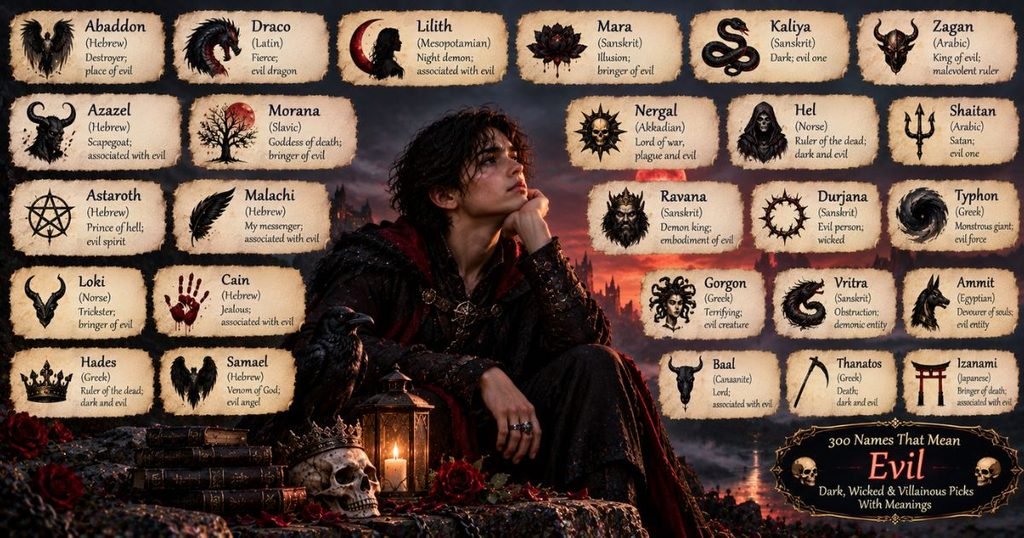
Names that mean evil are names whose roots, myths, or stories point to wickedness, deceit, destruction, or demons. Very few names literally mean “evil.” Most, like Ahriman, Belial, and Abaddon, come from scripture, mythology, or folklore. Others, like Mallory and Jabez, mean “unlucky” or “sorrowful.” This guide lists 300 of them with meanings.
Boy Names That Mean Evil: Wicked Kings, Betrayers, and Tyrants

- Ahriman (Persian): the “destructive spirit” of Zoroastrianism, rival of the good god Ahura Mazda.
- Belial (Hebrew): “worthless”; the Bible uses it for lawless, wicked people.
- Cain (Hebrew): the first murderer in Genesis; often linked to “acquired.”
- Nimrod (Hebrew): the mighty hunter-king of Genesis, later cast as a proud tyrant.
- Herod (Greek): “hero-like” in root, yet remembered for the child massacre in Matthew 2.
- Judas (Greek): form of Judah, “praised”; now shorthand for betrayal.
- Ahab (Hebrew): “father’s brother”; the wicked king of Israel in 1 Kings.
- Haman (Persian): the plotting villain of the Book of Esther.
- Korah (Hebrew): the rebel who challenged Moses in Numbers 16.
- Goliath (Philistine): the giant who opposed David; meaning uncertain.
- Barabbas (Aramaic): “son of the father”; the prisoner freed in Jesus’s place.
- Brutus (Latin): “heavy” or “dull”; Caesar’s betrayer in history and in Shakespeare.
- Nero (Latin): from a Sabine word for “strong”; the emperor remembered for cruelty.
- Caligula (Latin): “little boot,” a childhood nickname of the infamous emperor.
- Attila (Gothic): “little father”; the Hun king called the “Scourge of God.”
- Vlad (Slavic): “ruler”; linked to Vlad the Impaler of Wallachia.
- Malvolio (Italian-style): “ill will”; the sour steward of Twelfth Night.
- Ravana (Sanskrit): the ten-headed demon king of the Ramayana, revered by some communities.
- Duryodhana (Sanskrit): “hard to defeat”; chief rival in the Mahabharata.
- Shakuni (Sanskrit): “bird”; the scheming uncle of the Mahabharata.
- Kansa (Sanskrit): the tyrant king and uncle of Krishna.
- Bale (Old English): from bealu, “evil” or “harm.”
- Bane (Old English): from bana, “slayer” or “destroyer.”
- Grim (Old English): “fierce” or “cruel.”
- Doom (Old English): from dōm, “judgment” or “fate.”
- Dread (English): “great fear.”
- Scathe (Old Norse): from skaði, “harm.”
- Wyrm (Old English): “serpent” or “dragon.”
- Warlock (Old English): from wǣrloga, “oath-breaker,” before it meant a male witch.
- Vandal (Germanic): the tribe that sacked Rome in 455 CE.
- Magus (Latin): “sorcerer.”
- Vex (Latin): from vexare, “to harass.”
Girl Names That Mean Evil: Sorceresses, Furies, and Dark Queens
Evil girl names come from sirens, witches, avenging spirits, and scheming queens. Many of these portraits say more about ancient storytellers than about the women themselves. Scholars often read figures like Lilith, Jezebel, and Medusa in more than one way. Still, these names carry real drama.
- Lilith (Hebrew/Akkadian): a night spirit; medieval legend makes her Adam’s first wife.
- Jezebel (Hebrew): the queen of 1 Kings who promoted Baal worship; meaning debated.
- Delilah (Hebrew): “delicate”; the woman who betrayed Samson.
- Athaliah (Hebrew): the queen of Judah who seized the throne in 2 Kings 11.
- Salome (Hebrew): from shalom, “peace”; tied to the death of John the Baptist.
- Medusa (Greek): “guardian” in root; the Gorgon whose gaze turned men to stone.
- Hecate (Greek): goddess of witchcraft and crossroads; meaning uncertain.
- Circe (Greek): “hawk”; the sorceress who turned Odysseus’s crew into swine.
- Morgana (Arthurian): the enchantress Morgan le Fay; “sea-born” in Welsh roots.
- Medea (Greek): “cunning”; the vengeful sorceress of Euripides’ tragedy.
- Lamia (Greek): a Libyan queen turned child-devouring monster.
- Scylla (Greek): the six-headed sea monster of the Odyssey.
- Morrigan (Irish): “phantom queen” or “great queen,” goddess of war and fate.
- Mara (Sanskrit): “death” or “destroyer,” the tempter in Buddhist texts; in Hebrew it means “bitter.”
- Kali (Sanskrit): “black” or “time”; fierce goddess of destruction and renewal, widely revered.
- Carmilla (Latin-based): the vampire of Sheridan Le Fanu’s 1872 novella.
- Maleficent (Latin-based): from maleficus, “doing evil”; Disney’s Sleeping Beauty villain.
- Empusa (Greek): a shape-shifting demoness of the night.
- Alecto (Greek): “unceasing”; one of the three Furies.
- Megaera (Greek): “grudge”; another Fury.
- Tisiphone (Greek): “avenger of murder”; the third Fury.
- Echidna (Greek): “viper”; the mother of monsters.
- Lyssa (Greek): spirit of rage and madness.
- Cruella (Latin-based): from crudelis, “cruel”; Dodie Smith’s 1956 villain.
- Goneril (Shakespearean): the ruthless daughter in King Lear.
- Bellatrix (Latin): “female warrior”; also a star, and a Harry Potter villain.
- Ursula (Latin): “little she-bear”; the sea witch of Disney’s 1989 The Little Mermaid.
- Yaga (Slavic): from Baba Yaga, the forest witch of folklore.
- Lamashtu (Mesopotamian): a demoness said to prey on mothers and infants.
- Mormo (Greek): a bogey-woman used to frighten children.
Unisex Names That Mean Evil: Gothic Words and Dark Symbols
These unisex dark names are mostly modern word-names. They suit gothic baby names lists, fantasy characters, and gamer handles. Some are far gentler in daily life than their moody image suggests, which makes them the easiest picks for a real child.
- Raven (English): dark bird tied to omens and wisdom.
- Onyx (Greek): “claw” or “nail”; the black gemstone.
- Shadow (English): darkness cast by an object.
- Eclipse (Greek): from ekleipsis, “abandonment” or “failing.”
- Noir (French): “black.”
- Obsidian (Latin): black volcanic glass.
- Cinder (English): a burnt ember.
- Hex (German): from Hexe, “witch”; also a curse.
- Wraith (Scots): a ghost or specter.
- Omen (Latin): a sign of coming good or evil.
- Sable (Old French): “black”; also a dark fur.
- Rogue (English): a dishonest wanderer.
- Jinx (English): a charm or curse that brings bad luck.
- Phantom (Greek): an apparition.
- Specter (Latin): “appearance,” a ghost.
- Reaper (English): one who cuts grain; the “Grim Reaper.”
- Crow (English): dark bird tied to death in folklore.
- Thorn (English): a sharp plant spike; a symbol of pain.
- Briar (English): a thorny shrub from fairy-tale hedges.
- Ash (English): a tree, or the remains of fire.
- Midnight (English): the darkest hour.
- Nightshade (English): a family of poisonous plants.
- Salem (Hebrew): “peace,” yet forever linked to the 1692 witch trials.
- Poe (Old English): “peacock”; the gothic author Edgar Allan Poe.
Names That Mean Demon or Devil: Fallen Angels and Infernal Spirits
If you want names that mean demon or names that mean devil, this is the section. Many come from the Hebrew Bible, the Book of Revelation, and the Book of Enoch. Others come from the Ars Goetia, a 17th-century grimoire in the Lesser Key of Solomon that lists 72 spirits. Several of these names are sacred or sensitive in real faiths. They suit fiction far better than birth certificates.
- Lucifer (Latin): “light-bringer”; from Isaiah 14:12 in the Vulgate, later a name for the devil.
- Satan (Hebrew): “adversary” or “accuser.”
- Beelzebub (Hebrew): from Baal-zebub, “lord of the flies,” in 2 Kings 1.
- Abaddon (Hebrew): “destruction”; the angel of the abyss in Revelation 9:11.
- Apollyon (Greek): “destroyer”; the Greek name for that same figure.
- Asmodeus (Persian): from a root meaning “demon of wrath”; appears in the Book of Tobit.
- Azazel (Hebrew): tied to the scapegoat rite of Leviticus 16 and a fallen angel in Enoch.
- Samael (Hebrew): often read as “venom of God”; an angel of death in rabbinic lore.
- Mephistopheles (German): the devil of the Faust legend; origin unclear.
- Mastema (Hebrew): “hostility”; a leader of evil spirits in the Book of Jubilees.
- Baphomet (Medieval): an idol named in the Templar trials, later a symbol in occult art.
- Mammon (Aramaic): “wealth”; greed personified.
- Moloch (Hebrew): a god linked to child sacrifice in the Bible.
- Dagon (Semitic): a Philistine god; the name is tied to “grain” or “fish.”
- Leviathan (Hebrew): a sea monster; from a root meaning “twisted.”
- Behemoth (Hebrew): “beasts”; the great land monster of Job 40.
- Legion (Latin): “many”; the demons of Mark 5.
- Paimon (Ars Goetia): a king of spirits who rides a camel.
- Astaroth (Ars Goetia): a duke of hell, named from the goddess Astarte.
- Belphegor (Hebrew): demon of sloth in later lore; from Baal-Peor.
- Malphas (Ars Goetia): a president of hell who builds towers and houses.
- Valac (Ars Goetia): a president shown as a winged boy on a two-headed dragon.
- Marchosias (Ars Goetia): a marquis shown as a wolf with a gryphon’s wings.
- Andras (Ars Goetia): a marquis said to sow discord.
- Vassago (Ars Goetia): a prince spirit said to reveal hidden things.
- Bael (Ars Goetia): the first-listed king of the 72 spirits.
- Furfur (Ars Goetia): an earl linked to storms and lightning.
- Zagan (Ars Goetia): a king said to turn water into wine.
- Orobas (Ars Goetia): a prince spirit who appears as a horse.
- Sabnock (Ars Goetia): a marquis said to raise towers and afflict men.
- Naberius (Ars Goetia): a marquis who appears as a black crane.
- Pazuzu (Mesopotamian): a wind demon, known to modern audiences from The Exorcist (1973).
- Diabolos (Greek): “slanderer”; the root of the word “devil.”
- Diablo (Spanish): “devil.”
- Daeva (Avestan): a class of demons in Zoroastrian texts.
- Krampus (Alpine German): the horned winter companion of Saint Nicholas.
Names Meaning Darkness, Death, and Shadow
Names meaning darkness are usually gentler than names that mean evil. That is why Kieran and Blake are so popular. This list also includes names that mean death, drawn from Greek and Norse underworld myth. For a deeper dive, see our guide to names that mean death.
- Thanatos (Greek): “death”; the god of peaceful death.
- Hades (Greek): traditionally “the unseen”; ruler of the underworld.
- Erebus (Greek): “deep darkness.”
- Nyx (Greek): “night”; a primordial goddess.
- Moros (Greek): “doom”; spirit of fated death.
- Achlys (Greek): “mist of death” or misery.
- Orcus (Latin): a Roman underworld god who punished oath-breakers.
- Mors (Latin): “death.”
- Morana (Slavic): goddess of winter and death.
- Hel (Norse): ruler of the realm of the dead that shares her name.
- Azrael (Hebrew/Arabic): the angel of death in Jewish and Islamic tradition.
- Charon (Greek): the ferryman of the dead.
- Anubis (Egyptian): jackal-headed god of embalming and the dead.
- Noctis (Latin): “of the night.”
- Tenebris (Latin): “darkness.”
- Umbra (Latin): “shadow.”
- Vesper (Latin): “evening.”
- Dusk (English): twilight.
- Cerberus (Greek): the three-headed hound of the underworld.
- Persephone (Greek): queen of the underworld; meaning debated.
- Pluto (Latin): “wealth-giver,” a Roman name for Hades.
- Tartarus (Greek): the deepest pit of the underworld.
- Acheron (Greek): “river of woe.”
- Styx (Greek): “hatred”; the river that sealed the gods’ oaths.
- Lethe (Greek): “forgetfulness”; a river of the dead.
- Cocytus (Greek): “wailing”; the river of lamentation.
- Keres (Greek): spirits of violent death on the battlefield.
- Surtr (Norse): “black”; the fire giant who burns the world at Ragnarok.
- Kek (Egyptian): a god of primeval darkness.
- Dougal (Gaelic): “dark stranger,” once a name for Vikings.
- Kieran (Irish): “little dark one.”
- Donovan (Irish): “dark brown.”
- Duncan (Gaelic): “dark warrior,” from “brown” and “battle.”
- Blake (English): “black” or “pale,” two opposite readings.
- Corbin (French): “raven.”
- Bran (Welsh/Irish): “raven.”
- Cole (English): “coal.”
- Melantha (Greek): “dark flower.”
- Melanie (Greek): “black” or “dark.”
- Dorcha (Irish): “dark.”
- Nocturne (French): “of the night.”
- Gloom (English): darkness, or low spirits.
Villain-Inspired Names From Books, Film, and Legend
Villain names stick in memory. Tolkien, Shakespeare, and Bram Stoker’s Dracula gave us some of the best. Modern horror and fantasy added more. Villain names are perfect for writers and for anyone building fantasy villain names for a campaign.
- Voldemort (French): “flight of death”; J.K. Rowling’s dark wizard.
- Sauron (Tolkien): from a root meaning “abhorred”; the Dark Lord of The Lord of the Rings.
- Saruman (Old English): “man of craft”; Tolkien’s treacherous wizard.
- Morgoth (Sindarin): “Black Foe”; Tolkien’s first Dark Lord.
- Grima (Old English): “mask”; Tolkien’s Wormtongue.
- Smaug (Tolkien): from German smugan, “to squeeze through a hole.”
- Dracula (Romanian): from Vlad II “Dracul”; Bram Stoker’s 1897 count.
- Lestat (Anne Rice): the vampire of her 1976 novel.
- Hannibal (Punic): “grace of Baal”; Thomas Harris’s Dr. Lecter.
- Moriarty (Irish): Arthur Conan Doyle’s “Napoleon of crime,” first seen in 1893.
- Macbeth (Gaelic): “son of life”; Shakespeare’s usurper king.
- Iago (Spanish): a form of Jacob, “supplanter”; the betrayer in Othello.
- Claudius (Latin): “lame”; Hamlet’s murderous uncle.
- Edmund (Old English): “fortunate protector”; the scheming son in King Lear.
- Tybalt (Shakespearean): the hot-tempered duelist of Romeo and Juliet.
- Draven (modern): from Eric Draven of The Crow (1989 comic).
- Damien (Greek): “to tame”; the child of The Omen (1976).
- Kylo (invented): coined for Kylo Ren in Star Wars (2015).
- Darth (invented): coined for Star Wars (1977); often read as “dark” plus “death.”
- Thanos (Greek): from Thanatos; Marvel’s Mad Titan (1973).
- Sephiroth (Hebrew-inspired): Final Fantasy VII (1997), from the Kabbalistic sefirot.
- Draco (Latin): “dragon”; Harry Potter’s Malfoy.
- Dorian (Greek): “of Doris”; Oscar Wilde’s corrupted Dorian Gray (1890).
- Hyde (Old English): a “hide” of land; Stevenson’s monstrous alter ego (1886).
- Kurtz (German): “short”; the ruined trader of Heart of Darkness (1899).
- Norman (Old French): “northman”; Norman Bates of Psycho.
- Freddy (German): “peaceful ruler”; the dream-stalker of A Nightmare on Elm Street.
- Jason (Greek): “healer”; the hockey-masked killer of Friday the 13th.
- Grendel (Old English): the monster of Beowulf; meaning uncertain.
- Mordred (Welsh): from Medraut; Arthur’s treacherous knight.
- Lex (Greek): short for Alexander, “defender”; Superman’s foe Lex Luthor.
- Zod (invented): DC’s General Zod.
- Khan (Turkic): “ruler”; the villain of Star Trek II (1982).
- Jafar (Arabic): “small stream”; the vizier of Aladdin.
- Grindelwald (German): a Swiss village name; Harry Potter’s dark wizard.
- Scar (English): the treacherous uncle of The Lion King (1994).
- Gaston (French): “from Gascony”; the vain hunter of Beauty and the Beast.
- Pennywise (invented): Stephen King’s clown in It (1986).
- Ganondorf (invented): the Gerudo king of The Legend of Zelda.
- Sweeney (Irish): “little hero”; the murderous barber Sweeney Todd.
Names That Mean Chaos, Deceit, and Destruction
Here are names that mean chaos and names that mean destruction, plus the tricksters who cause both. Most come from Greek, Norse, Egyptian, and Slavic myth. A few, like Rudra and Bhairav, are revered in living faiths and mean “fierce” rather than “evil.”
- Loki (Norse): trickster god; meaning unclear.
- Dolion (Greek): “deceitful,” from dolios.
- Dolos (Greek): the spirit of trickery.
- Apate (Greek): goddess of deceit.
- Sinon (Greek): the Greek who lured Troy into taking the wooden horse.
- Puck (Old English): from pūca, “goblin.”
- Mendax (Latin): “lying.”
- Eris (Greek): “strife”; her golden apple sparked the Trojan War.
- Chaos (Greek): the primordial void, a “yawning gap.”
- Set (Egyptian): god of storms, disorder, and the desert.
- Apep (Egyptian): the serpent of chaos who attacks the sun god Ra each night.
- Typhon (Greek): a storm giant and father of monsters.
- Tiamat (Babylonian): the sea goddess and chaos dragon of the Enuma Elish.
- Fenrir (Norse): “fen-dweller”; the wolf fated to kill Odin.
- Jormungandr (Norse): “huge monster”; the world serpent.
- Nergal (Mesopotamian): god of plague, war, and the underworld.
- Rudra (Sanskrit): “howler” or “fierce”; a Vedic storm god.
- Bhairav (Sanskrit): “terrifying”; a fierce form of Shiva.
- Ares (Greek): god of war; the name is linked to “ruin” or “bane.”
- Enyo (Greek): goddess of war and destruction.
- Bellona (Latin): Roman goddess of war.
- Nemesis (Greek): “retribution.”
- Ate (Greek): goddess of ruin and reckless folly.
- Havoc (Old French): from havot, “plunder”; now wide destruction.
- Mayhem (Old French): from mahaigne, “maiming.”
- Riot (Old French): “quarrel.”
- Tempest (Latin): “storm.”
- Fury (Latin): “rage,” as in the Furies of Roman myth.
- Ruin (Latin): “collapse.”
- Wrath (Old English): “fierce anger.”
- Rage (Old French): “madness.”
- Discord (Latin): “disagreement.”
- Calamity (Latin): “disaster.”
- Carnage (Italian): “slaughter.”
- Bedlam (English): a nickname for London’s Bethlehem Hospital; now “chaos.”
- Pandora (Greek): “all-gifted”; the woman who opened the jar of troubles.
- Nidhogg (Norse): “malice striker”; the dragon gnawing the world tree’s roots.
- Balor (Irish): the Fomorian giant with a deadly eye.
- Chernobog (Slavic): “black god.”
- Koschei (Slavic): “the Deathless,” a villain of folklore.
Names That Mean Sorrow, Curses, and Bad Luck (Plus Invented Fantasy Names)
Some of the most haunting names mean sorrow, not wickedness. Others belong to cursed heroes of Greek tragedy. Both fit a moody, “dark but wearable” style. The final group is original: invented fantasy names built from dark word parts. They are labeled as invented because they have no historical meaning.
Sorrow, Fate, and Cursed Names
- Tristan (Celtic): likely from Pictish Drustan, later tied to Latin tristis, “sad.”
- Brennan (Irish): often linked to “sorrow.”
- Jabez (Hebrew): “he makes sorrow,” per 1 Chronicles 4:9.
- Ichabod (Hebrew): “no glory,” from 1 Samuel 4.
- Benoni (Hebrew): “son of my sorrow,” from Genesis 35.
- Mallory (Old French): “unfortunate.”
- Desdemona (Greek): “ill-fated”; the heroine of Othello.
- Dolores (Spanish): “sorrows.”
- Deirdre (Irish): the heroine of “Deirdre of the Sorrows”; meaning uncertain.
- Perdita (Latin): “lost”; from Shakespeare’s The Winter’s Tale.
- Niobe (Greek): the mother turned to weeping stone.
- Cassandra (Greek): the seer cursed never to be believed.
- Tantalus (Greek): the king punished with eternal thirst and hunger.
- Sisyphus (Greek): the king doomed to roll a boulder uphill forever.
- Moira (Greek): “fate.”
- Rue (English): “regret.”
- Dolor (Latin): “pain.”
- Lament (Latin): a cry of grief.
- Requiem (Latin): “rest”; the Mass for the dead.
- Dirge (Latin): from dirige, a mournful song.
- Melancholia (Greek): “black bile,” the old root of melancholy.
- Elegy (Greek): a mournful poem.
- Ananke (Greek): “necessity”; the goddess of inevitability.
- Oedipus (Greek): “swollen foot”; the king doomed by prophecy.
Invented Fantasy Names That Sound Evil
These are original blends for writers and gamers. None has a historical meaning.
- Malvarix: Latin mal, “bad,” plus a sharp ending.
- Vexmoor: “vex” plus “moor.”
- Noctivar: Latin noctis, “night,” plus -var.
- Zarkoth: hard consonants, built for a boss fight.
- Draxmoor: a “dragon” echo plus “moor.”
- Morvane: Latin mors, “death,” plus “vane.”
- Nythrak: “Nyx” plus a harsh ending.
- Vorlith: a low, rolling sound plus “lith,” stone.
- Kaelthar: fantasy rhythm with no root meaning.
- Umbrael: Latin umbra, “shadow,” plus -el.
- Sablethorne: “sable” (black) plus “thorn.”
- Grimvale: “grim” plus “vale.”
- Hexwyn: “hex” plus a Welsh-style ending.
- Dreadmoor: “dread” plus “moor.”
- Ashgrave: “ash” plus “grave.”
- Wraithmere: “wraith” plus “mere,” a lake.
- Duskhollow: “dusk” plus “hollow.”
- Nightbane: “night” plus “bane.”
- Gravewood: “grave” plus “wood.”
- Cindervale: “cinder” plus “vale.”
- Ebonmire: “ebony” plus “mire.”
- Thornwraith: “thorn” plus “wraith.”
- Shadowmere: “shadow” plus “mere.”
- Vulgrath: a rough, brutish sound.
- Malakor: “mal” plus -kor.
- Sorrowfang: “sorrow” plus “fang.”
- Hollowmere: “hollow” plus “mere.”
- Skarrow: “scar” blended with “sorrow.”
- Morthyn: “mort” plus -thyn.
- Veyloth: “veil” plus -oth.
- Crypthorne: “crypt” plus “thorn.”
- Obsidrake: “obsidian” plus “drake.”
You May Also Read: 550 Girl Names That Mean Survivor: Strong, Resilient & Meaningful.
Conclusion
Names that mean evil are rarely about evil itself. They are about stories: fallen angels, doomed kings, trickster gods, and villains readers love to fear. Whether you want a fierce character name, a gamer tag, or a dark-but-wearable baby name, the 300 picks above give you real roots to build on. Bookmark this page for your next naming session, share it with a fellow writer or gamer, and tell us in the comments which name sent a shiver down your spine.
FAQs
What name literally means evil?
Very few names literally mean evil. The closest are Ahriman, the “destructive spirit” of Zoroastrianism; Belial, meaning “worthless” or wicked in Hebrew; and Mastema, meaning “hostility.” Most other names on this list mean destroyer, deceiver, darkness, or sorrow, or belong to villains from myth and fiction.
Which names mean demon or devil?
Lucifer, Azazel, Asmodeus, Abaddon, Beelzebub, and Samael are linked to demons, devils, or fallen angels. Most come from the Hebrew Bible, the Book of Enoch, or later demonologies. Spirits like Paimon and Malphas come from the 17th-century Ars Goetia. Many are sensitive to real faiths, so use them with care.
What names mean darkness?
Names meaning darkness include Erebus and Nyx (Greek), Noctis and Umbra (Latin), Kieran and Donovan (Irish), and Dougal (Gaelic). Blake can mean either “black” or “pale.” Darkness names are usually gentler than names that mean evil, which makes them popular for real children.
Is it okay to give a child a name that means evil?
In most places, yes, but rules vary. Some countries, including Denmark and Iceland, check first names against approved lists. Softer picks like Raven, Kieran, or Blake wear well in daily life. Reserve harsh names like Beelzebub or Abaddon for characters, and check your local registry rules first.
What are good evil names for characters and gamers?
Try Draven, Morgoth, or invented picks like Malvarix and Noctivar. Hard sounds like k, v, x, and z feel menacing. For gamer tags, short names like Wraith, Hex, or Nidhogg stand out. Say the name aloud and check that the handle is free before you commit.