250 Names That Mean Misfortune: Dark, Tragic, and Unforgettable
Names that mean misfortune are names whose meanings or legends point to bad luck, sorrow, doom, or tragic fate. Examples include Mara (“bitter”), Dolores (“sorrows”), Desdemona (“ill-fated”), Mallory (“unlucky”), and Ichabod (“no glory”). Writers, gamers, and curious parents often choose them for their dramatic depth and rich history.
Why would anyone pick a name that means bad luck? Because names that mean misfortune carry something plain names can’t: a story. They appear in Greek tragedy, the Bible, Irish legend, and Shakespeare, and they still suit novels, games, and bold baby choices today. This guide gathers 250 of them, from Mara (“bitter”) to Moros (“doom”). Each entry has an origin, and we flag where scholars disagree about a meaning.
Girl Names That Mean Misfortune, Sorrow, and Bad Luck
Girl names that mean misfortune lean romantic and tragic. Many come from Catholic titles like Our Lady of Sorrows, and many more come from Greek heroines whose stories end in loss. These 35 range from soft and vintage to fierce and theatrical.

- Mara (Hebrew): “bitter.” Naomi’s chosen name after her losses in the Book of Ruth.
- Dolores (Spanish): “sorrows,” from Our Lady of Sorrows.
- Lola (Spanish): a pet form of Dolores, so it quietly carries “sorrows.”
- Angustias (Spanish): “anguish,” from the title Our Lady of Anguish.
- Addolorata (Italian): “sorrowful,” another Marian title turned given name.
- Dores (Portuguese): “sorrows,” short for Maria das Dores.
- Desdemona (Greek): “ill-fated.” Shakespeare’s doomed heroine in Othello.
- Deirdre (Irish): heroine of “Deirdre of the Sorrows.” The meaning itself is debated.
- Brona (Irish): from brónach, “sorrowful.”
- Tristana (Latin): feminine of Tristan, linked to Latin tristis, “sad.”
- Rue (English): “regret” or “sorrow.” Also a bitter herb.
- Calamity (English): “disaster.” Famous through frontierswoman Calamity Jane.
- Wednesday (English): from the rhyme “Wednesday’s child is full of woe.”
- Cassandra (Greek): the Trojan prophetess cursed never to be believed.
- Jezebel (Hebrew): a biblical queen whose reign ended in ruin. Meaning debated.
- Moira (Greek): “fate” or “share,” tied to the Fates.
- Myrrha (Greek): from “myrrh,” a bitter resin. A cursed figure in Ovid.
- Isolde (Celtic): the tragic lover in the Tristan legend. Origin uncertain.
- Niobe (Greek): a queen who lost her children after boasting. Origin unclear.
- Melpomene (Greek): the Muse of tragedy.
- Eurydice (Greek): Orpheus’s lost wife, taken back to the underworld.
- Lorelei (German): the Rhine siren said to lure sailors onto the rocks.
- Hecuba (Greek): the queen of Troy who survived its fall.
- Dido (Phoenician/Latin): the queen of Carthage in Virgil’s Aeneid, whose story ends in tragedy.
- Arachne (Greek): “spider.” A weaver punished for pride.
- Echo (Greek): the nymph cursed to repeat only others’ last words.
- Philomela (Greek): “lover of song.” A victim of cruelty in Ovid, later turned into a nightingale.
- Alcyone (Greek): the grieving wife of the drowned Ceyx.
- Thisbe (Greek): half of the doomed lovers’ tale that echoes in Romeo and Juliet.
- Medea (Greek): the sorceress at the center of Euripides’ tragedy.
- Pandora (Greek): “all gifts.” She opened the jar of troubles.
- Lamia (Greek): a queen turned monster after losing her children.
- Callisto (Greek): “most beautiful.” A nymph turned into a bear by Hera’s jealousy.
- Jocasta (Greek): the queen in Sophocles’ Oedipus, caught in a cursed family line.
- Antigone (Greek): Sophocles’ heroine, who defies a king and pays the price.
You Can Also Read: 300 Names That Mean Fairy: Real Folklore Names, Elf Names & Fairycore Picks.
Boy Names That Mean Misfortune and Tragic Fate
Boy names that mean misfortune come largely from scripture, Greek tragedy, and Shakespeare. A few, like Ichabod and Ben-Oni, record real grief. Most of the rest carry fate through a famous downfall. Meanings are given where they are well documented.
- Tristan (Celtic/French): linked to “sorrowful” by folk etymology. The knight of a tragic romance.
- Ichabod (Hebrew): “no glory” or “the glory has departed” (1 Samuel 4:21).
- Ben-Oni (Hebrew): “son of my sorrow,” Rachel’s name for her dying-hour son.
- Job (Hebrew): traditionally “persecuted.” The biblical man of suffering.
- Mahlon (Hebrew): “sickly.” Naomi’s son in the Book of Ruth.
- Nabal (Hebrew): “fool.” A rich man whose pride led to his downfall (1 Samuel 25).
- Cain (Hebrew): tied to “acquired.” The first exile in Genesis.
- Pentheus (Greek): from penthos, “grief.” The king torn apart in Euripides’ Bacchae.
- Achilles (Greek): possibly linked to achos, “grief.” Scholars debate this.
- Malvolio (Italian): “ill will.” The scorned steward in Twelfth Night.
- Oedipus (Greek): “swollen foot.” The man who could not outrun prophecy.
- Orpheus (Greek): the musician who lost Eurydice twice.
- Icarus (Greek): flew too high on wax wings and fell.
- Phaethon (Greek): “shining.” Lost control of the sun’s chariot.
- Sisyphus (Greek): condemned to roll a boulder forever.
- Tantalus (Greek): punished with food and water just out of reach. Source of “tantalize.”
- Prometheus (Greek): “forethought.” Punished for giving fire to humans.
- Atlas (Greek): “enduring.” Condemned to hold up the sky.
- Alastor (Greek): “avenger.” A spirit of family vengeance.
- Hamlet (Danish): Shakespeare’s tragic prince.
- Macbeth (Scottish): Shakespeare’s doomed king.
- Othello (Italian): Shakespeare’s general, undone by jealousy.
- Romeo (Italian): “pilgrim to Rome.” Half of literature’s best-known doomed pair.
- Faust (Latin): “fortunate,” ironically. The scholar who sold his soul.
- Jonah (Hebrew): “dove.” Sailors still call an unlucky shipmate “a Jonah.”
- Ahab (Hebrew): “father’s brother.” Also Melville’s doomed captain.
- Mordred (Welsh): Arthur’s betrayer in legend. Meaning debated.
- Balin (Arthurian): the knight of the Dolorous Stroke in Malory.
- Absalom (Hebrew): “father of peace,” a bitter irony given his rebellion and death.
- Lo-Ammi (Hebrew): “not my people,” a symbolic name in the Book of Hosea.
- Jabez (Hebrew): “he causes pain.” His mother named him for her suffering (1 Chronicles 4:9).
- Diarmuid (Irish): the hero whose love for Gráinne led to his death. Meaning debated.
- Naoise (Irish): Deirdre’s doomed lover.
- Hector (Greek): “holding fast.” Troy’s defender, slain by Achilles.
- Patroclus (Greek): “glory of the father.” Achilles’ fallen friend.
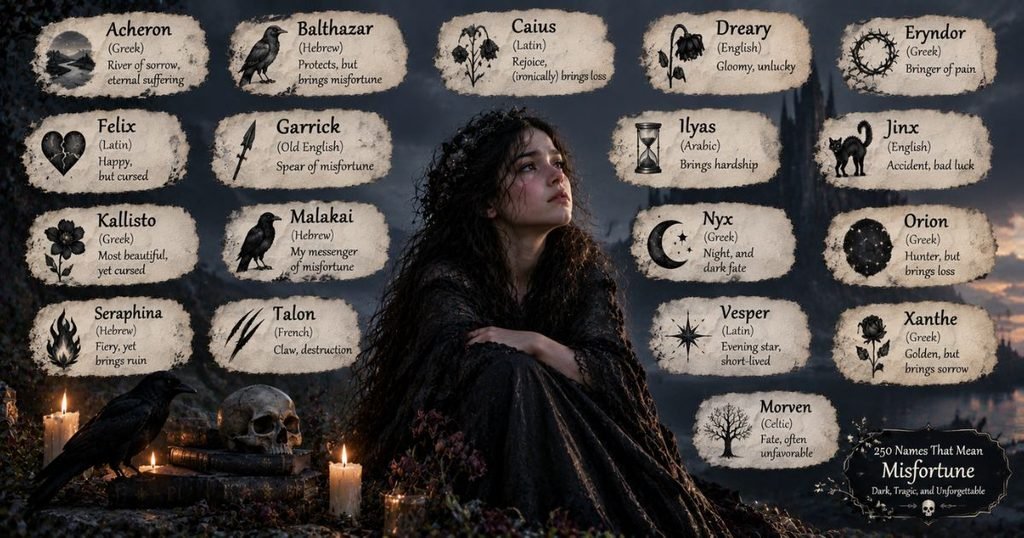
Unisex Names That Mean Misfortune, Doom, and Ill Omen
Unisex names that mean misfortune are mostly short, strong words. Many are old English or Latin terms that now work as modern “word names.” They suit characters, gamer tags, and parents who like a one-syllable punch.
- Mallory (French): “unlucky,” from Old French malheuré.
- Jinx (English): a spell or curse, from the wryneck bird used in charms.
- Hex (German/English): a curse or spell, from German Hexe, “witch.”
- Omen (Latin): a sign of future events, usually bad ones.
- Bane (Old English): “slayer” or “cause of harm.”
- Doom (Old English): “judgment” or “fate.”
- Woe (English): deep grief or trouble.
- Sorrow (English): grief or sadness.
- Raven (English): a bird of ill omen in European folklore.
- Corvus (Latin): “raven” or “crow.”
- Crow (English): another bird tied to omens of death.
- Fate (Latin): from fatum, “that which is spoken.”
- Wyrd (Old English): fate or destiny, a key idea in Anglo-Saxon poetry.
- Dread (English): deep fear.
- Gloom (English): darkness or low spirits.
- Grim (Old English): “fierce.” Also an old name for Odin.
- Ruin (Latin): from ruina, “collapse.”
- Storm (English): turmoil and upheaval.
- Tempest (Latin): from tempestas, “storm.” Also Shakespeare’s play title.
- Ash (English): what remains after a fire.
- Thorn (English): a symbol of hardship and pain.
- Havoc (Old French): from the war-cry “havoc,” meaning wide destruction.
- Chaos (Greek): from khaos, “abyss.”
- Karma (Sanskrit): “action,” and its consequences.
- Kismet (Turkish/Arabic): “fate.”
- Lament (Latin): a passionate expression of grief.
- Requiem (Latin): “rest,” the Mass for the dead.
- Elegy (Greek): a poem of mourning.
- Plague (Latin): from plaga, “blow” or “wound.”
- Anguish (French): severe pain or distress.

Mythological Names That Mean Misfortune and Chaos
Myth gave humans some of the oldest names that mean misfortune. Ancient cultures turned trouble into characters, which let them name, fear, and sometimes bargain with it. Below are 45 of these figures, grouped by tradition.
Greek mythology
- Ate: goddess of ruin and reckless folly.
- Eris: goddess of strife, who started the Trojan War with a golden apple.
- Nemesis: goddess of retribution.
- Moros: spirit of doom, named in Hesiod’s Theogony.
- Thanatos: personified Death.
- Oizys: personified misery, also from Hesiod.
- Nyx: goddess of night and mother of many troubles.
- Hecate: goddess of witchcraft and crossroads.
- Ker: a spirit of violent death. The plural is the Keres.
- Algos: personified pain.
- Achlys: the mist of death and sorrow.
- Lyssa: spirit of mad rage.
- Ananke: goddess of necessity and compulsion.
- Atropos: “inflexible,” the Fate who cuts the thread of life.
- Hades: ruler of the dead.
- Persephone: queen of the underworld.
- Medusa: “guardian,” the cursed gorgon.
Norse mythology
- Loki: the trickster whose schemes bring down the gods.
- Hel: ruler of the realm of the dead.
- Fenrir: the wolf destined to break free at Ragnarök.
- Angrboda: “she who brings anguish,” mother of Fenrir.
- Skuld: a Norn whose name relates to “debt” or “what shall be.”
- Ran: sea goddess who pulls sailors under.
- Surtr: the fire giant who burns the world.
Egyptian mythology
- Set: god of chaos and storms.
- Apep: the serpent that attacks the sun each night.
- Sekhmet: “the powerful one,” goddess of destruction.
- Ammit: “devourer,” who consumed unworthy hearts.
- Isfet: the Egyptian idea of chaos, opposite of order (Ma’at).
Celtic mythology
- Morrigan: a war and fate goddess who appears as a crow.
- Balor: the giant whose single eye brought ruin.
- Badb: “crow,” a war goddess whose cry foretold death.
Hindu and Mesopotamian traditions
- Kali: “black” or “time,” goddess of destruction and change.
- Yama: god of death.
- Nirriti: Vedic goddess of misfortune and decay.
- Alakshmi: the goddess of ill luck, the opposite of Lakshmi.
- Ereshkigal: Mesopotamian queen of the underworld.
- Nergal: god of plague, war, and the underworld.
Slavic, Finnish, and Abrahamic traditions
- Likho: the one-eyed spirit of bad luck in Russian folklore.
- Nedolya: personified ill fate in Slavic tradition.
- Marzanna: goddess of winter and death.
- Tuoni: Finnish god of death.
- Lilith: a night demon in Hebrew and Mesopotamian lore.
- Abaddon: Hebrew for “destruction.”
- Azrael: the angel of death in Jewish and Islamic tradition.
Names That Mean Misfortune in Other Languages and Cultures
Nearly every language has its own word for sorrow or bad luck. Most of the 50 entries below are everyday words, not traditional given names, so treat them as creative options for fiction, pen names, and projects. The three Yoruba-tradition and Hebrew-tradition protective names noted earlier are the exceptions. Where a word is also a real name, we say so.
French, Spanish, Italian, and Portuguese
- Malchance (French): “bad luck.”
- Chagrin (French): grief or vexation.
- Desventura (Spanish): “misfortune.”
- Infortunio (Spanish): “mishap” or “ill luck.”
- Pesar (Spanish): “sorrow” or “regret.”
- Sfortuna (Italian): “bad luck.”
- Affanno (Italian): anguish or breathlessness.
- Cordoglio (Italian): “grief.”
- Azar (Portuguese): “bad luck” in Brazilian usage.
- Mágoa (Portuguese): hurt or sorrow.
German, Dutch, and Scandinavian
- Pech (German): “bad luck.”
- Kummer (German): grief or worry.
- Leid (German): suffering.
- Verdriet (Dutch): “sorrow.”
- Olycka (Swedish): “misfortune” or “accident.”
- Sorg (Scandinavian): “grief.”
Irish and Welsh
- Brón (Irish): “sorrow.”
- Mí-ádh (Irish): “bad luck.”
- Doilíos (Irish): grief or sorrow.
- Anró (Irish): hardship or misery.
- Galar (Welsh): grief.
- Trallod (Welsh): trouble or misery.
Latin, Greek, and Hebrew
- Luctus (Latin): mourning.
- Maeror (Latin): deep grief.
- Dolor (Latin): pain or sorrow.
- Dystychia (Greek): “bad luck.”
- Symphora (Greek): misfortune or disaster.
- Ason (Hebrew): “disaster.”
- Evel (Hebrew): “mourning.”
- Tzara (Hebrew): “trouble.”
Arabic, South Asian, and Turkish
- Nahs (Arabic): “bad luck” or an ill omen.
- Huzn (Arabic): “sorrow.”
- Karb (Arabic): distress.
- Gham (Urdu/Persian): “grief.”
- Dukh (Hindi/Punjabi): “sorrow.”
- Durbhagya (Sanskrit): “misfortune.”
- Dert (Turkish): trouble or sorrow.
African, Slavic, Hungarian, and Japanese
- Msiba (Swahili): “calamity” or mourning.
- Huzuni (Swahili): “sadness.”
- Taabu (Swahili): hardship.
- Kokumo (Yoruba): “will not die again,” a protective abiku name.
- Malomo (Yoruba): “do not go again,” a protective abiku name.
- Beda (Russian): “misfortune.”
- Gore (Russian): “grief.”
- Pechal (Russian): “sorrow.”
- Bánat (Hungarian): “sorrow.”
- Fukō (Japanese, 不幸): unhappiness or misfortune.
- Wazawai (Japanese, 災い): disaster.
- Fuun (Japanese, 不運): bad luck.
- Kunan (Japanese, 苦難): hardship.
Dark Gothic Names and Last Names That Carry Ill Omen
Gothic names that mean misfortune borrow from Poe’s poems, Shakespeare’s villains, and the symbols of mourning. Edgar Allan Poe gave readers Lenore and Ligeia, two lost women whose names still set a mood. Their pull is tone first and literal meaning second.
Gothic first names
- Lenore: the lost beloved in Poe’s “The Raven.”
- Ligeia: Greek for “clear-voiced,” and the title of a Poe story about a lost wife.
- Morgana: the sorceress of Arthurian legend.
- Bellatrix: Latin for “female warrior,” also a star name.
- Damien: Greek for “to tame,” linked to horror through the film The Omen (1976).
- Caliban: the bitter, enslaved creature in The Tempest.
- Belladonna: Italian for “beautiful lady,” also deadly nightshade.
- Hemlock: a poisonous plant.
- Cypress: a tree long linked with mourning.
- Magpie: from the folk rhyme “One for sorrow.”
- Sable: Old French for “black,” the color of mourning.
- Jet: a black gemstone used in Victorian mourning jewelry.
- Nox: Latin for “night.”
- Umbra: Latin for “shadow.”
- Vesper: Latin for “evening.”
- Wraith: a Scottish word for a ghostly double.
- Revenant: one who returns from the dead.
- Phantom: a ghost or apparition.
- Spectre: a ghost or haunting presence.
- Dirge: a funeral song.
- Bleak: cold and without hope.
- Vex: “to trouble” or “to annoy.”
- Pyre: a funeral fire.
- Cinder: the burned remains of a fire.
- Dusk: the fading light before night.
- Gloaming: Scots for twilight.
- Mortis: Latin for “of death.”
- Banshee: from Irish bean sí, a spirit whose wail foretells a death.
- Augur: Latin for a priest who read omens.
- Portent: a sign that something bad is coming.
- Harbinger: one who announces what is to come.
- Reaper: from the Grim Reaper.
- Shroud: a burial cloth.
- Dolour: a poetic word for deep sorrow.
- Lacrima: Latin for “tear.”
Last names that mean misfortune or ill luck
Many of these surnames come from Norman French, where mal means “bad.” Meanings come from standard surname scholarship, and a few are traditional explanations.
- Hazard: from Old French hasard, a dice game of chance.
- Grimm: “grim” or “fierce,” made famous by the Brothers Grimm.
- Grimes: from the Old Norse name Grímr.
- Maltravers: Norman for “bad crossing.”
- Mauleverer: “bad hare-hunter,” from Old French.
- Malpas: “bad passage.”
- Malatesta: Italian for “bad head,” meaning stubborn.
- Malaspina: Italian for “bad thorn.”
- Malfatti: Italian for “badly made.”
- Maldonado: traditionally read as “badly given.”
- Malebranche: French for “bad branch.”
- Mauclerc: “bad clerk.”
- Malherbe: “bad grass” or “bad herb.”
- Malvoisin: “bad neighbor.”
- Mauduit: “badly taught.”
- Mordaunt: “biting,” from Old French.
- Mortimer: from a Norman place name often explained as “dead sea.”
- Danger: from Old French danger, once meaning a lord’s power.
- Mauvais: French for “bad.”
- Malet: a Norman nickname built on mal, “bad.”
You May Also Read: 350 Boy Names That Mean Strength: Powerful Picks With Origins and Meanings.
Final Thoughts
These 250 names show that misfortune has always been part of how people name things. A name like Mara, Moros, or Mallory can carry grief, humor, or fierce pride. Pick the one that fits your story. If this list helped, bookmark it, share it with a fellow writer or expecting parent, and tell us which name you’d choose in the comments. You can also explore more dark baby names next.
FAQs
What name means bad luck?
Mallory is the best-known name meaning bad luck. It comes from the Old French word malheuré, meaning “unfortunate.” Other options include Calamity (“disaster”), Jinx (“curse”), and Wednesday, from the rhyme that says Wednesday’s child is full of woe. Most are rare, so they stand out.
What is the best girl name that means misfortune?
It depends on the tone you want. Mara (“bitter”) is soft and classic, Dolores (“sorrows”) feels vintage, and Desdemona (“ill-fated”) is dramatic. For something fierce, try Nemesis or Hecate. Each has a documented origin in the Bible, Spanish tradition, or Greek myth.
Is it okay to give a baby a name that means misfortune?
Yes, many parents do. Names like Mara, Dolores, and Tristan have been used for centuries and rarely draw comment. Choose a name you love for its sound and story, check how it pairs with your surname, and avoid meanings tied to real tragedies. Say it aloud before you decide.
Which mythological figures represent misfortune?
In Greek myth, Ate (ruin), Moros (doom), Oizys (misery), and Eris (strife) personify trouble. Norse tales have Loki and Angrboda, Egyptian myth has Set and Apep, and Slavic folklore has Likho, the spirit of bad luck. Hesiod’s Theogony names several Greek examples.
Why do some cultures give children unlucky-sounding names?
Many families believed an ugly or sorrowful name would protect a child from evil spirits or the evil eye. Old Slavic naming used names like Nekras (“not beautiful”), and Chinese families used humble nicknames. Other names, like Ben-Oni in the Bible, recorded a parent’s grief instead.