

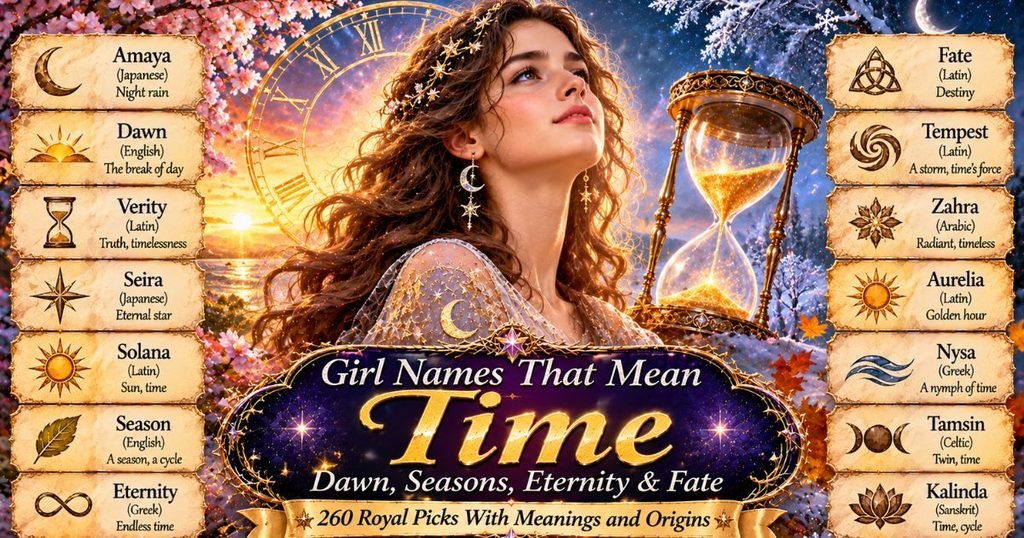
260 Girl Names That Mean Time: Dawn, Seasons, Eternity & Fate
Girl names that mean time include Kala (Sanskrit for time and fate), Hora (Greek for hour), Era (Latin for age), Aeon (Greek for an age or eternity), and Kairos (Greek for the opportune moment). Other time-inspired choices draw on dawn, seasons, months, and eternity, like Aurora, Autumn, and Amara. You’ll find 260 options, each with its origin and meaning.
Girl Names That Mean Time Directly
These names come straight from a word for time, an hour, a moment, or an age. They are the closest match for anyone searching for baby girl names meaning time. Many are short, which makes them easy to spell and say.
- Kala (Sanskrit): time; fate
- Kali (Sanskrit): “she who is time”; the Hindu goddess of time and change
- Kalika (Sanskrit): “of Kali” and so linked to time; also “bud”
- Samaya (Sanskrit): time; the right moment
- Nimisha (Sanskrit): a blink; a moment
- Kshana (Sanskrit): an instant
- Tithi (Sanskrit): a lunar day in the Hindu calendar
- Yuga (Sanskrit): an age or era of the world
- Hora (Greek): hour; season
- Era (Latin): an age; a long period of time
- Aeon (Greek): an age; eternity
- Kairos (Greek): the opportune moment
- Zamana (Urdu, from Arabic): time; an era
- Toki (Japanese, 時): time
- Tokiko (Japanese, 時子): child of time
- Aika (Finnish): time
- Toshiko (Japanese, 年子): child of the year, in one common spelling
- Mirai (Japanese, 未来): future
- Asuka (Japanese, 明日香): “tomorrow” plus “fragrance,” in one common spelling

Timeless Girl Names That Mean Eternity or Forever
Eternity is time without an end. These names suit parents who want a meaning that lasts. Many come from Sanskrit, Arabic, and Japanese words for “everlasting,” “imperishable,” or “long life.”
- Amara (Greek, Sanskrit, Igbo): unfading (Greek); immortal (Sanskrit); grace (Igbo)
- Nitya (Sanskrit): eternal
- Shashwati (Sanskrit): everlasting
- Anantya (Sanskrit): endless
- Amrita (Sanskrit): the nectar of immortality
- Ajara (Sanskrit): ageless
- Akshara (Sanskrit): imperishable; also a letter or syllable
- Akshaya (Sanskrit): never-ending
- Ayushi (Sanskrit): blessed with long life
- Dhruvi (Sanskrit): constant; fixed
- Perpetua (Latin): everlasting
- Immortelle (French): the everlasting flower
- Amaranta (Spanish): from amaranth, the “unfading” flower
- Athanasia (Greek): immortality
- Khalida (Arabic): immortal; everlasting
- Khulud (Arabic): eternity
- Daima (Arabic): constant; everlasting
- Eternity (English): endless time
- Infinity (English): without limit
- Eiko (Japanese, 永子): eternal child, in one spelling
- Towa (Japanese, 永遠): eternity
- Hisako (Japanese, 久子): long-lasting child
- Tokiwa (Japanese, 常盤): eternally unchanging rock
- Chiyo (Japanese, 千代): a thousand generations
- Chiyoko (Japanese, 千代子): child of a thousand generations
- Yachiyo (Japanese, 八千代): eight thousand generations
You Can Also Read: Names That Mean Nothing: 300 Names for Zero, Void, and Emptiness.
Girl Names That Mean Dawn, Morning, and New Day
Dawn marks the start of every day, so it is one of the oldest ways people measured time. Almost every language has a name for first light.
Greek, Latin, and Romance Dawn Names
- Aurora (Latin): dawn; the Roman goddess of the morning
- Eos (Greek): dawn; the Greek goddess of sunrise
- Dawn (English): the first light of day
- Aurore (French): dawn
- Alba (Latin, Spanish, Italian): white; dawn
- Avgi (Greek): dawn
- Chrysavgi (Greek): golden dawn
- Matuta (Latin): the Roman goddess of dawn
South Asian Dawn Names
- Usha (Sanskrit): dawn
- Pratyusha (Sanskrit): early dawn
- Ushasi (Sanskrit): dawn; morning
- Prabhati (Sanskrit): of the morning
- Ahana (Sanskrit): day; dawn
- Aarushi (Sanskrit): the first ray of the sun
- Arunima (Sanskrit): the red glow of dawn
- Subah (Hindi, Urdu): morning
Arabic, Persian, Turkish, and Hebrew Dawn Names
- Sahar (Arabic, Persian): dawn; daybreak
- Fajr (Arabic): dawn
- Shurooq (Arabic): sunrise
- Sabah (Arabic): morning
- Duha (Arabic): mid-morning light
- Sepideh (Persian): dawn
- Şafak (Turkish): dawn
- Seher (Turkish): the hour before sunrise
- Tanyeli (Turkish): the dawn breeze
- Shachar (Hebrew): dawn
Slavic, Baltic, Celtic, and Finno-Ugric Dawn Names
- Zora (Slavic): dawn
- Zorana (Serbian, Croatian): dawn
- Zorica (Serbian): little dawn
- Zorka (Slavic): little dawn
- Zarya (Russian): dawn
- Zorya (Slavic): the goddess of dawn
- Danica (Slavic): the morning star
- Gwawr (Welsh): dawn
- Hajnal (Hungarian): dawn
- Hajnalka (Hungarian): from hajnal, dawn
- Aušra (Lithuanian): dawn
- Aušrinė (Lithuanian): the morning star
- Ausma (Latvian): dawn
- Arshaluys (Armenian): dawn
- Aamu (Finnish): morning
East and Southeast Asian Dawn Names
- Liwayway (Filipino): dawn
- Fajar (Indonesian, Malay): dawn
- Asako (Japanese, 朝子): morning child
- Asami (Japanese, 朝美): morning beauty
Girl Names That Mean Evening, Dusk, and Night
Twilight and night make up the other half of the day. These names feel quiet and soft. They often come from the words for “evening star” or “night” itself.
- Vesper (Latin): evening; the evening star
- Vespera (Latin): evening
- Hesperia (Greek): the land of the evening, meaning the west
- Sandhya (Sanskrit): twilight
- Sanjh (Hindi, Punjabi): twilight; evening
- Ratri (Sanskrit): night
- Nisha (Sanskrit): night
- Nishita (Sanskrit): midnight
- Yamini (Sanskrit): night
- Rajani (Sanskrit): night
- Layla (Arabic): night
- Samar (Arabic): evening conversation
- Nyx (Greek): night; the goddess of night
- Nox (Latin): night
- Yuko (Japanese, 夕子): evening child
- Yuzuki (Japanese, 夕月): evening moon
- Akane (Japanese, 茜): madder red, the color of the sunset sky
- Senja (Indonesian): twilight; dusk
Sun and Moon Girl Names That Mark Time
Before clocks, people read time in the sky. The moon counted the months, and the sun counted the days. Names from both still feel connected to that old rhythm.
Moon Names and Lunar Cycles
- Luna (Latin): moon
- Selene (Greek): the Greek goddess of the moon
- Diana (Latin): the Roman goddess of the moon and the hunt
- Artemis (Greek): the Greek goddess later linked with the moon
- Mene (Greek): moon; month
- Cynthia (Greek): an epithet of Artemis, from Mount Cynthus
- Chandra (Sanskrit): moon
- Chandrika (Sanskrit): moonlight
- Chandni (Hindi): moonlight
- Kaumudi (Sanskrit): moonlight
- Mahina (Hawaiian): moon
- Marama (Maori): moon
- Qamar (Arabic): moon
- Yue (Chinese, 月): moon; month
- Tsukiko (Japanese, 月子): moon child
- Aylin (Turkish): the halo around the moon
- Ayla (Turkish): moonlight; halo of the moon
- Mahtab (Persian): moonlight
- Mahsa (Persian): like the moon
- Mahnoor (Persian, Urdu): light of the moon
- Mahjabeen (Persian): moon-browed
- Purnama (Indonesian): full moon
Sun Names and the First Clock
- Sol (Latin): sun
- Solana (Spanish): sunshine
- Soleil (French): sun
- Helia (Greek): from Helios, the sun
- Sunna (Old Norse): the sun goddess
- Saulė (Lithuanian): the sun goddess
- Savitri (Sanskrit): of the sun; a figure from Hindu epics
- Asahi (Japanese, 朝日): morning sun
- Hinata (Japanese, 日向): a sunny place
- Yoko (Japanese, 陽子): child of the sun, in one common spelling
- Sunniva (Old English): gift of the sun
- Suria (Malay): sun
- Arev (Armenian): sun

Girl Names for Months, Days, and Holidays
Some names mark a specific point on the calendar. Others honor the day or season of a birth. This is one of the most personal ways to choose a name tied to time.
Month Names
- April (English): the month of April
- Avril (French): April
- Abril (Spanish, Portuguese): April
- May (English): the month of May
- Maia (Latin, Greek): the Roman goddess for whom May is named
- June (English): the month of June, tied to the goddess Juno
- Junia (Latin): a Roman clan name linked to Juno
- Augusta (Latin): venerable; August is named for Emperor Augustus
- Marcia (Latin): of Mars, the god for whom March is named
- Yayoi (Japanese, 弥生): March in the traditional calendar
- Satsuki (Japanese, 皐月): May in the traditional calendar
- Hazuki (Japanese, 葉月): August, the “leaf month,” in the traditional calendar
- Mutsuki (Japanese, 睦月): January in the traditional calendar
- Sivan (Hebrew): a month in the Hebrew calendar
Weekday Names
The Akan people of Ghana traditionally name a child for the day of birth. These are the girls’ forms.
- Adwoa (Akan): born on Monday
- Abena (Akan): born on Tuesday
- Akua (Akan): born on Wednesday
- Yaa (Akan): born on Thursday
- Afua (Akan): born on Friday
- Ama (Akan): born on Saturday
- Akosua (Akan): born on Sunday
- Dominica (Latin): of the Lord; traditionally given to Sunday-born girls
- Kyriaki (Greek): Sunday; of the Lord
Holiday and Day Names
- Noelle (French): Christmas
- Natalia (Latin): from “birthday of the Lord,” meaning Christmas Day
- Natasha (Russian): a pet form of Natalia
- Pascale (French): Easter
- Natividad (Spanish): nativity
- Epiphany (Greek): a manifestation; the feast day of January 6
- Daisy (Old English): “day’s eye,” named for the flower that opens at dawn
- Dagny (Old Norse): new day
- Dagmar (Scandinavian): day maiden
Seasonal Girl Names That Mean a Time of Year
Seasons are the most human way to feel time pass. These names work well for a baby born in a certain season. They also suit parents who like the idea of a name tied to a favorite time of year.
Spring Names
- Spring (English): the season of renewal
- Vesna (Slavic): spring; the Slavic spring goddess
- Primavera (Italian, Spanish): spring
- Haru (Japanese, 春): spring
- Harumi (Japanese, 春美): spring beauty
- Haruko (Japanese, 春子): spring child
- Haruna (Japanese, 春菜): spring greens
- Haruhi (Japanese, 春日): spring day
- Vasanti (Sanskrit): of spring
- Madhavi (Sanskrit): vernal; spring-born
- Bom (Korean): spring
- Bahar (Persian, Turkish): spring
- Nowruz (Persian): new day; the Persian New Year at the spring equinox
- Aviva (Hebrew): springtime
- Rabia (Arabic): spring; also “fourth”
- Xuan (Vietnamese, Xuân): spring
- Kasumi (Japanese, 霞): spring haze
- Sakura (Japanese, 桜): cherry blossom, the symbol of spring
Summer Names
- Summer (English): the warm season
- Sommer (German, Danish): summer
- Haf (Welsh): summer
- Natsumi (Japanese, 夏美): summer beauty
- Natsuko (Japanese, 夏子): summer child
- Natsuki (Japanese, 夏希): summer hope
- Grishma (Sanskrit): summer
Autumn Names
- Autumn (English): the season of change
- Aki (Japanese, 秋): autumn
- Akiko (Japanese, 秋子): autumn child
- Sharada (Sanskrit): autumnal
- Gaeul (Korean): autumn
- Stav (Hebrew): autumn
- Thu (Vietnamese): autumn
- Kaede (Japanese, 楓): maple, the tree of autumn color
Winter Names
- Winter (English): the cold season
- Fuyumi (Japanese, 冬美): winter beauty
- Fuyuka (Japanese, 冬香): winter plus fragrance
- Fuyuko (Japanese, 冬子): winter child
- Gyeoul (Korean): winter
- Talvikki (Finnish): winter
Rain and General Season Names
- Varsha (Sanskrit): rain; the monsoon season
- Barkha (Hindi): rain
- Ritu (Sanskrit): season
- Rutuja (Marathi): born of the seasons
Goddesses of the Hours, Fate, and Memory
Ancient cultures told stories about time, and many of those stories feature women. The Horae (the Hours) kept the seasons in order. The Moirai (the Fates) measured each life. The Norns shaped fate in Norse myth.
Goddesses of the Hours and the Calendar
- Hemera (Greek): day; the goddess of daylight
- Thallo (Greek): blossom; a Hora linked with spring
- Auxo (Greek): growth; a Hora of the growing season
- Carpo (Greek): fruit; a Hora of harvest
- Eunomia (Greek): good order; a Hora
- Dike (Greek): justice; a Hora
- Eirene (Greek): peace; a Hora
- Auge (Greek): first light; one of the twelve hours named in Greek myth
- Anatole (Greek): sunrise; one of the twelve hours
- Mesembria (Greek): midday; one of the twelve hours
- Hesperis (Greek): evening; one of the twelve hours
- Themis (Greek): divine law; the mother of the Horae and the Moirai
- Rhea (Greek): a Titaness and the consort of Kronos
- Nona (Latin): ninth; one of the three Roman Fates
- Decima (Latin): tenth; one of the three Roman Fates
- Antevorta (Latin): the Roman goddess of the future
- Postverta (Latin): the Roman goddess of the past
- Renpet (Egyptian): the goddess of the year
- Seshat (Egyptian): the goddess of writing and record-keeping
Fate and Destiny Names
- Moira (Greek): fate; one’s portion in life
- Ananke (Greek): necessity
- Tyche (Greek): fortune
- Fortuna (Latin): fortune
- Clotho (Greek): the Fate who spins the thread of life
- Lachesis (Greek): the Fate who measures the thread
- Atropos (Greek): the Fate who cuts the thread
- Urd (Old Norse): what has become; the past
- Verdandi (Old Norse): what is becoming; the present
- Skuld (Old Norse): what shall be; the future
- Laima (Latvian, Lithuanian): the goddess of fate
- Destiny (English): fate
- Kismet (Turkish, Arabic): fate
- Kader (Turkish): fate
- Bhagya (Sanskrit): fortune
- Vidhi (Sanskrit): fate; destiny
- Niyati (Sanskrit): destiny
Memory and History Names
- Mnemosyne (Greek): memory; the mother of the Muses
- Mneme (Greek): memory; one of the early Muses
- Clio (Greek): the Muse of history
- Zikra (Arabic): remembrance
- Smriti (Sanskrit): memory
- Zakira (Arabic): one who remembers
You May Also Read: Japanese Names That Mean Death: 300 Dark, Meaningful Picks With Kanji.
Conclusion
Girl names that mean time offer meaning from every corner of the world. You can pick the quiet strength of Kala, the glow of Aurora, the calm of Vesper, or the steady promise of Nitya. Whatever you choose, trust how it sounds and what it means to you. Bookmark this list, share it with someone helping you decide, and tell us your favorite in the comments.
FAQs
What is a girl name that means time?
Kala is the clearest answer. It is the Sanskrit word for time, and it also means fate. Hora (Greek for hour), Era (Latin for age), Samaya (Sanskrit for time), and Toki (Japanese for time) are also direct choices.
What girl name means forever or eternal?
Nitya, Shashwati, Khalida, Perpetua, and Towa all mean eternal or everlasting. Amara is the most widely used in English-speaking countries, though its meaning differs by language: unfading in Greek, immortal in Sanskrit, and grace in Igbo.
Is there a Greek goddess of time?
Greek mythology has no single female goddess of time. Chronos and Aion are male. The goddesses closest to the idea are the Horae, who ruled the hours and seasons, and the Moirai, who ruled fate.
What is the difference between Chronos and Kairos?
Chronos means time that moves forward in measured steps, such as minutes and years. Kairos means the right or opportune moment. Both are Greek, and Kairos is sometimes used for girls.
What girl names mean dawn or a new day?
Aurora, Eos, Usha, Zora, Sahar, Gwawr, and Aamu all mean dawn. For “new day,” Dagny (Old Norse) and Nowruz (Persian) are good choices.