Names That Mean Nothing: 300 Names for Zero, Void, and Emptiness
Names that mean nothing fall into two groups: real names from languages like Latin, Sanskrit, and Japanese that translate to nothing, zero, or void, and invented names with no established meaning. Nihil, Shunya, Mu, and Nada are real examples. Coined options such as Brellia and Corvane carry no meaning at all.
This guide gives you 300 names for baby naming, fiction, gaming, and creative projects. Each entry includes its origin and a quick note on why it works.
Names That Mean Nothing, Zero, or None
These 30 names are the closest you can get to “nothing” in a literal sense. They come from Latin, Italian, Sanskrit, Hebrew, and a few modern languages. Many sound surprisingly soft. That is why they work well for characters, pets, and creative aliases. If you like the idea of a dark or mysterious tone, you may also enjoy our list of names that mean dark.

- Nihil (Latin) – “nothing.” The root of nihilism, which makes this the most direct “nothing” name on the list.
- Nihilo (Latin) – “from nothing,” as in the phrase ex nihilo (“out of nothing”). The soft vowels make it easy to say.
- Nihilum (Latin) – “a nothing” or “nonexistence.” Rare, scholarly, and distinctive.
- Nullus (Latin) – “none” or “not any.” Crisp and strong, with a Roman feel.
- Nulla (Italian) – “nothing” or “none.” It flows like a soft girl’s name.
- Null (English, from Latin) – “no value.” Programmers use it daily, so it suits tech characters.
- Nil (Latin, short for nihil) – “zero.” British sports fans say “two-nil.” In Turkey, Nil is also a girl’s name meaning “the Nile,” so it has two true meanings.
- Nada (Spanish) – “nothing.” In Arabic, Nada is a girl’s name meaning “dew” or “generosity.”
- Niente (Italian) – “nothing.” Musicians know al niente as a direction to fade “to nothing.”
- Rien (French) – “nothing.” In the Netherlands, Rien is also a short form of names like Marinus.
- Nic (Polish, Czech) – “nothing.” Most people see it as short for Nicholas, so it hides its meaning well.
- Nimic (Romanian) – “nothing.” A crisp two-syllable name that is rarely used.
- Nolla (Finnish) – “zero.” A real word that sounds like a friendly girl’s name.
- Nula (Czech, Slovak) – “zero.” Short, symmetrical, and easy to spell.
- Zero (Italian, via Arabic) – “zero.” Bold and popular in fiction for calm, mysterious characters.
- Sifr (Arabic) – “zero” or “empty.” This is the ancestor of both zero and cipher.
- Cipher (English, via Old French and Arabic) – “zero,” later “secret code.” Gender-neutral and a little edgy.
- Shunya (Sanskrit) – “zero” or “void.” The Sanskrit root behind both zero and the Buddhist idea of emptiness.
- Abhava (Sanskrit) – “absence” or “non-existence.” A term from Indian philosophy with a gentle sound.
- Asat (Sanskrit) – “non-being.” The Rig Veda’s famous creation hymn describes a time with neither asat nor sat (being).
- Naught (Old English) – from nāwiht, “no thing.” Old-fashioned and poetic.
- Nullo (Italian) – “null” or “void,” as in “null and void.” Warm and flowing.
- Zilch (American slang) – “nothing.” Playful, so it works as a funny nickname.
- Zip (American slang) – “nothing.” Short, energetic, and common as a pet name.
- Nix (German slang, English) – “nothing.” It is also Latin for “snow,” so it carries a second image.
- Niks (Dutch) – informal “nothing.” Quirky and short.
- Efes (Hebrew) – “zero” or “nothing.” It is also the Turkish name for the ancient city of Ephesus.
- Ayin (Hebrew) – “nothingness” in Kabbalah, the source beyond all description. It is spelled differently from the Hebrew letter ayin, which means “eye.”
- Tiada (Malay, Indonesian) – “none” or “there is not.” Smooth and open-voweled.
- Hakuna (Swahili) – “there is none.” Famous from the phrase hakuna matata, “no worries.”
You Can Also Read: Boy Names That Mean Love and Strength: 300 Meaningful Picks With Origins.
Names That Mean Empty or Hollow
“Empty” is close to “nothing,” but it is not identical. An empty jar still has a shape. These 30 names focus on hollow spaces, bare rooms, and vacant places. They come from Greek, Latin, Romance, Germanic, Slavic, Arabic, and South Asian roots. Some are common words in their own language, so a native speaker will hear a plain meaning right away.
- Kenos (Greek) – “empty.” From kenós, used by ancient writers for empty jars and empty promises.
- Kenon (Greek) – “the void.” Greek atomists such as Democritus used it for the empty space between atoms.
- Kenosis (Greek) – “emptying.” A theology term for self-emptying, taken from Philippians 2. Rare and spiritual.
- Vacuus (Latin) – “empty.” The source of the English word vacuum.
- Holloway (English) – from “hollow way,” meaning a sunken road. It sounds empty, but it does not mean “empty.” It is a surname used as a first name.
- Inanis (Latin) – “empty” or “hollow.” It gives English the word inane.
- Cassus (Latin) – “hollow” or “lacking.” Do not confuse it with Cassius.
- Vana (Latin) – “empty” or “vain.” In Sanskrit, vana means “forest,” so the context matters.
- Cavus (Latin) – “hollow.” It is the root of English cavity.
- Vacío (Spanish) – “empty.” The accent gives it a lyrical flow.
- Vazio (Portuguese) – “empty.” Soft, with a Brazilian sound.
- Vuoto (Italian) – “empty.” Bold and fun to say.
- Vide (French) – “empty.” A short, minimalist choice.
- Creux (French) – “hollow.” Unusual and sharp.
- Leeg (Dutch) – “empty.” A tiny word with a long vowel.
- Leer (German) – “empty.” It is also the name of a town in Lower Saxony.
- Hohl (German) – “hollow.” Strong and simple.
- Tom (Swedish, Danish, Norwegian) – “empty.” English speakers know Tom as a classic name, while Scandinavians read the plain word. A hidden double meaning.
- Tyhjä (Finnish) – “empty.” Pronounced roughly “TUE-hyah.”
- Pusty (Polish) – “empty.” Easy to say for English speakers.
- Pustoy (Russian) – “empty.” Written пустой in Cyrillic.
- Prazan (Serbian, Croatian) – “empty.” Smooth and masculine.
- Boş (Turkish) – “empty.” Pronounced “bosh.”
- Üres (Hungarian) – “empty.” Short and unusual.
- Gol (Romanian) – “empty” or “bare.” Quick to say.
- Khali (Hindi, Urdu) – “empty.” It comes from Arabic khālī.
- Farigh (Arabic) – “empty” or “free of work.” Used in classical poetry for a mind with nothing in it.
- Falamh (Scottish Gaelic; Irish folamh) – “empty.” Said roughly “FAL-uv.”
- Rikta (Sanskrit) – “empty” or “vacant.” Rare and refined.
- Kosong (Malay, Indonesian) – “empty” or “zero.” The same word covers both ideas.
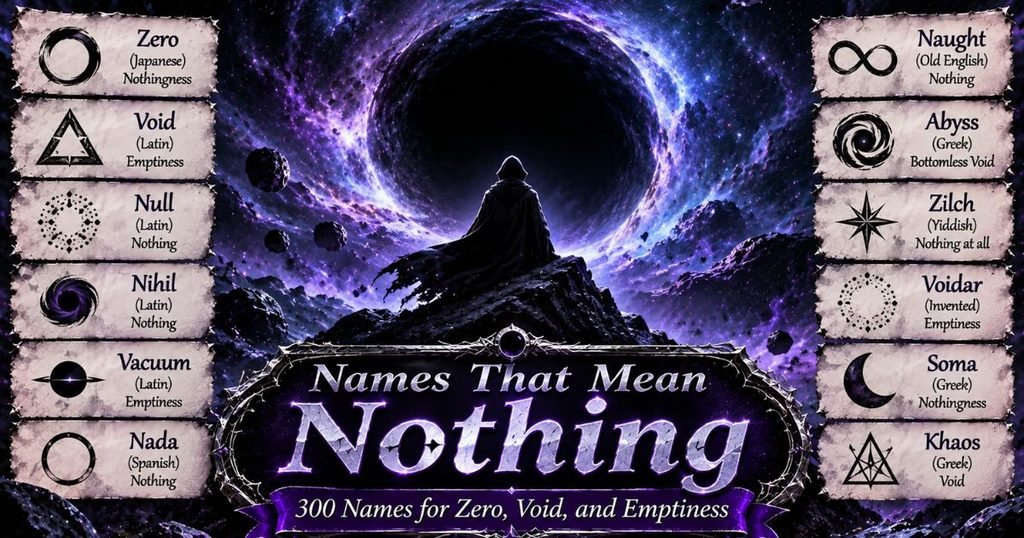
Names That Mean Void, Abyss, or Primordial Chaos
Creation myths often begin with nothing at all. Greek, Norse, Egyptian, Mesopotamian, Hebrew, Hindu, Chinese, and Polynesian stories each describe an empty, dark, or formless state before the world. These 36 names come from those stories. They are dramatic, so they suit fantasy characters, gamers, and anyone who wants a name with deep roots. For more of this mood, try our girl names that mean chaos.
Greek
- Chaos – from Khaos, “gaping void.” In the poet Hesiod’s Theogony, Chaos is the first thing to exist.
- Barathron – “pit” or “abyss.” A deep, dramatic word that is almost never used as a name.
- Erebus – “deep darkness.” In Greek myth, a primordial god of shadow.
- Nyx – “night.” A primordial goddess born from Chaos in Hesiod’s account.
- Tartarus – the deepest pit of the Greek underworld.
- Abyss – from Greek ábyssos, “bottomless.” Instantly clear to English readers.
- Skotos – “darkness.” A rare, stark choice.
- Eremos – “deserted place.” It is the root of the English word hermit.
- Apeiron – “boundless.” The philosopher Anaximander (6th century BCE) said everything came from the apeiron.
- Kenoma – “emptiness.” Gnostic writers contrasted kenoma with pleroma, which means “fullness.”
Norse
- Ginnungagap – “yawning void.” In Norse myth, this is the gap between fire and ice where the world began.
- Ymir – the first giant, formed in Ginnungagap. The meaning of his name is debated among scholars.
Egyptian (the eight primordial deities of Hermopolis)
- Nun – the formless waters before creation.
- Naunet – Nun’s female counterpart.
- Kek – “darkness.”
- Kauket – the female form of Kek.
- Heh – “endlessness” or “infinity.”
- Hauhet – the female form of Heh.
- Amun – “the hidden one.”
- Amunet – the female form of Amun.
Mesopotamian
- Tiamat – the primordial saltwater goddess in the Babylonian Enuma Elish.
- Apsu – the primordial freshwater abyss, her partner in that myth.
- Nammu – the primeval sea goddess in Sumerian myth.
Hebrew
- Tehom – “the deep,” from Genesis 1:2.
- Tohu – “formless.” It appears in the phrase tohu va-vohu, “formless and void.” Tohu is also a Māori name meaning “sign.”
- Bohu – “void,” the second half of that same phrase.
Hindu and Buddhist
- Akasha – “space” or “aether.” Also used as a modern given name.
- Ananta – “endless.” A real given name in India and a title of the serpent Shesha.
- Avyakta – “unmanifest,” the formless source of nature in Samkhya philosophy.
- Pralaya – “dissolution,” the periodic ending of the universe in Hindu thought.
- Nirvana – from Sanskrit, “blown out” or “extinguished.”
- Nirvan – a short form used as a boy’s name in India.
Chinese, Polynesian, and English
- Hundun – “primordial chaos.” In the Zhuangzi, the faceless Hundun dies when two friends give him seven holes.
- Te Kore – Māori for “the void,” the realm of pure potential before creation.
- Pō – in Hawaiian and other Polynesian traditions, “night” and the primordial darkness.
- Void – from Old French voide, “empty.” A bold, plain choice.

Japanese, Buddhist, and Taoist Names That Mean Nothing
Eastern traditions treat emptiness as something to explore, not something to fear. In Zen Buddhism, the one-word answer mu means “no” or “nothing” and is used to cut through overthinking. In Mahayana Buddhism, shunyata does not say that nothing exists. It says that nothing exists on its own, apart from everything else. That is a much richer idea than a simple “empty.” It is also why these 30 names feel calm and thoughtful instead of cold.
Japanese
- Mu (無) – “nothing” or “without.” The famous Zen answer in the koan about a monk asking whether a dog has Buddha-nature.
- Kū (空) – “emptiness” or “sky.” One of the five elements in Japanese Buddhist teaching, alongside earth, water, fire, and wind.
- Kara (空) – “empty,” as in karate, which means “empty hand.” In English-speaking countries, Kara is also an everyday Western name.
- Sora (空) – “sky.” It uses the same character as emptiness and is a common given name in Japan.
- Utsuro (虚ろ) – “hollow” or “empty.” Quiet and a little haunting.
- Kokū (虚空) – “empty sky” or “void.”
- Kokūzō (虚空蔵) – “Womb of Space,” the name of a Buddhist bodhisattva (Akasagarbha in Sanskrit).
- Kūkai (空海) – “sky and sea” or “void and sea.” The name of the monk who founded Shingon Buddhism in Japan.
- Kūya (空也) – a wandering Buddhist monk of the 10th century.
- Kyomu (虚無) – “nihility” or “nothingness.” The Japanese word for the philosophy of nihilism.
- Kūhaku (空白) – “blank” or “empty space.” Like a blank page.
- Mushin (無心) – “no-mind.” A Zen and martial arts state of calm without overthinking.
- Mumon (無門) – “gateless.” The name of the Zen master behind the 13th-century collection The Gateless Gate.
- Mujō (無常) – “impermanence.” The idea that all things change.
- Mumei (無名) – “nameless.” Swordsmiths use the word for a blade left unsigned.
- Mugen (無限) – “limitless” or “infinite.”
- Ma (間) – “gap” or “pause.” In Japanese art, the meaningful space between things.
Chinese
- Wu (無/无) – “nothing” or “without.” It is also a very common surname written with other characters.
- Wuji (無極) – “without limit.” In Taoism, the boundless state before yin and yang separate.
- Wuwei (無為) – “non-doing.” The Taoist idea of effortless action.
- Wuming (無名) – “nameless.” The Tao Te Ching describes the nameless as the beginning of heaven and earth.
- Xu (虛) – “empty” or “void.” Also a common surname written with other characters.
- Kong (空) – “empty” or “sky.” It is not the same as the surname Kong (孔) of Confucius, which uses a different character.
Sanskrit, Pali, Tibetan, Korean, and Vietnamese
- Shunyata (Sanskrit) – “emptiness.” The key idea behind Mahayana Buddhism, often written as śūnyatā.
- Nagarjuna (Sanskrit) – an Indian Buddhist philosopher of roughly the 2nd to 3rd century CE who developed the Madhyamaka teaching on emptiness.
- Nirodha (Sanskrit) – “cessation.” The third of the Buddha’s Four Noble Truths.
- Anatta (Pali) – “non-self.” The teaching that there is no fixed, permanent self.
- Tongpa (Tibetan) – “empty,” from stong pa. Tibetan teachers use tongpa-nyi for “emptiness.”
- Heo (Korean, 虛) – “empty.” It is also a Korean surname written with a different character.
- Khong (Vietnamese, không) – “empty,” “none,” or “no.”
Names That Mean No One
If you want a name that means “nobody,” history offers some great choices. These 30 names all mean “nobody” or “nobody in particular.”
Literary and classical
- Outis (Greek) – “no one.” The name Odysseus used to fool the Cyclops.
- Nemo (Latin) – “no one.” Captain Nemo made it famous, and many people now use it as a first name.
- Noman (English) – the form some English translations of the Odyssey use for Outis.
- Nobody (English) – the plain-English version of the same joke.
- Nullius (Latin) – “of no one.” It appears in legal phrases like res nullius, “a thing belonging to no one.”
- Everyman (English) – the hero of a 15th-century English morality play who stands for every ordinary person.
“Nobody” in other languages
- Nessuno (Italian) – “nobody.”
- Nadie (Spanish) – “nobody.”
- Personne (French) – “nobody” in a negative sentence, and “person” otherwise.
- Niemand (German, Dutch) – “nobody.”
- Nikt (Polish) – “nobody.”
- Nikto (Russian) – “nobody.” Written никто in Cyrillic.
- Ingen (Swedish, Danish, Norwegian) – “no one.”
Nameless and unknown
- Anon – short for “anonymous,” from Greek anonymos, “without a name.”
- Anonymus (Latin) – the classic label for an author whose name is lost.
- Incognito (Italian) – “unknown,” used for someone traveling without revealing who they are.
- Nomen Nescio (Latin) – “I do not know the name.” Often shortened to N.N. in old records.
Placeholder names that stand for “nobody in particular”
- John Doe (English) – a stand-in for an unidentified person in legal and police records. English courts used it for centuries.
- Jane Doe – the female version.
- Richard Roe – the traditional second placeholder, used alongside John Doe in old English lawsuits.
- Joe Bloggs (British English) – the everyday “average person” in the UK.
- Max Mustermann (German) – “sample man.” The standard fake name on German forms.
- Erika Mustermann (German) – the matching female form.
- Jean Dupont (French) – a typical placeholder for an average French person.
- Juan Pérez (Spanish) – a common stand-in for an unnamed person.
- Fulano (Spanish) – “so-and-so,” from Arabic fulān.
- Mario Rossi (Italian) – the usual sample name on Italian forms.
- Jan Kowalski (Polish) – the Polish “John Doe.”
- Ola Nordmann (Norwegian) – the typical “average Norwegian” man.
- Kari Nordmann (Norwegian) – the matching female form.
Made-Up Names With No Meaning at All
Here is the honest truth: the only way to get a name with no meaning is to invent one. Every name above comes from a real word or story. The 144 names below are coined sounds. They are built from familiar name endings like -elle, -an, and -ric, because familiar endings help a new name feel real and easy to say.
Invented Girl Names That Mean Nothing
- Brellia (BREL-ee-ah) – light and airy, with a friendly double-l.
- Cavelle (kah-VEL) – a crisp, French-style finish.
- Dorvella (dor-VEL-ah) – gentle rhythm with a strong middle.
- Fenvira (fen-VEER-ah) – flowing, with a bright long vowel.
- Halvery (HAL-ver-ee) – warm and casual, like a modern surname.
- Ivenna (eye-VEN-ah) – soft and rounded.
- Jolvanne (jol-VAN) – a playful start with a serious finish.
- Lorvenne (lor-VEN) – calm and balanced.
- Maverelle (MAV-er-el) – spirited, with a lilt.
- Nuvessa (noo-VESS-ah) – smooth, with a hissing “ss.”
- Orlenne (or-LEN) – round vowels give it grace.
- Pelvara (pel-VAR-ah) – an open, musical ending.
- Quillara (kwih-LAR-ah) – a quirky Q start and an easy rhythm.
- Risselda (ris-EL-dah) – a storybook feel.
- Sarvelle (sar-VEL) – crisp and clean.
- Tavienne (tav-ee-EN) – elegant, in the style of French names.
- Ulverra (ul-VER-ah) – earthy and rare.
- Vessaly (VESS-ah-lee) – a breezy three-beat flow.
- Wylenne (wy-LEN) – light, with an uncommon W start.
- Yselvia (iss-EL-vee-ah) – ornate and dreamy.
- Zenavie (zen-ah-VEE) – bright and high-energy.
- Adorrin (AD-or-in) – strong, with a compact rhythm.
- Belarnie (beh-LAR-nee) – friendly, like a nickname.
- Corvenna (kor-VEN-ah) – a darker, richer sound.
- Delvaine (del-VAYN) – refined, with a long “ay.”
- Elmarra (el-MAR-ah) – gentle and open.
- Fiovelle (fee-oh-VEL) – musical and airy.
- Gaverelle (gav-er-EL) – lively, with a bouncy beat.
- Halovenne (hal-oh-VEN) – long, dreamy, and rhythmic.
- Imerelle (im-er-EL) – light and delicate.
- Jovelline (joh-vel-EEN) – playful yet formal.
- Kimbrelle (kim-BREL) – brisk and modern.
- Lysavane (lih-sah-VAN) – silky and graceful.
- Mirevelle (meer-eh-VEL) – soft and romantic.
- Nerivande (nair-ih-VAND) – a stately, storybook sound.
- Orvelia (or-VEEL-yah) – a bright “ee” lifts it.
- Pimarelle (pim-ar-EL) – cheerful and small.
- Rovenna (roh-VEN-ah) – strong consonants, soft finish.
- Taliveth (TAL-ih-veth) – a crisp “th” ending.
- Seravine (SAIR-ah-veen) – elegant and flowing.
Invented Boy Names That Mean Nothing
- Barnavel (BAR-nah-vel) – friendly and bouncy, like an old-world name.
- Corvane (kor-VAYN) – a dark, crisp sound.
- Dalverin (dal-VER-in) – steady, with three even beats.
- Evrenn (EV-ren) – brief and modern.
- Fennick (FEN-ik) – playful and spunky.
- Garrowen (GAIR-oh-en) – strong and rolling.
- Havrick (HAV-rik) – bold, with a hard K.
- Ivorn (EYE-vorn) – rugged.
- Jarlow (JAR-loh) – relaxed, with an open ending.
- Kelvarn (KEL-varn) – firm and earthy.
- Marvec (MAR-vek) – sharp and sporty.
- Navarr (nah-VAR) – regal, with a final stress.
- Orvenn (OR-ven) – compact and strong.
- Pervane (per-VAYN) – polished.
- Rovaan (roh-VAHN) – broad, calm vowels.
- Sardek (SAR-dek) – hard consonants give it a tough feel.
- Tavrin (TAV-rin) – brisk and sleek.
- Ulrec (UL-rek) – gritty.
- Veldan (VEL-dan) – clean and balanced.
- Wessmar (WESS-mar) – stable, with a Nordic feel.
- Yorvane (yor-VAYN) – a distinct Y opening.
- Zandrek (ZAN-drek) – punchy.
- Aldervan (AL-der-van) – grand and long.
- Brevick (BREV-ik) – short and snappy.
- Calbrik (KAL-brik) – solid, like a builder.
- Dremmick (DREM-ik) – quirky and compact.
- Edmarro (ed-MAR-oh) – warm, with a Spanish lean.
- Ferrovan (FAIR-oh-van) – metallic and strong.
- Gevrol (GEV-rol) – punchy and rounded.
- Hessik (HESS-ik) – fast and sharp.
- Ilvoro (il-VOR-oh) – musical and open.
- Joravic (JOR-ah-vik) – Slavic-sounding.
- Kenzivo (ken-ZEE-voh) – modern and upbeat.
- Lovrenn (LOV-ren) – smooth, a little romantic.
- Merrovin (MAIR-oh-vin) – flowing and friendly.
- Nelvaric (NEL-vah-rik) – stately, with a hard finish.
- Olbrin (OL-brin) – grounded.
- Pellick (PEL-ik) – cheeky.
- Sevrick (SEV-rik) – sharp and athletic.
- Torvane (tor-VAYN) – strong and steady.
Invented Gender-Neutral Names That Mean Nothing
- Alvery (AL-ver-ee) – smooth and friendly.
- Brinnow (BRIN-oh) – light, with a breezy end.
- Cavrel (KAV-rel) – short and sleek.
- Dovaly (DOH-vah-lee) – gentle and rhythmic.
- Emmerit (EM-er-it) – warm and familiar.
- Fallory (FAL-or-ee) – airy, with a hint of autumn feel.
- Harvello (har-VEL-oh) – upbeat and open.
- Idrel (ID-rel) – compact and modern.
- Jorvey (JOR-vee) – casual and bright.
- Kelvory (KEL-vor-ee) – round, with a steady beat.
- Lorrel (LOR-el) – soft and simple.
- Marvory (MAR-vor-ee) – strong yet gentle.
- Nevery (NEV-er-ee) – easy to say and remember.
- Ostrel (OS-trel) – crisp and cool.
- Parvey (PAR-vee) – a friendly nickname feel.
- Quennel (kwen-EL) – refined and unusual.
- Rellow (REL-oh) – mellow and relaxed.
- Savrin (SAV-rin) – sleek and quick.
- Tennely (TEN-el-ee) – bouncy and bright.
- Uvrey (UV-ree) – quirky, with a rare U start.
- Vellory (VEL-or-ee) – smooth and graceful.
- Wenrick (WEN-rik) – sturdy and calm.
- Xandry (ZAN-dree) – lively, with a bold X.
- Yarrel (YAIR-el) – open and earthy.
- Zevory (ZEV-or-ee) – energetic.
- Ambrel (AM-brel) – soft, with a gentle drop.
- Berrow (BAIR-oh) – cozy and warm.
- Colvery (KOL-ver-ee) – balanced and calm.
- Dervoy (der-VOY) – bold, with a lively end.
- Eskry (ESS-kree) – short and sharp.
- Finvory (FIN-vor-ee) – playful and light.
- Gallory (GAL-or-ee) – friendly and open.
- Hevlin (HEV-lin) – quick and modern.
- Imory (IM-or-ee) – gentle and dreamy.
- Jessarin (JESS-ah-rin) – smooth and flowing.
- Kivrel (KIV-rel) – a snappy, modern feel.
Invented Fantasy and Sci-Fi Names That Mean Nothing
- Aelvorn (AYL-vorn) – elven-sounding, with a strong close.
- Brynthal (BRIN-thal) – rolling and mountain-like.
- Draevik (DRAY-vik) – sharp, like a rogue.
- Eldrimar (EL-drih-mar) – grand, like a wise elder.
- Faelorn (FAY-lorn) – a woodland feel.
- Gryndal (GRIN-dal) – stern and heavy.
- Havroth (HAV-roth) – deep, with a stony end.
- Ithrane (ITH-rayn) – whispery and smooth.
- Jhorvain (JOR-vayn) – bold and tall.
- Kaldrith (KAL-drith) – cold and brisk.
- Lenthera (len-THAIR-ah) – a gentle, healer-like sound.
- Morvaleth (MOR-vah-leth) – shadowy and slow.
- Nythralen (NITH-rah-len) – eerie and flowing.
- Ostravael (os-TRAV-ayl) – ornate and rich.
- Pryndmoor (PRIND-moor) – craggy, like a hill.
- Quelmoran (kwel-MOR-an) – regal.
- Rhevalis (reh-VAL-iss) – mysterious.
- Sythrael (SITH-rayl) – hissing and sly.
- Tarnovex (TAR-noh-vex) – a sci-fi edge from the final X.
- Ulmaravel (ul-MAR-ah-vel) – long and lyrical.
- Vaelkoth (VAYL-koth) – dark and hard.
- Wyrnthal (WURN-thal) – weighty and old.
- Xenthoril (ZEN-thor-il) – otherworldly.
- Yvrandor (iv-RAN-dor) – epic and bold.
- Zaelthorn (ZAYL-thorn) – sharp and thorny.
- Krellivar (KREL-ih-var) – mechanical, like a starship pilot.
- Tessarax (TESS-ah-rax) – a sleek sci-fi finish.
- Cylvaris (sil-VAR-iss) – smooth and spacey.
You May Also Read: Names That Mean Surprise: 300+ Meaningful Names for Wonder, Miracle, and Unexpected Joy.
Conclusion
Names that mean nothing are really names that mean a little of everything: zero, silence, mystery, or a fresh start. You now have 156 real names with solid origins and 144 invented ones with no meaning to carry. Pick one that sounds right out loud, then confirm the origin in a second source. Bookmark this page so you can come back when inspiration strikes, and share your favorite name in the comments below.
FAQs
Are there names that literally mean nothing?
Yes, but only a few. Latin nihil (“nothing”), Spanish nada, Sanskrit shunya (“zero, void”), and Japanese mu (“nothing”) are real examples. Most other names express related ideas such as emptiness, the void, zero, or “no one.” Check a name’s origin in more than one reliable source, because meanings are sometimes debated.
What name means void or emptiness?
Many names carry these meanings. Chaos and Erebus come from Greek myth, Ginnungagap from Norse myth, and Nun from Egyptian myth. Kū, Utsuro, and Mushin come from Japanese, while Shunyata and Akasha come from Sanskrit. For emptiness in a plain sense, try Kenos (Greek), Vacuus (Latin), or Falamh (Gaelic).
What is a name that means nobody or no one?
Outis is the oldest. It is the name Odysseus gave the Cyclops in Homer’s Odyssey. Nemo is Latin for “no one” and belongs to Captain Nemo in Jules Verne’s novel. Placeholder names such as John Doe, Max Mustermann, and Ola Nordmann also stand for an unnamed or average person.
Can you name a baby a name that has no meaning?
In most places, yes. Rules vary, though. Countries such as Denmark, Germany, and Iceland have naming rules or registries, and U.S. states set their own limits on characters and length. Check your local vital records office. Also test the spelling, the pronunciation, and whether the name means something in another language.
How do you create a name that means nothing?
Pick two or three smooth syllables, add a familiar name ending such as -elle or -ric, and say it aloud. Then check it in a dictionary site and a translator for accidental meanings. Test the spelling with a few people. Finally, search the name as a username or domain if you plan to use it online.