Japanese Names That Mean Death: 300 Dark, Meaningful Picks With Kanji
Japanese names that mean death are names built from real Japanese words and kanji tied to death, the afterlife, and spirits, such as Yomi (黄泉, the underworld), Shinigami (死神, death god), Rei (霊, spirit), and Mei (冥, netherworld). The plain word for death, shi (死), is almost never used in real given names.
You will find 300 names, each with kanji, meaning, and a short note on why it works. You will also learn what Japanese culture says about death, why the word shi is tricky, and how to pick a name that is dark without being wrong.
The Japanese Word for Death: Kanji Behind These Names
If you want to know what a name really says, look at its kanji. These characters appear again and again. Most kanji have several readings, so the same character can sound different in different names.
| Kanji | Reading | Meaning | Example names |
| 死 | shi | death, to die | Shinigami (死神) |
| 亡 | bō | the departed, lost | Bōya (亡夜) |
| 逝 | sei, yuku | to pass away | Seiya (逝夜) |
| 冥 | mei, myō | netherworld, dark | Mei (冥), Meiō (冥王) |
| 幽 | yū | faint, ghostly, hidden | Yūgen (幽玄) |
| 霊 | rei | spirit, soul | Rei (霊), Reiji (霊児) |
| 魂 | kon, tamashii | soul | Kon (魂), Tamako (魂子) |
| 葬 | sō, hōmuru | burial, funeral | Sōka (葬花) |
| 墓 | bo, haka | grave | Haka (墓) |
| 喪 | mo | mourning | Mo (喪) |
| 弔 | chō, tomurai | condolence, mourning | Chō (弔) |
| 黄泉 | yomi, kōsen | land of the dead | Yomi (黄泉) |
| 彼岸 | higan | the far shore; equinox week | Higanbana (彼岸花) |
| 骸 | mukuro, gai | remains, body | Mukuro (骸) |
| 屍 | kabane, shikabane | corpse | Kabane (屍) |
Japanese Names for Death Gods and the Underworld
- Shinigami (死神) — “Death god.” The reaper of folklore, rakugo storytelling, and manga.
- Izanami (伊邪那美) — The goddess who died giving birth to fire, then ruled Yomi, per the Kojiki.
- Izanagi (伊邪那岐) — Izanami’s husband, who followed her into Yomi and fled in horror.
- Yomi (黄泉) — “Yellow springs,” the Kojiki’s land of the dead. Short and memorable.
- Hirasaka (比良坂) — The slope between the living world and Yomi.
- Enma (閻魔) — The king who judges the dead, Japan’s form of the Buddhist Yama.
- Jizō (地蔵) — The bodhisattva who guards travelers and the souls of the dead. His statues stand in many graveyards.
- Kagutsuchi (迦具土) — The fire god whose birth killed Izanami.
- Shikome (黄泉醜女) — The “hags of Yomi” who chased Izanagi out of the underworld.
- Ōikazuchi (大雷) — A thunder god that grew on Izanami’s corpse in the Kojiki.
- Susanoo (須佐之男) — The storm god who wept to join his mother Izanami in the land of roots.
- Meifu (冥府) — The netherworld, the court of the dead.
- Meido (冥土) — The road and realm the dead travel.
- Kakuriyo (幽世) — The “hidden world,” a Shinto term for the unseen realm of the dead.
- Sanzu (三途) — The river the dead cross in Buddhist belief.
- Datsue (奪衣) — Short for Datsue-ba, the old woman at the Sanzu River who strips the dead of their clothes.
- Higan (彼岸) — “The far shore,” paradise across the river. Families also visit graves during the spring and autumn Higan weeks.
- Nehan (涅槃) — Nirvana, release after death.
- Gokuraku (極楽) — The Pure Land, paradise after death.
- Jigoku (地獄) — Hell. A bold pick for villains.
- Mujō (無常) — Impermanence, the Buddhist idea that all things end.
- Eimin (永眠) — “Eternal sleep,” a gentle word for death.
- Irei (慰霊) — Comforting the spirits of the dead.
- Kuyō (供養) — Memorial offerings made for the dead.
- Shōryō (精霊) — The ancestral spirits welcomed home at Obon.
- Ihai (位牌) — The memorial tablet on a family altar.
- Tsuka (塚) — A burial mound.
- Sōsō (葬送) — A funeral procession, “seeing off the dead.”
- Urabon (盂蘭盆) — The full name of the Obon festival.
- Rinne (輪廻) — The cycle of death and rebirth.
You Can Also Read: 290 Names That Mean Wrath: Fierce Picks With Origins and Meanings.
Ghost, Spirit and Yokai Names
Looking for Japanese names that mean ghost or spirit? Japanese has many words for the dead who linger. Yūrei are the classic ghosts of kabuki and woodblock prints, while onryō are spirits driven by a grudge. Several names below come from famous ghost stories, so each one arrives with a built-in plot.
- Yūrei (幽霊) — “Faint spirit,” the classic white-robed ghost.
- Onryō (怨霊) — A vengeful spirit driven by a grudge.
- Ubume (産女) — The ghost of a woman who died in childbirth.
- Kasha (火車) — A “fire cart” yokai said to snatch the corpses of the wicked.
- Gaki (餓鬼) — A hungry ghost in Buddhist lore.
- Oni (鬼) — An ogre of hell. In Chinese, the same character means ghost.
- Rokurokubi (轆轤首) — A woman whose neck stretches at night.
- Jorōgumo (絡新婦) — A spider woman who lures men.
- Yamauba (山姥) — A mountain witch of folk tales.
- Hitodama (人魂) — A floating soul-fire, the spirit of the newly dead.
- Okiku (お菊) — The servant ghost of the Plate Mansion tale, who counts plates each night.
- Oiwa (お岩) — The betrayed wife in Yotsuya Kaidan, the kabuki play first staged in 1825.
- Otsuyu (お露) — The ghost in the Peony Lantern tale who visits her lover by night.
- Funayūrei (船幽霊) — Ghosts of drowned sailors who try to sink ships.
- Bōrei (亡霊) — A departed spirit.
- Shiryō (死霊) — The spirit of a dead person.
- Reikon (霊魂) — The soul that outlives the body.
- Mononoke (物の怪) — Spirits blamed for illness and death in Heian court tales.
- Gashadokuro (餓者髑髏) — A giant skeleton formed from the unburied dead.
- Yuki-onna (雪女) — The snow woman who freezes travelers, retold in Lafcadio Hearn’s Kwaidan (1904).
- Hone-onna (骨女) — A skeleton woman who appears as a beauty.
- Nure-onna (濡女) — The “wet woman,” a serpent-bodied water yokai.
- Obake (お化け) — A “changed thing,” a shape-shifting ghost.
- Bakemono (化け物) — A creature that changes form; a monster or ghost.
- Ayakashi (妖) — Strange phantoms, often tied to the sea.
- Yōkai (妖怪) — The general word for supernatural beings.
- Nukekubi (抜け首) — A ghost whose head flies free of its body.
- Yūkon (幽魂) — A “faint soul.”
- Bōkon (亡魂) — The soul of the departed.
- Mayoi (迷い) — “Lost, wandering,” a spirit that cannot move on.
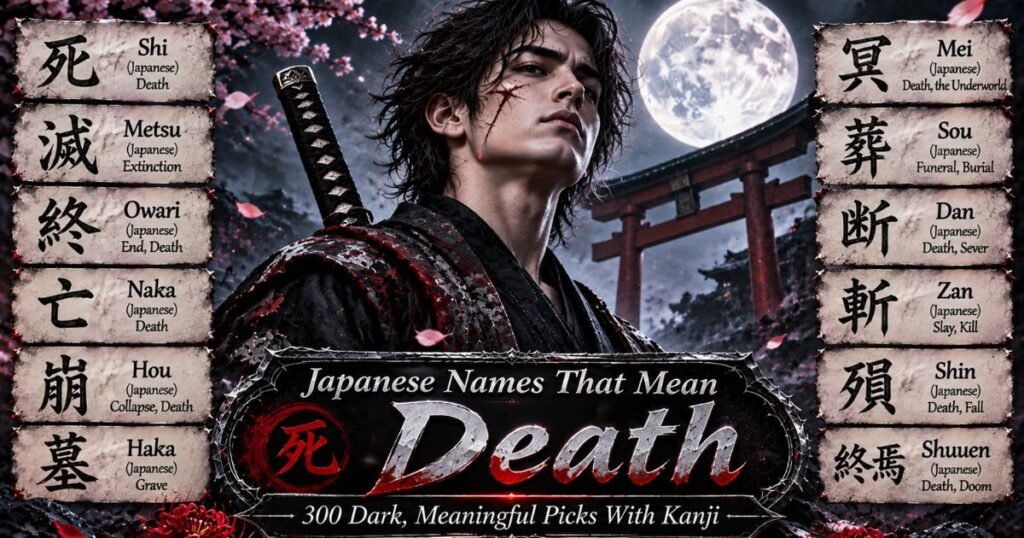
Japanese Girl Names That Mean Death
- Yomika (黄泉花) — “Flower of Yomi.” A soft ending on an underworld root.
- Yomiko (黄泉子) — “Child of Yomi.” The -ko ending makes it sound classic.
- Mei (冥) — “Dark, netherworld.” One syllable, same kanji as Meifu. Mei is also written with many other kanji.
- Meiko (冥子) — “Child of the netherworld.” Meiko is a common name when written with other kanji.
- Meika (冥華) — “Netherworld blossom.”
- Meina (冥奈) — “Dark grace.” The last kanji adds sound, not meaning.
- Yūko (幽子) — “Faint child,” soft and ghostly.
- Yūka (幽香) — “Faint fragrance,” like incense drifting.
- Yūri (幽里) — “Hidden village,” a quiet place beyond the world.
- Rei (霊) — “Spirit.” Strong, short, and flexible.
- Reiko (霊子) — “Spirit child.”
- Reina (霊奈) — “Spirit grace.”
- Reika (霊花) — “Spirit flower.”
- Reimi (霊美) — “Beautiful spirit.”
- Tamako (魂子) — “Soul child.”
- Tamae (魂恵) — “Blessed soul.”
- Tamami (魂美) — “Beautiful soul.”
- Mitama (御霊) — “Honored spirit,” a Shinto word for the spirits of the dead.
- Sayo (小夜) — “Small night.” Sounds like a lullaby.
- Tsuya (通夜) — “Passing the night,” the funeral wake.
- Yoru (夜) — “Night.”
- Yami (闇) — “Darkness.”
- Yamiko (闇子) — “Child of darkness.”
- Yamika (闇花) — “Dark flower.”
- Kageko (影子) — “Shadow child.”
- Kurohana (黒花) — “Black flower.”
- Kuroha (黒羽) — “Black feather,” a crow’s feather.
- Tsukiyo (月夜) — “Moonlit night.”
- Nagori (名残) — “Lingering trace,” what remains after a farewell.
- Nokoka (残香) — “Lingering scent.” A creative reading of a real word.
- Sōka (葬花) — “Burying flowers,” from the Chinese novel Dream of the Red Chamber, where Lin Daiyu buries fallen petals.
- Shion (紫苑) — The aster. An old tale in the Konjaku Monogatari collection links it to remembering a lost parent.
- Shizuka (静) — “Quiet,” often tied to a peaceful passing.
- Kaguya (輝夜) — The moon princess who leaves the earth in the Tale of the Bamboo Cutter.
- Hotaru (蛍) — “Firefly.” Folklore often sees fireflies as souls of the dead.
- Aika (哀歌) — “Elegy,” a song of grief.
- Banka (挽歌) — “Dirge,” a funeral song.
- Hakumei (薄命) — “Short-lived,” from the saying that beautiful people die young.
- Kagerō (蜻蛉) — “Mayfly.” Also the title of a 10th-century court diary, Kagerō Nikki.
- Tsuyu (露) — “Dew,” a classic symbol of fleeting life.
- Setsuna (刹那) — “An instant,” the Buddhist word for the shortest moment.
- Kurenai (紅) — “Crimson.”
- Wakare (別) — “Parting,” farewell.
- Yūzuki (夕月) — “Evening moon.”
- Tasogare (黄昏) — “Twilight,” the hour when the living and the dead are said to blur.
- Kiri (霧) — “Mist,” the veil in many ghost tales.
- Yūgao (夕顔) — The Genji lady who dies suddenly after a spirit attacks her.
- Aoi (葵) — Lady Aoi in Genji, who dies after being possessed by a living spirit.
- Kiritsubo (桐壺) — Genji’s mother, whose death opens the novel.
- Utakata (泡沫) — “Foam,” a symbol of life’s brevity in the Hōjōki (1212).
Japanese Boy Names That Mean Death
- Meiō (冥王) — “King of the netherworld.” Meiōsei (冥王星) is the Japanese name for Pluto.
- Meiya (冥夜) — “Netherworld night.”
- Meikai (冥界) — “The realm of the dead.”
- Reiji (霊児) — “Spirit boy.”
- Reiya (霊也) — “Spirit.” The -ya ending is a common boy’s suffix.
- Reito (霊斗) — “Spirit,” with a modern -to ending.
- Yūto (幽人) — “Hidden person.”
- Yūya (幽夜) — “Dim night.”
- Yūgen (幽玄) — “Profound mystery,” a key ideal of Noh theatre shaped by the actor Zeami.
- Kon (魂) — “Soul.”
- Tamahiko (魂彦) — “Soul prince.”
- Yamito (闇人) — “Person of darkness.”
- Yamiya (闇夜) — “Dark night.”
- Yamikage (闇影) — “Shadow of darkness.”
- Kage (影) — “Shadow.”
- Kageto (影人) — “Shadow person.”
- Kagemaru (影丸) — “Shadow,” with the old-style -maru ending.
- Kuro (黒) — “Black.”
- Kuroya (黒夜) — “Black night.”
- Kuroto (黒斗) — “Black,” in a modern style.
- Gen (玄) — “Mystery, deep black.”
- Genya (玄夜) — “Mysterious night.”
- Jisei (辞世) — “Farewell to the world,” the death poem that samurai and monks wrote before dying.
- Bōya (亡夜) — “Night of the departed.”
- Haku (白) — “White,” the color of burial robes.
- Hakuya (白夜) — “White night.”
- Ren (蓮) — “Lotus,” a symbol of rebirth in the Pure Land.
- Gō (業) — “Karma,” the deeds that shape rebirth.
- Kaimyō (戒名) — The posthumous Buddhist name given to the dead.
- Sotoba (卒塔婆) — The tall wooden slats placed at graves.
- Amida (阿弥陀) — The Buddha who welcomes souls to the Pure Land.
- Raigō (来迎) — “Welcoming descent,” when Amida appears at a deathbed in Buddhist art.
- Kūkai (空海) — The monk (774–835) whom followers believe still meditates at Okunoin on Mount Kōya.
- Takamura (篁) — Ono no Takamura (802–853), said in legend to visit hell by night through a well to serve Enma.
- Tōrō (灯籠) — “Lantern,” as in the floating lanterns of Obon.
- Mukaebi (迎え火) — The “welcoming fire” lit to guide spirits home.
- Okuribi (送り火) — The “sending-off fire,” like Kyoto’s Daimonji bonfire.
- Shūen (終焉) — “The end.”
- Shūya (終夜) — “All night,” as in a funeral vigil.
- Matsugo (末期) — “Last moments,” linked to the “last water” ritual for the dying.
- Rinjū (臨終) — The moment of death.
- Seiya (逝夜) — “Night of passing.” A creative combination.
- Takeru (建) — The prince Yamato Takeru, whose spirit flew off as a white bird in the Kojiki. The kanji vary (建, 尊, 猛).
- Naozane (直実) — Kumagai Naozane, the samurai who killed young Atsumori and later became a monk.
- Michizane (道真) — Sugawara no Michizane (845–903), an exiled scholar feared as a vengeful spirit, then honored as the god of learning.
- Masakado (将門) — Taira no Masakado (d. 940), a rebel whose severed head is said to have flown home.
- Sutoku (崇徳) — Emperor Sutoku (1119–1164), exiled and long believed to haunt the capital.
- Hōichi (芳一) — The blind biwa player who performs for ghosts in Hearn’s Kwaidan.
- Atsumori (敦盛) — The young Taira warrior killed in 1184, hero of a famous Noh play.
- Okuribito (送り人) — “One who sends off,” the Japanese title of Departures.
Unisex Japanese Names That Mean Death
- Shinobu (偲) — “To remember fondly,” especially the dead.
- Mitori (看取) — “Caring for someone to the end.”
- Okuri (送) — “Sending off.”
- Shi (死) — “Death.” The plain word, better for pen names than real children.
- Bō (亡) — “The departed.”
- Sei (逝) — “To pass away.”
- Mo (喪) — “Mourning.”
- Chō (弔) — “Condolence, mourning.”
- Sō (葬) — “Burial.”
- Haka (墓) — “Grave.”
- Hai (灰) — “Ash.”
- Kemuri (煙) — “Smoke,” from incense or a pyre.
- Kō (香) — “Incense,” offered to the dead.
- Rin (鈴) — “Bell,” the small bell struck at Buddhist altars.
- Oboro (朧) — “Hazy,” like a moon behind mist.
- Utsuro (虚) — “Hollow, empty.”
- Mu (無) — “Nothingness,” a Zen idea.
- Kū (空) — “Emptiness” in Buddhism.
- Chiru (散) — “To scatter,” like falling petals.
- Ochiba (落葉) — “Fallen leaves.”
- Kuchiba (朽葉) — “Rotting leaves.”
- Karasu (烏) — “Crow,” a folk omen of death.
- Kotsu (骨) — “Bone.” Japanese funerals include a bone-picking ritual after cremation.
- Mukuro (骸) — “Remains.”
- Kabane (屍) — “Corpse.”
- Tomurai (弔い) — “Mourning rites.”
- Kakure (隠れ) — “Hidden,” a polite euphemism for a noble’s death.
- Metsu (滅) — “To perish.”
- Shūmatsu (終末) — “The end times.”
- Zetsu (絶) — “To cut off, to die out.”
Japanese Death Flower Names
- Higanbana (彼岸花) — The red spider lily, the most famous death flower in Japan.
- Manjushage (曼珠沙華) — The Buddhist name for the same flower, a heavenly bloom in the sutras.
- Shibitobana (死人花) — “Corpse flower,” a folk nickname.
- Hōzuki (鬼灯) — The Chinese lantern plant, whose orange lanterns guide Obon spirits.
- Kiku (菊) — The chrysanthemum, a standard funeral flower.
- Shiragiku (白菊) — “White chrysanthemum.”
- Yuri (百合) — The lily, often seen at funerals.
- Shirayuri (白百合) — “White lily.”
- Tsubaki (椿) — The camellia, whose flower falls whole. Some avoid it as a gift for the sick.
- Sakura (桜) — Cherry blossom, loved because it falls so fast.
- Hasu (蓮) — The lotus, which rises pure from mud, a symbol of rebirth.
- Renge (蓮華) — “Lotus flower,” seen on Buddhist altars.
- Wasuregusa (忘れ草) — “Grass of forgetting,” which old poems say helps you forget grief.
- Sakaki (榊) — A sacred tree whose branches are offered in Shinto rites, including funerals.
- Shikimi (樒) — The Japanese star anise, a toxic tree planted at graves and placed on altars.
- Hagi (萩) — Bush clover. The sweet ohagi is offered during Higan.
- Asagao (朝顔) — The morning glory, a flower that lasts one morning.
- Mukuge (木槿) — The rose of Sharon, whose blossoms last a single day.
- Momiji (紅葉) — Autumn maple leaves.
- Yanagi (柳) — The willow, where Edo-era ghosts often stand in prints.
- Momo (桃) — The peach. In the Kojiki, Izanagi threw peaches to drive off his Yomi pursuers.
- Ume (梅) — The plum. Legend says Michizane’s plum tree flew to his place of exile.
- Higanzakura (彼岸桜) — “Equinox cherry,” which blooms around the Higan season.
- Tsuyukusa (露草) — “Dew grass,” a dayflower that blooms for only hours.
- Gekka (月下) — “Under the moon,” from gekka bijin, the cactus that blooms for one night.
Dark Japanese Names: Death Angel, Death Bringer and Shadow
- Ankoku (暗黒) — “Pitch darkness.”
- Kurayami (暗闇) — “Gloom, the dark.”
- Shikkoku (漆黒) — “Jet black.”
- Shin’en (深淵) — “Abyss.”
- Naraku (奈落) — “Bottomless pit,” from the Sanskrit word for hell.
- Yamigami (闇神) — “Dark god.”
- Maō (魔王) — “Demon king.”
- Akuma (悪魔) — “Devil.” Fine for fiction, but a Tokyo court once refused it as a real boy’s name.
- Kishin (鬼神) — “Demon god.”
- Shura (修羅) — The asura realm of endless fighting.
- Taizan (泰山) — Short for Taizan Fukun, a god of Mount Tai called on in Onmyōdō rites to extend life.
- Tenshi (天使) — “Angel.” Pair it with shi no for “angel of death.”
- Yamitenshi (闇天使) — “Dark angel.”
- Shikaku (刺客) — “Assassin.”
- Kuroba (黒刃) — “Black blade.”
- Yaiba (刃) — “Blade.”
- Hōmuru (葬る) — “To bury,” or to wipe out.
- Shōmetsu (消滅) — “Vanishing, extinction.”
- Hametsu (破滅) — “Ruin.”
- Kyomu (虚無) — “The void, nihilism.”
- Mōja (亡者) — The souls of the dead, especially in hell.
- Shisha (使者) — “Messenger.” It sounds the same as 死者 (“the dead”), so shi no shisha means “messenger of death.”
- Muramasa (村正) — The swordsmith whose blades were said to be cursed.
- Jakumetsu (寂滅) — A Buddhist term for nirvana, “calm extinction.”
- Nyūmetsu (入滅) — “Entering extinction,” used for the death of the Buddha.
- Ōjō (往生) — Dying and being reborn in the Pure Land.
- Zetsumei (絶命) — “To breathe one’s last.”
- Saigo (最期) — “One’s final moments.”
- Matsuro (末路) — “Final fate.”
- Kiseki (鬼籍) — The “register of the dead.” To enter it means to die.
- Yūmei (幽冥) — The dim world beyond.
- Kōsen (黄泉) — An alternate reading of Yomi, the “yellow springs.”
- Gaikotsu (骸骨) — “Skeleton.”
- Dokuro (髑髏) — “Skull.”
- Iei (遺影) — The portrait of the deceased shown at a funeral.
Japanese Last Names That Mean Death
Real Japanese surnames rarely mention death outright. What you find instead are surnames built from kanji for burial mounds, demons, shadows, lotus flowers, and funeral chrysanthemums, plus place names tied to the afterlife. The first 25 below are real surnames. The second 25 are historic places, legends, and folklore figures that work well as creative surnames.
Real Japanese Surnames With Grave, Demon and Shadow Kanji
- Tsukamoto (塚本) — “Base of the mound.” The kanji 塚 often marks a burial mound.
- Tsukada (塚田) — “Mound field.”
- Tsukahara (塚原) — “Mound plain,” the name of the swordmaster Bokuden Tsukahara (1489–1571).
- Tsukagoshi (塚越) — “Beyond the mound.”
- Tsukasaki (塚崎) — “Mound cape.”
- Onizuka (鬼塚) — “Demon mound.”
- Onizawa (鬼沢) — “Demon marsh.”
- Onitsuka (鬼束) — “Demon bundle.”
- Onimaru (鬼丸) — “Demon circle,” also the name of the famed sword Onimaru Kunitsuna.
- Kageyama (影山) — “Shadow mountain.”
- Kurosawa (黒澤) — “Black marsh.”
- Kuroda (黒田) — “Black field.”
- Kurokawa (黒川) — “Black river.”
- Kuroiwa (黒岩) — “Black rock.”
- Kuroki (黒木) — “Black tree.”
- Kirishima (霧島) — “Mist island.”
- Tsuyuki (露木) — “Dew tree,” echoing life as dew.
- Hasumi (蓮見) — “Lotus view.”
- Hasuike (蓮池) — “Lotus pond.”
- Hasunuma (蓮沼) — “Lotus swamp.”
- Kikuchi (菊池) — “Chrysanthemum pond.”
- Kikuta (菊田) — “Chrysanthemum field.”
- Shiratori (白鳥) — “White bird,” like the bird Yamato Takeru became.
- Shirakawa (白川) — “White river.”
- Shioda (塩田) — “Salt field.” Mourners receive purifying salt after funerals.
Place Names and Folklore Names for Creative Surnames
- Adashino (化野) — A historic Kyoto burial ground, home to thousands of stone Buddhas at Adashino Nenbutsu-ji.
- Toribeno (鳥辺野) — Another old Kyoto burial ground.
- Rendaino (蓮台野) — The third great burial ground of Heian-era Kyoto.
- Osorezan (恐山) — “Mount Fear” in Aomori, long seen as a gate to the afterlife.
- Jigokudani (地獄谷) — “Hell Valley,” a name given to several steaming valleys.
- Okunoin (奥之院) — The cemetery on Mount Kōya with more than 200,000 tombstones.
- Kōyasan (高野山) — Mount Kōya, the center of Shingon Buddhism.
- Yomotsuhirasaka (黄泉比良坂) — The legendary slope to Yomi, linked to a site in Shimane.
- Sanzugawa (三途川) — The River of Three Crossings.
- Miyajima (宮島) — The sacred island where, by tradition, no one was allowed to be born or die.
- Rashōmon (羅城門) — Kyoto’s southern gate, where old tales say corpses were abandoned.
- Rokudō (六道) — The “six paths” of rebirth. Rokudō Chinnō-ji in Kyoto marks a crossing between worlds.
- Daimonji (大文字) — The “great character” bonfire that sends spirits off each August.
- Kubizuka (首塚) — “Head mound,” the name of Masakado’s memorial in Tokyo.
- Kitsunezuka (狐塚) — “Fox mound.”
- Hyakki (百鬼) — “Hundred demons,” from the night parade of spirits.
- Gokurakuji (極楽寺) — “Paradise temple.”
- Jōdo (浄土) — The Pure Land.
- Kumano (熊野) — A region seen as a gateway to the afterlife, now a UNESCO pilgrimage route.
- Izumo (出雲) — The shrine region where the god Ōkuninushi is said to rule unseen matters, often read as the afterlife.
- Tōno (遠野) — Home of the Tōno Monogatari (1910) folklore collection.
- Yanagita (柳田) — Kunio Yanagita, founder of Japanese folklore studies.
- Koizumi (小泉) — The surname Lafcadio Hearn took in Japan.
- Yakumo (八雲) — “Eight clouds,” Hearn’s Japanese given name.
- Ueda (上田) — Ueda Akinari, author of the ghost tales Ugetsu Monogatari (1776).
You May Also Read: Names That Mean Spirit: 250 Soulful Ideas With Origins and Meanings.
Final Thoughts
Japanese names that mean death are not really about fear. They come from a culture that honors the dead, watches the seasons turn, and finds beauty in things that end. From Yomi and Izanami to Hotaru and Utakata, every name here carries a story you can check. Pick the one that fits your character, your username, or your own dark taste, and confirm the kanji first. Bookmark this guide, share it with a fellow writer, and tell us your favorite pick in the comments.
FAQs
Is there a Japanese name that means death?
Not in a literal, everyday sense. The plain word for death, shi (死), is almost never used in real given names. But many names carry death-related meanings through words for spirits, the underworld, and mourning, such as Yomi (黄泉), Rei (霊), and Mei (冥). For fiction and games, direct options like Shinigami work well.
What does Shinigami mean in Japanese?
Shinigami (死神) means “death god.” It joins shi (死, death) with kami (神, god or spirit). It describes a being who guides, summons, or claims the dying. The figure comes from folk belief, storytelling, and modern manga, while the Kojiki’s own ruler of the dead is the goddess Izanami.
What is the Japanese word and kanji for death?
The Japanese word for death is shi, written 死. The verb “to die” is shinu (死ぬ). Because shi sounds like the number four, many people avoid it in daily life. Softer terms include eimin (永眠, eternal sleep) and zetsumei (絶命, breathing one’s last).
What Japanese names mean ghost or spirit?
Good choices include Rei (霊, spirit), Yūrei (幽霊, ghost), Tamako (魂子, soul child), Mitama (御霊, honored spirit), and Reikon (霊魂, soul). Yūrei, onryō, and hitodama come from long folk traditions. Rei is the easiest of these to use as a real given name.
Can you legally give a baby a death-related name in Japan?
It depends on the name. Japanese law limits names to approved kanji and kana, and officials can refuse names judged to abuse parental naming rights. A widely reported early-1990s Tokyo case rejected Akuma (悪魔). Soft symbolic names like Rei, Shion, or Kaguya are far safer. Confirm with your local registry office.