
350 Girl Names That Mean Magic: Enchanting Ideas With Meanings
Picture a name that sounds like moonlight on still water. That is the pull of girl names that mean magic. Some carry the word itself, like Taika in Finnish. Others borrow their spell from myth, fairy tales, stars, or herbs. When we sort names for families, we see the same pattern: parents want a meaning they can explain in one sentence and a sound they can say with a smile. Below you will find 350 names with origins, grouped by theme, plus simple tips for choosing the right one.
What Female Name Means Magic? Girl Names That Mean Magic Directly
Few names have “magic” as their dictionary meaning, so this list is the heart of the article. Name meanings vary by language, and many names have more than one root. We list the most widely cited magical sense for each. Names like Merlyn nod to Merlin, the legendary wizard. Others, like Runa and Gondul, come from Old Norse, where magic and secret knowledge were closely linked. Roman writers such as Tacitus also recorded Germanic seeresses named Veleda and Albruna.
- Maya – Sanskrit: illusion, magic (māyā)
- Kimaya – Indian: magic, sleight of hand
- Taika – Finnish: magic, spell
- Bormey – Khmer: magical power
- Kesem – Hebrew: magic, charm, enchantment
- Mohini – Sanskrit: enchantress, one who bewitches
- Mohana – Sanskrit: enchanting, bewitching
- Afsoon – Persian: enchantment, spell (afsun)
- Fatina – Arabic: captivating, enchanting
- Maftuna – Uzbek and Persian, from Arabic: enchanted, captivated
- Dilruba – Persian and Urdu: heart-stealer, enchanting one
- Karishma – Hindi: miracle, wonder
- Vismaya – Sanskrit: wonder, amazement
- Milagros – Spanish: miracles
- Siddhi – Sanskrit: supernatural power, accomplishment
- Shakti – Sanskrit: power, divine energy
- Mana – Polynesian: spiritual power, supernatural force
- Orenda – Iroquoian: spiritual power, magical energy
- Runa – Old Norse: secret lore, rune
- Sigrun – Old Norse: victory secret; a Valkyrie name
- Gondul – Old Norse: wand-wielder; a Valkyrie name
- Albruna – Germanic: elf secret; a seeress recorded by Roman writers
- Veleda – Germanic seeress mentioned by Tacitus
- Ganna – Germanic seeress noted in Roman accounts
- Merlyn – Feminine take on Merlin, the legendary wizard
- Carmen – Latin: song; in old Latin also a charm or incantation
- Charmaine – Variant of Charmian, from Greek “joy”; often heard as “charm”
- Mirabel – Latin: wonderful
- Mirabella – Latin: wonderful and beautiful
- Miranda – Latin: worthy of wonder; heroine of Shakespeare’s The Tempest, set on a magician’s island
- Magia – Italian and Spanish: magic (rare as a name)
- Mira – Latin: wonder, marvel (also Slavic: peace)
- Arcana – Latin: secrets, mysteries

Witch, Sorceress, and Enchantress Girl Names
Witch names come from three sources: ancient myth, old romances, and modern stories. Circe and Medea are sorceresses from Greek myth. Hecate was the Greek goddess of witchcraft and crossroads. Morgana, from the Arthurian legends, is better known as Morgan le Fay. Alcina, Armida, and Melissa come from Italian Renaissance epics. Aradia comes from Charles Leland’s 1899 book on Italian witch lore. Modern picks like Hermione and Sabrina bring a friendlier, wearable kind of spell.
- Circe – Greek sorceress of the Odyssey who turns men into animals
- Medea – Greek sorceress who helped Jason win the Golden Fleece
- Hecate – Greek goddess of witchcraft and crossroads
- Morgana – Arthurian enchantress, Morgan le Fay
- Morgause – Arthurian sorceress, sister of Morgan le Fay
- Nimue – Arthurian Lady of the Lake who enchants Merlin
- Viviane – Arthurian Lady of the Lake; French form of Vivian, “alive”
- Alcina – Enchantress of a magic island in Orlando Furioso
- Armida – Sorceress in Tasso’s Jerusalem Delivered
- Melissa – Greek: honeybee; also a kind sorceress in Orlando Furioso
- Pasiphaë – Greek: shining for all; sorceress queen of Crete
- Aradia – Witch figure in Leland’s Aradia, or the Gospel of the Witches (1899)
- Endora – Witch mother on the TV series Bewitched
- Samantha – Likely Aramaic: listener; the witch heroine of Bewitched
- Tabitha – Aramaic: gazelle; the witch daughter on Bewitched
- Sabrina – Latin name of the River Severn; the teenage witch of comics and TV
- Hermione – Greek, feminine of Hermes; Harry Potter’s brilliant witch
- Minerva – Roman goddess of wisdom; Professor McGonagall’s first name
- Agatha – Greek: good; borne by witches in modern TV and comics
- Glinda – The Good Witch of Oz; a name invented by L. Frank Baum
- Elphaba – Wicked Witch of the West in Wicked; built from Baum’s initials (L-F-B)
- Matilda – Germanic: mighty in battle; Roald Dahl’s telekinetic heroine
- Sophie – Greek: wisdom; heroine of Howl’s Moving Castle
- Elsa – Scandinavian short form of Elisabeth; the ice-magic queen of Frozen
- Galadriel – Tolkien’s Sindarin: maiden crowned with radiance; elven lady of Lothlórien
- Lúthien – Tolkien’s Elf-maiden whose songs wove enchantment
- Melian – Tolkien’s Maia queen whose enchanted Girdle guarded Doriath
- Bellatrix – Latin: female warrior; a star in Orion and a Harry Potter dark witch
- Nymphadora – Greek: gift of the nymph; Harry Potter’s shape-shifting auror
- Rowena – Origin uncertain; the founder of Ravenclaw
- Helga – Old Norse: holy; the founder of Hufflepuff
- Belladonna – Italian: beautiful lady; the nightshade of old witch lore
- Raven – English: the bird of omens and prophecy lore
- Salem – Hebrew: peace; the town famous for the 1692 witch trials
- Thessaly – Greek region long famous for its witches
- Lilith – From Mesopotamian lilitu spirits; a night figure in Jewish folklore
- Ursula – Latin: little she-bear; Disney’s sea witch
- Daenerys – Coined by George R. R. Martin; dragon-hatching queen
- Melisandre – Form of Melisande; the Red Priestess of A Song of Ice and Fire
- Fleur – French: flower; part-Veela champion in Harry Potter
- Angelica – Latin: angelic; princess with a magic ring in Orlando Furioso
- Igraine – Arthurian mother of Arthur; Merlin’s magic disguised Uther as her husband
Celtic, Norse, Slavic, and Arthurian Girl Names That Mean Magic
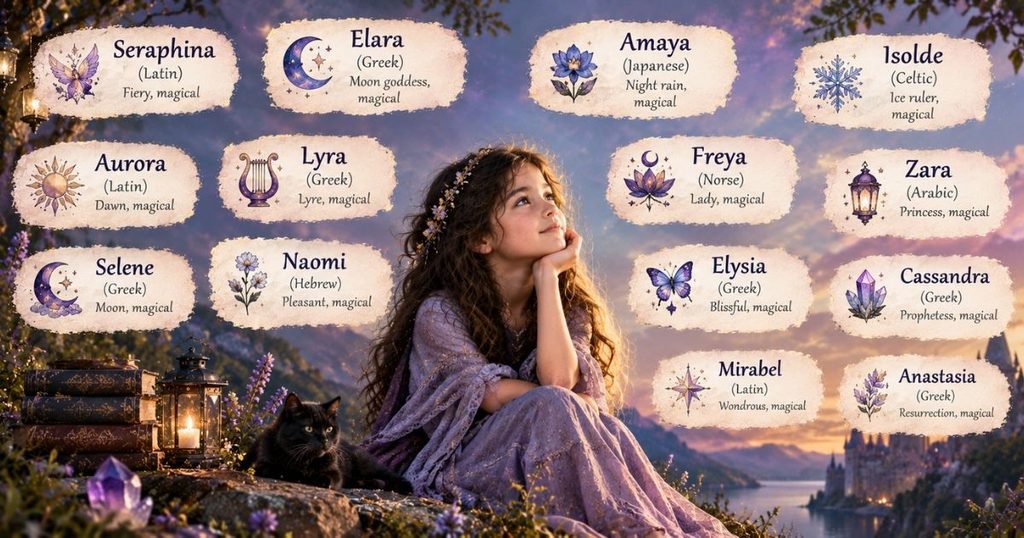
Northern and Celtic myths are full of enchantresses, shape-shifters, and fate-weavers. Freya was linked to seiðr, a form of Norse magic. Cerridwen stirred the cauldron of inspiration in Welsh legend. Blodeuwedd was conjured from flowers by magicians in the Mabinogi. Irish names like Fionnuala and Étaín tell of curses, swans, and rebirth. The Arthurian cycle, home to Merlin and Morgan le Fay, adds names such as Guinevere and Luned.
- Freya – Old Norse: lady; goddess tied to seiðr magic
- Frigg – Norse queen of the gods, said to know every fate
- Idunn – Norse keeper of the apples of youth
- Sif – Norse goddess whose golden hair was forged by dwarves
- Skuld – Norse norn of the future
- Urd – Norse norn of the past; name linked to “fate”
- Brynhild – Old Norse: armored battle; Valkyrie sleeping inside a ring of magic fire
- Embla – First woman of Norse myth, shaped from a tree
- Sunna – Old Norse and Old High German: sun; named in the Merseburg Charms
- Edda – Title of the Icelandic books that preserve Norse myth
- Cerridwen – Welsh enchantress of the cauldron of inspiration
- Arianrhod – Welsh: silver wheel; goddess who laid destinies on her son
- Blodeuwedd – Welsh: flower face; woman conjured from flowers
- Rhiannon – Welsh: great queen; her magical birds could wake the dead
- Epona – Celtic goddess of horses
- Niamh – Irish: radiance; fairy princess of Tír na nÓg
- Aine – Irish: radiance; goddess linked to summer and fairy lore
- Morrigan – Irish: great queen or phantom queen; shape-shifting goddess
- Brigid – Irish: exalted one; goddess of poetry, smithcraft, and healing
- Danu – Irish mother goddess of the Tuatha Dé Danann, the magical folk
- Maeve – Irish: she who intoxicates; the warrior queen Medb
- Etain – Irish heroine transformed by sorcery and reborn
- Fionnuala – Irish: white shoulder; turned into a swan by a spell
- Olwen – Welsh: white footprint; white clover sprang where she walked
- Branwen – Welsh: white raven; heroine of the Mabinogi
- Sadhbh – Irish: sweet; turned into a deer by a druid’s spell
- Guinevere – Welsh: white phantom; Arthur’s queen
- Isolde – Celtic origin uncertain; heroine of the love-potion legend
- Luned – Welsh Arthurian maiden who gave Owain a ring of invisibility
- Avalon – The legendary Arthurian isle where Arthur was taken to heal
- Arwen – Tolkien’s Sindarin: noble maiden
- Tinúviel – Tolkien’s Sindarin: nightingale; Lúthien’s second name
- Louhi – Witch-queen of the Finnish Kalevala
- Ilmatar – Finnish: spirit of the air; creator figure in the Kalevala
- Laima – Baltic goddess of fate and luck
- Vasilisa – Greek: queen; Russian fairy-tale heroine helped by an enchanted doll
- Vesna – Slavic: spring; goddess of spring
- Morana – Slavic goddess of winter, driven out in spring rites
Greek, Roman, and Ancient World Girl Names Linked to Magic
Ancient cultures treated magic, prophecy, and fate as real forces, and their stories left behind beautiful names. Isis was called “great of magic” in Egypt. Greek myth gave us oracles like Sibyl and Pythia. It also gave us transformation tales like Daphne, Arethusa, and Arachne. Roman Carmenta ruled prophecy and charms. Asian and Mesoamerican names, such as Chang’e and Ixchel, add moon goddesses and healers to the list.
- Isis – Egyptian goddess called “great of magic”
- Isadora – Greek: gift of Isis
- Nephthys – Egyptian: lady of the house; goddess who aided Isis in sacred rites
- Ishtar – Mesopotamian goddess of love and war
- Inanna – Sumerian: lady of heaven
- Galatea – Greek: milk-white; the statue brought to life in the Pygmalion myth
- Pandora – Greek: all gifts; the first woman, keeper of the famous jar
- Persephone – Greek queen of the underworld
- Calypso – Greek: she who conceals; enchantress nymph who held Odysseus
- Ariadne – Greek: most holy; her thread led Theseus out of the labyrinth
- Cassandra – Trojan prophetess whose true visions went unheard
- Sibyl – Greek prophetess, an oracle
- Pythia – Title of the priestess of Delphi
- Delphine – French: from Delphi, home of the famous oracle
- Manto – Greek: seer; prophetess daughter of Tiresias
- Themis – Greek: divine law; Titaness who held the Delphic oracle before Apollo
- Psyche – Greek: soul, breath; heroine of Cupid and Psyche
- Echo – Greek nymph who could only repeat the last words spoken
- Daphne – Greek: laurel; nymph turned into a laurel tree
- Arethusa – Greek nymph transformed into a spring
- Eurydice – Greek: wide justice; Orpheus tried to win her back with enchanted music
- Nephele – Greek: cloud; a nymph shaped from cloud by Zeus
- Thetis – Greek sea nymph who could shape-shift
- Arachne – Greek: spider; weaver turned into a spider by Athena
- Parthenope – Greek: maiden-voiced; a siren of myth
- Athena – Greek goddess of wisdom and craft
- Aphrodite – Greek goddess of love whose girdle made her irresistible
- Juno – Roman queen of the gods
- Vesta – Roman goddess of the hearth, whose sacred flame never went out
- Egeria – Roman nymph who counseled King Numa
- Carmenta – Roman goddess of prophecy and charms
- Fortuna – Latin: luck; Roman goddess of fortune
- Moira – Greek: fate, share
- Tyche – Greek: luck, fortune; goddess of chance
- Gaia – Greek: earth; the primordial earth goddess
- Chang’e – Chinese moon goddess who drank the elixir of immortality
- Kaguya – Japanese: shining night; the moon princess of The Tale of the Bamboo Cutter
- Amaterasu – Japanese: shining over heaven; sun goddess
- Anahita – Persian: immaculate; goddess of waters
- Ixchel – Maya goddess of the moon and healing
- Menaka – Celestial nymph (apsara) of Hindu myth
- Urvashi – Sanskrit apsara; celestial nymph
- Gayatri – Sanskrit: a sacred mantra; goddess form of a Vedic hymn
Fairy and Fairy-Tale Girl Names With a Magical Touch
Fairy names feel light, wild, and a little mischievous. Faye comes from Old French fae, “fairy.” Aubrey and Elfrida both come from old Germanic words for elves. Persian pari and peri give us Pari, Peri, and Parisa, all linked to fairies. Fairy-tale heroines like Belle, Alice, and Dorothy bring a storybook feel that kids already love.
- Faye – Old French: fairy (fae)
- Titania – Fairy queen of A Midsummer Night’s Dream
- Mab – Queen Mab, fairy of English folklore
- Oonagh – Irish fairy queen of folklore
- Aubrey – Germanic: elf ruler
- Elfrida – Old English: elf strength
- Alva – Old Norse and Swedish: elf
- Alvina – Old English: elf friend
- Pixie – English: folklore sprite
- Ariel – Hebrew: lion of God; airy spirit of The Tempest
- Nixie – Germanic: water sprite
- Ondine – From Latin unda: wave; water spirit
- Selkie – Scots: seal-folk who shed their skins to become women
- Lorelei – German: named for the Rhine rock; the legendary siren
- Ligeia – Greek: clear-voiced; a siren, and the title of Poe’s tale
- Melusine – French folklore water spirit who is half serpent
- Pari – Persian: fairy
- Peri – Persian and Turkish: fairy; winged spirits of Persian lore
- Parisa – Persian: like a fairy
- Tünde – Hungarian: fairy; popularized by a 19th-century poet
- Diwata – Filipino: nature spirit, fairy
- Afsaneh – Persian: fable, legend
- Una – Latin: one; heroine of The Faerie Queene
- Gloriana – Faerie queen in Spenser’s epic; from Latin “glory”
- Briar – English: thorny shrub; the Briar Rose of Sleeping Beauty
- Odette – French, from Old German “wealth”; swan princess enchanted by a sorcerer
- Odile – French: wealth; the black swan in Swan Lake
- Belle – French: beautiful; heroine of the enchanted-castle tale
- Alice – Old French: noble; heroine of Wonderland
- Dorothy – Greek: gift of God; carried to Oz by a tornado
- Gerda – Norse: protected; heroine of The Snow Queen
- Gretel – German short form of Margarete, “pearl”; outwitted a witch
- Rapunzel – German: rampion, a salad plant; the tower princess of the fairy tale
- Jasmine – Persian: fragrant flower; heroine of the Aladdin story
- Coraline – Variant of Coralie; Neil Gaiman’s heroine who finds a hidden door
- Giselle – Germanic: pledge; ballet heroine who joins the spirit-brides
- Clara – Latin: bright; heroine of The Nutcracker, where toys come alive
- Lucy – Latin: light; the first to step through the wardrobe into Narnia
- Scheherazade – Persian: noble lineage (disputed); storyteller of the Arabian Nights
- Amalthea – Greek: nurse of Zeus; the unicorn’s human name in The Last Unicorn

Celestial Girl Names That Mean Magic: Moon and Star Names
Moon and star names feel magical because people have looked to the sky for meaning for thousands of years. Sailors, farmers, and storytellers all used the stars as guides. That history gives these names depth along with their shine.
Moon and Night Goddess Names
- Luna – Latin: moon
- Selene – Greek: moon; the moon goddess
- Artemis – Greek goddess of the moon and the hunt
- Diana – Latin: divine; Roman goddess of the moon and hunt
- Phoebe – Greek: bright, radiant; a Titaness linked to the moon
- Cynthia – Greek: from Mount Cynthus; an epithet of Artemis
- Theia – Greek: goddess; Titaness of shining light, mother of Selene
- Asteria – Greek: starry one; Titaness of falling stars and night prophecy
- Astraea – Greek: star-maiden; goddess of justice who became the constellation Virgo
- Urania – Greek: heavenly; muse of astronomy
- Nyx – Greek: night; primordial goddess of night
Dawn, Star, and Constellation Names
- Eos – Greek: dawn; goddess of dawn
- Aurora – Latin: dawn
- Usha – Sanskrit: dawn; Vedic dawn goddess
- Zorya – Slavic: dawn; guardian goddesses of dawn and dusk
- Stella – Latin: star
- Estelle – Old French: star
- Estrella – Spanish: star
- Étoile – French: star
- Seren – Welsh: star
- Citlali – Nahuatl: star
- Najma – Arabic: star
- Setareh – Persian: star
- Sitara – Hindi and Urdu: star
- Tara – Sanskrit: star
- Nakshatra – Sanskrit: star, lunar mansion
- Arundhati – Sanskrit: the small star Alcor, pointed out in a Hindu wedding custom
- Chandra – Sanskrit: moon
- Chandni – Hindi: moonlight
- Chandrika – Sanskrit: moonlight
- Kumudini – Sanskrit: night-blooming water lily
- Indu – Sanskrit: moon, bright drop
- Jyotsna – Sanskrit: moonlight
- Rohini – Sanskrit: the star Aldebaran; the moon’s favorite wife in Hindu myth
- Mahtab – Persian: moonlight
- Mahsa – Persian: like the moon
- Danica – Slavic: morning star
- Lucero – Spanish: bright star, morning star
- Venus – Latin: love; Roman goddess and the planet
- Celeste – Latin: heavenly
- Elara – Greek: lover of Zeus; a moon of Jupiter
- Lyra – Greek: lyre; the constellation
- Vega – Arabic: the swooping eagle; a bright star in Lyra
- Cassiopeia – Greek: vain queen of myth; the constellation
- Andromeda – Greek: chained princess saved by Perseus; the galaxy
- Alcyone – Greek: kingfisher; brightest star of the Pleiades
- Electra – Greek: amber, bright; one of the Pleiades
- Maia – Greek: great mother; eldest of the Pleiades
- Merope – One of the Seven Sisters of the Pleiades
- Carina – Latin: keel; a southern constellation
- Capella – Latin: little she-goat; bright star in Auriga
- Polaris – The North Star
- Vesper – Latin: evening; the evening star
- Nova – Latin: new; a star that suddenly brightens
- Aster – Greek: star
- Astra – Latin and Greek: star
- Cosima – Greek: order, from kosmos (the cosmos)
- Thurayya – Arabic: the Pleiades
- Soraya – Persian form of Thurayya; also “jewel”
- Zohra – Arabic: Venus, bright
- Hilal – Arabic: crescent moon
- Qamar – Arabic: moon
- Ayla – Turkish: moonlight, the halo of the moon
- Mahina – Hawaiian: moon
- Marama – Maori: moon
- Hōkūlani – Hawaiian: star of heaven
Planet, Moon, and Starlight Names From Around the World
- Callisto – Greek: most beautiful; nymph set among the stars; a moon of Jupiter
- Europa – Greek: princess carried off by Zeus; a moon of Jupiter
- Rhea – Greek Titaness, mother of gods; a moon of Saturn
- Dione – Greek: divine queen; a Titaness and a moon of Saturn
- Tethys – Greek Titaness of fresh water; a moon of Saturn
- Ceres – Latin: grain; Roman harvest goddess and the first dwarf planet found
- Levana – Hebrew: moon, white; also the Roman goddess who lifted newborns
- Noga – Hebrew: brightness; the planet Venus
- Kochava – Hebrew: star
- Csilla – Hungarian: star
- Byeol – Korean: star
- Izar – Basque: star
- Sirona – Gaulish: star; goddess of healing springs
- Saule – Baltic: sun; sun goddess
- Yue – Chinese: moon
- Hoshi – Japanese: star
- Metztli – Nahuatl: moon
- Quilla – Quechua: moon; Inca moon goddess Mama Quilla
- Hina – Polynesian moon goddess
- Nyota – Swahili: star
- Mayari – Philippine moon goddess
- Tala – Tagalog: star
- Noor – Arabic: light
- Hikari – Japanese: light
- Layla – Arabic: night
Nature-Inspired Magical Baby Girl Names (Herbs, Gems, Water)
Folklore treats plants, stones, and water as carriers of quiet power. Rowan was planted near homes to ward off enchantment. Fern seed was said to grant invisibility. Amethyst gets its name from the Greek for “not intoxicated,” because people once wore it as a charm. These names are easy to wear day to day, and they keep a hidden story.
- Rowan – Gaelic: little red one; the rowan tree, long believed to ward off enchantment
- Hazel – English: hazel tree; Irish lore tells of hazelnuts of wisdom
- Fern – English: plant; folklore said its seed made you invisible
- Clover – English: meadow plant; the four-leaf clover is a luck charm
- Willow – English: graceful tree tied to wands and charms in folklore
- Juniper – Latin: evergreen, burned for protection in folk custom
- Rue – English: an herb of grace used in old folk charms
- Verbena – Latin: sacred foliage used in ancient rites
- Rosemary – Latin: dew of the sea; herb of remembrance in folk custom
- Sage – English: wise; an herb burned in cleansing rituals
- Ivy – English: evergreen vine, a symbol of fidelity
- Laurel – Latin: evergreen sacred to Apollo; used by the priestesses of Delphi
- Elowen – Cornish: elm
- Holly – English: evergreen shrub said in folklore to guard the home
- Primrose – Latin: first rose; a flower of fairy lore
- Bluebell – English: woodland flower; folklore warns of fairy-haunted bluebell woods
- Lavender – Latin: fragrant herb used in sachets and love charms
- Myrtle – Greek: evergreen sacred to Aphrodite
- Pomona – Latin: fruit; Roman goddess of orchards
- Flora – Latin: flower; Roman goddess of blossoms
- Tansy – English: plant; from Greek athanasia, “immortality”
- Amaranta – Spanish: unfading flower, from Greek amarantos
- Wren – English: tiny songbird, called king of birds in Celtic folklore
- Zephyrine – Greek: west wind
- Aura – Greek: breeze
- Ione – Greek: violet; also a sea nymph
- Amethyst – Greek: not intoxicated; a stone worn as a charm
- Opal – Sanskrit: jewel; a stone with shifting colors
- Jade – Spanish: stone of the flank; a protective stone in Chinese lore
- Amber – Arabic: fossil resin worn as an amulet
- Pearl – Latin: pearl; treasure of the sea
- Esmeralda – Spanish: emerald
- Beryl – Greek: a gem used in crystal-gazing
- Crystal – Greek: ice, clear; the material of scrying balls
- Coral – Greek: sea gem; red coral amulets guard against the evil eye
- Ambrosia – Greek: immortality, the food of the gods
- Phoenix – Greek: the bird reborn from its ashes
- Ember – English: glowing coal
- Nerida – Greek: sea nymph (Nereid)
- Naida – Greek: water nymph (naiad)
- Nerissa – Greek: sea nymph; a character in Shakespeare’s The Merchant of Venice
- Marina – Latin: of the sea
- Moana – Polynesian: ocean
What Is a Mystical Name for a Girl? Dream, Spirit, and Mystery Names
A mystical name often points to dreams, souls, visions, or places that feel half real. Irish Aisling means “dream” or “vision.” Greek Psyche and Latin Anima both point to the soul. Others, like Elysia, Arcadia, and Hesperia, name the idealized lands of ancient myth. Elpis is the Greek spirit of hope, the one thing left in Pandora’s jar. These choices suit parents who want a magical meaning that feels quiet and thoughtful.
- Aisling – Irish: dream, vision
- Yume – Japanese: dream
- Ruya – Turkish and Arabic: dream
- Hayal – Turkish: dream, imagination
- Swapna – Sanskrit: dream
- Kalpana – Sanskrit: imagination, creation
- Poppy – English; the flower of sleep and dreams in Greek myth
- Seraphina – Hebrew: fiery ones, from the seraphim
- Anima – Latin: soul, breath
- Fable – English: a story with magic or a moral
- Reverie – French: daydream
- Amrita – Sanskrit: immortality; nectar of the gods
- Dewi – Sanskrit and Javanese: goddess
- Elysia – Latin: from Elysium, the blissful afterlife
- Arcadia – Greek: an idealized pastoral land
- Calliope – Greek: beautiful voice; muse of epic poetry
- Alma – Latin: nourishing; Spanish: soul
- Neshama – Hebrew: soul, breath
- Hesperia – Greek: western land; home of the Hesperides and their golden apples
- Elpis – Greek: hope; the spirit left in Pandora’s jar
How to Choose Girl Names That Mean Magic
A magical name should feel good on a birth certificate, in a classroom roll call, and in a grown-up email signature. Use the quick checks below before you decide.
- Check the meaning. Look for the most widely cited meaning and note any other roots.
- Respect the culture. Names like Orenda, Mana, and Ixchel come from living traditions, so learn their background first.
- Say it aloud. Try it with your last name, and imagine calling it across a playground.
- Plan for nicknames. Seraphina can become Sera, and Freya stays Freya.
- Think long term. Elsa and Luna fit a child and an adult equally well.
Read More: Girl Names That Mean Butterfly: 450 Names With Meanings and Origins.
Final Thoughts
You now have 350 girl names that mean magic, from names that spell it out, like Taika and Kesem, to names that carry it through myth, stars, and herbs. Pick the story you love most, then check the sound and the nicknames. Bookmark this page, share it with someone who is naming a baby or building a character, and tell us your favorite in the comments.
FAQs
What female name means magic?
Maya is one of the best-known answers. It comes from Sanskrit māyā, meaning illusion or magic. Other names with a direct magic meaning include Taika (Finnish), Kesem (Hebrew), Mohini (Sanskrit, “enchantress”), and Afsoon (Persian, “enchantment”).
What is the most magical girl name?
There is no single winner. Maya literally means magic, Circe and Hecate are the classic sorceress names, and Morgana comes from Arthurian legend. For an everyday pick with a magical feel, Luna and Hazel are easy to wear.
What is a mystical name for a girl?
Mystical names often point to dreams, souls, or mythic lands. Aisling (Irish, “dream”), Psyche (Greek, “soul”), Elysia, Arcadia, and Hesperia are popular choices. Calliope and Seraphina add a poetic, spiritual feel.
What girl names mean witch or sorceress?
Circe, Medea, and Hecate are sorceress names from Greek myth. Morgana and Nimue come from Arthurian legend. Mohini means “enchantress” in Sanskrit. Names like Sabrina, Endora, and Hermione are also tied to famous witch characters.
Are magical names good for real babies?
Yes. Many magical names, like Miranda, Alice, Hazel, and Luna, are already well-established and easy to wear. Bolder names such as Titania or Hecate can work well as middle names. Check the origin, say it aloud, and think about nicknames.