
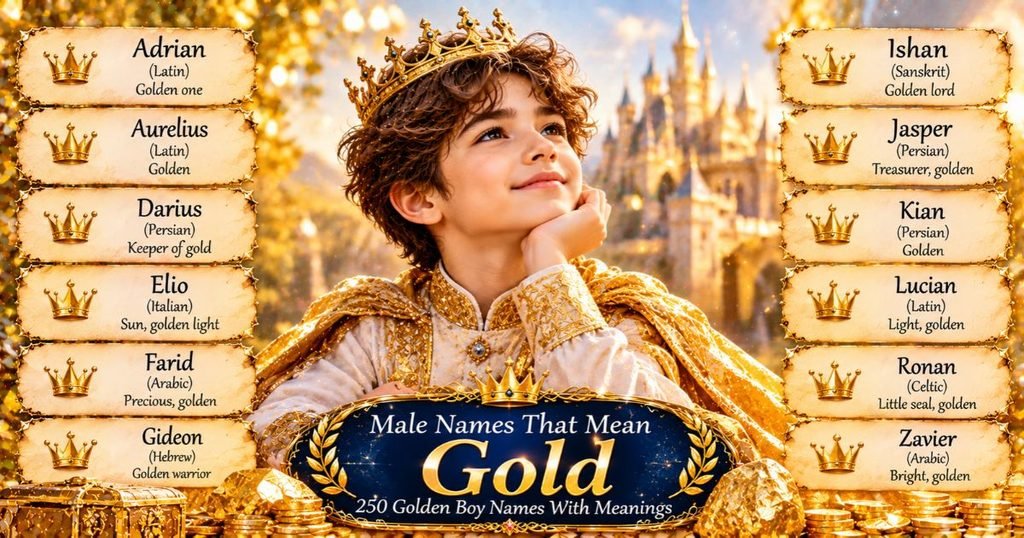
Male Names That Mean Gold: 250 Golden Boy Names With Meanings
Male names that mean gold include Aurelius (Latin), Zlatan (Slavic), Chrysander (Greek), Ofir (Hebrew), Altan (Mongolian), and Hemachandra (Sanskrit). Each one grows from an ancient word for gold, such as Latin aurum, Greek chrysos, Slavic zlato, or Sanskrit hema. The best pick pairs a clear golden meaning with easy pronunciation.
We checked each root word, then sorted 250 names into those that truly mean gold and those that carry a golden spirit through sunlight, wealth, or royalty. You will leave with clear meanings, origins, and ideas that fit your family.
Words for Gold Behind These Names
| Language | Word for gold | Sample names |
| Latin | aurum, aureus | Aurelius, Auric, Aurum |
| Greek | chrysos | Chrysander, Chrysostom |
| Slavic | zlato | Zlatan, Zlatko |
| Hebrew | zahav, paz | Zahav, Paz |
| Persian | zar | Zar, Zarrin |
| Sanskrit | hema, kanaka, hiranya, suvarna | Hemang, Kanak, Hiranya |
| Mongolian | altan | Altan, Altangerel |
| Japanese | kin (金) | Kin, Kintaro |
| Chinese | jin (金) | Jin, Jinlong |
| Thai | thong | Thong, Thongchai |
| Amharic | werq | Worku, Workneh |
Classic Male Names That Mean Gold From Latin and Greek
Latin and Greek gave the Western world its best-known gold names. Latin uses aurum for gold and aureus for “golden.” Roman families turned that root into surnames such as Aurelius. The philosopher-emperor Marcus Aurelius ruled from 161 to 180 CE, and his name still sounds noble today. It works because the “-ius” ending signals family heritage, while the “Aur-” sound points straight to gold.

Greek uses chrysos for gold. Names built on it often read like tiny sentences. Chrysander means “golden man,” and Chrysostom means “golden mouth.” John Chrysostom (c. 347–407 CE) earned that nickname because his sermons were so powerful. If you love history, these names carry real weight.
Latin Names Meaning Gold and Golden
- Aurelius (Latin) – “golden.” A Roman family name built on aureus; philosopher-emperor Marcus Aurelius (ruled 161–180 CE) made it famous.
- Aurelian (Latin) – “golden.” Borne by the Roman emperor Aurelian, who ruled from 270 to 275 CE.
- Aurelio (Italian, Spanish) – “golden.” A softer, more musical cousin of Aurelius.
- Aureliano (Spanish, Italian) – “golden.” Readers know it from Colonel Aureliano Buendía in Gabriel García Márquez’s novel One Hundred Years of Solitude.
- Aurel (Romanian, German) – “golden.” A short, modern-feeling form of Aurelius.
- Aurélien (French) – “golden.” Elegant and easy to say in English.
- Aurèle (French) – “golden.” The classic French form of Aurelius.
- Aureli (Catalan) – “golden.” The Catalan form of Aurelius.
- Aureliusz (Polish) – “golden.” The Polish form of Aurelius.
- Aurelijus (Lithuanian) – “golden.” The Lithuanian form of Aurelius.
- Auric (English, Latin) – “of gold,” from Latin aurum. Ian Fleming gave it to the villain Auric Goldfinger.
- Aurum (Latin) – literally “gold.” Chemists took the symbol Au from this word. Bold, rare, and very short.
- Aureo (Spanish, Italian, Portuguese) – “golden.” A smooth, vowel-rich option.
- Aureolus (Latin) – “golden,” a diminutive of aureus. A Roman general of that name rebelled against Emperor Gallienus around 268 CE.
- Auriol (English, French) – “golden,” from Latin aureolus.
- Oriol (Catalan) – “golden,” from Latin aureolus. It is also the Catalan word for the oriole, a golden-yellow songbird.
- Oriel (English, Latin) – “golden,” from the same Latin root as Auriol.
- Oro (Spanish, Italian) – “gold.” Just three letters, and instantly clear.
You May Also Read: Japanese Names That Mean Flower: 400 Blossom Names With Kanji and Meanings.
Greek Names That Mean Gold
- Chrysostom (Greek) – “golden mouth,” from chrysos (gold) and stoma (mouth). John Chrysostom (c. 347–407 CE) earned the title for his powerful sermons.
- Chrysostomos (Greek) – “golden mouth.” The Greek form, still used in Greece.
- Chrysander (Greek) – “golden man,” from chrysos and aner (man).
- Chrysanthos (Greek) – “golden flower,” from chrysos and anthos (flower).
- Chrysanthus (Latin, English) – “golden flower.” The Latinized form, worn by an early Christian martyr.
- Crisanto (Spanish, Filipino) – “golden flower.” The Spanish form of Chrysanthus, common in the Philippines.
- Chrysogonus (Greek) – “golden-born.” An early Christian martyr whose name appears in the Roman Canon.
- Chrysippus (Greek) – “golden horse.” The name of the Stoic philosopher Chrysippus of Soli (c. 279–206 BCE).
- Chryses (Greek) – “golden one.” The priest of Apollo who opens the plot of Homer’s Iliad.
- Chrysaor (Greek) – “golden sword” or “golden armor.” In myth, a giant sprang from Medusa’s blood with this name.
- Chrysovalantis (Greek) – “golden purse.” A real Greek name, and a true showstopper.
- Chrysologus (Greek) – “golden-worded.” Saint Peter Chrysologus (c. 380–450 CE) was famed for brief, brilliant sermons.
Strong Boy Names That Mean Golden From Slavic, Hebrew, Welsh and English Roots
Slavic languages use zlato for gold, and the names built on it sound powerful. Zlatan is the best-known example, thanks to Zlatan Ibrahimović. Hebrew uses zahav for gold and paz for refined gold. Hebrew names also point to Ophir, the land that 1 Kings 9:28 links with gold shipments.
Welsh and English add warm, old-fashioned options. Welsh eur means gold, so Eurwyn means “fair gold.” Old English gold plus wine (friend) gives Goldwin. Because these names that mean gold are shorter and punchier than many Latin ones, they suit parents who want a strong sound.
Slavic Names for Gold
- Zlatan (South Slavic) – “golden,” from zlato (gold). Swedish striker Zlatan Ibrahimović carried it worldwide.
- Zlatko (South Slavic) – “golden one.” A warm, friendly form used across the Balkans.
- Zlatimir (Serbian, Bulgarian) – “golden peace,” from zlato and mir (peace or world).
- Zlatomir (Bulgarian) – “golden peace.” A close variant of Zlatimir.
- Zlatoslav (Slavic) – “golden glory,” from zlato and slava (glory).
- Zlatin (Bulgarian) – “golden.” Short and easy to pronounce.
- Zlatyo (Bulgarian) – “golden.” A pet form that works as a full name.
- Zlatoust (Russian) – “golden mouth.” The Slavic translation of Chrysostom.
- Zlatibor (Serbian) – “golden pine,” from zlato and bor (pine). It is also a famous mountain region.
Hebrew Boy Names Meaning Gold
- Ofir (Hebrew) – “gold,” from Ophir, the land the Bible names as a source of gold (1 Kings 9:28).
- Ophir (Hebrew) – “gold.” The classic spelling of the biblical place name.
- Paz (Hebrew) – “refined gold.” Used in Israel for boys and girls.
- Zahav (Hebrew) – “gold.” The plain Hebrew word, used as a name.
- Zahavi (Hebrew) – “golden.” A smooth, modern Israeli choice.
Welsh, English, Germanic and Other European Gold Names
- Eurwyn (Welsh) – “fair gold,” from eur (gold) and gwyn (white, fair, or blessed).
- Eurig (Welsh) – “gold,” from eur. Rare and sweet.
- Goldwin (English) – “gold friend,” from Old English gold and wine (friend).
- Goldwyn (English) – a spelling of Goldwin. Hollywood producer Samuel Goldwyn coined his surname by blending Goldfish and Selwyn.
- Gold (English) – the plain English word, used as a modern first name.
- Golden (English) – “of gold.” A growing modern choice in the United States.
- Goldmund (German) – “golden mouth.” The artistic hero of Hermann Hesse’s 1930 novel Narcissus and Goldmund.
- Orval (French) – “golden valley,” from Latin Aurea Vallis. It names Orval Abbey in Belgium.
- Orville (English) – coined by novelist Fanny Burney for her 1778 book Evelina. Often explained as “gold town,” though that origin is unproven.
- Eldorado (Spanish) – “the gilded one,” from the legend of El Dorado, the gilded king.
- Okropir (Georgian) – “golden mouth,” from okro (gold). It is the Georgian counterpart of Chrysostom.
- Voskan (Armenian) – “golden,” built on voski (gold).
- Kuldar (Estonian) – “golden,” built on kuld (gold).
Pakistani, Indian and Persian Boy Names That Mean Gold
Persian gives us zar, which means gold and appears in many Urdu and Pashto names. Sanskrit has several gold words: hema, kanaka, hiranya, and suvarna. Punjabi, Hindi, Bengali, Nepali, and Tamil names grew from these roots. Because Pakistan and India share a deep naming tradition, many families will find boy names that mean gold with a familiar sound here.
Families who prefer Arabic or Persian roots often check a name’s meaning with an elder or scholar. Hindu and Sikh families may likewise ask elders or a priest about Sanskrit and Punjabi names. We list the most common readings and note when a name has more than one.
Urdu and Persian Boy Names Mean Gold
- Zar (Persian, Urdu) – “gold.” One syllable, clean and strong.
- Zarrin (Persian) – “golden,” from zar.
- Zarmehr (Persian) – “gold and sun,” from zar and mehr (sun or kindness).
- Asjad (Arabic, Urdu) – commonly given as “gold” or “gilded.” Families sometimes list more than one reading.
- Zahab (Arabic, Urdu) – “gold,” from Arabic dhahab. Uncommon, so it stands out.
- Altan (Mongolian, Turkic) – “golden.” Altan Khan (1507–1582) gave the title Dalai Lama to Sonam Gyatso in 1578. In Turkish, it can also mean “red dawn.”
- Altay (Turkic) – tied to the Altai Mountains, often read as “golden mountain.”
- Altynbek (Kazakh) – “golden prince,” from altyn (gold) and bek (lord).
- Altangerel (Mongolian) – “golden light,” from altan and gerel (light).
- Altankhuyag (Mongolian) – “golden armor,” from altan and khuyag (armor).
Sanskrit Names for Gold, Plus Punjabi and South Indian Picks
- Sonu (Hindi, Punjabi, Urdu) – “my golden one,” a pet form from sona (gold).
- Kanak (Sanskrit) – “gold.” Short and bright.
- Kanchan (Sanskrit) – “gold.” Used across northern India and Nepal.
- Hem (Sanskrit) – “gold,” from hema.
- Hemachandra (Sanskrit) – “golden moon.” A famous 12th-century Jain scholar carried this name.
- Hemendra (Sanskrit) – “lord of gold.”
- Hemang (Sanskrit) – “golden body,” from hema and anga (limb).
- Hemraj (Sanskrit, Hindi) – “king of gold.”
- Hemadri (Sanskrit) – “golden mountain,” a poetic title for Mount Meru.
- Hiranya (Sanskrit) – “gold.” A Vedic word for the metal.
- Hiranmay (Sanskrit, Bengali) – “golden” or “made of gold.”
- Hiranyagarbha (Sanskrit) – “golden womb,” the glowing cosmic egg of creation in the Rigveda. Very rare.
- Swarnim (Sanskrit, Nepali) – “golden.” A favorite in Nepal.
- Swaran (Punjabi, Sanskrit) – “golden,” from suvarna. Often paired with Singh.
- Suvarn (Sanskrit) – “golden,” from suvarna (good color, gold).
- Rukmin (Sanskrit) – “adorned with gold,” from rukma (gold). In the Mahabharata tradition, he is Rukmini’s brother.
- Bangaru (Telugu) – “gold,” from bangaram.
- Ponraj (Tamil) – “golden king,” from pon (gold) and raj (king).
- Ponnusamy (Tamil) – “golden lord,” from ponnu (gold) and samy (lord).
Unique Gold Names for Boys From East Asia, Southeast Asia and Africa
- Kin (Japanese) – “gold,” when written with the kanji 金.
- Kintaro (Japanese) – “golden boy.” Kintarō is a folk hero raised in the mountains, often linked to the warrior Sakata no Kintoki.
- Kinjiro (Japanese) – “gold” plus “second son.” Ninomiya Kinjirō (1787–1856) became a national symbol of hard work.
- Jin (Chinese) – “gold,” when written 金. Other characters, such as 瑾 (fine jade), share the sound.
- Jinlong (Chinese) – “golden dragon” (金龙).
- Jinbao (Chinese) – “golden treasure” (金宝).
- Jinhai (Chinese) – “golden sea” (金海).
- Thong (Thai) – “gold.” A short, strong Thai name.
- Thongchai (Thai) – “golden victory,” from thong and chai (victory).
- Thongdee (Thai) – “good gold,” from thong and dee (good).
- Sovann (Khmer) – “gold,” from Sanskrit suvarna.
- Meas (Khmer) – “gold.” A short Cambodian name.
- Shwe (Burmese) – “gold.” It also appears in Shwedagon, Myanmar’s golden pagoda.
- Suwan (Thai) – “gold,” from Sanskrit suvarna.
- Souvanna (Lao) – “gold.” Prince Souvanna Phouma led Laos as prime minister.
- Suwarno (Javanese, Indonesian) – “golden,” from Sanskrit suvarna.
- Worku (Amharic) – “his gold.” A common Ethiopian name.
- Workneh (Amharic) – “you are gold.” A heartfelt Ethiopian name.

Golden-Haired Boy Names and Names for Golden Hues
Some names do not mean the metal itself. They describe the color: yellow, tawny, or fair-haired. Romans used flavus for golden-yellow hair, which gave us Flavius and its cousins. Greek xanthos means yellow or golden. Old English and Gaelic added names for fair hair, such as Sherlock and Bowie.
These names suit families who want a link to gold that feels softer. They also work well as middle names, and they extend your shortlist of names that mean gold. Flavian Zlatan or Fulvio Aurel, for example, pair two golden roots in one name.
Golden-Haired Boy Names and Golden-Yellow Picks
- Flavius (Latin) – “golden” or “yellow-haired.” The Flavian dynasty ruled Rome from 69 to 96 CE.
- Flavio (Italian, Spanish, Portuguese) – “golden-haired,” from Flavius.
- Flavian (Latin, English) – “golden-haired,” from Flavius.
- Flavien (French) – “golden-haired.” The French form of Flavian.
- Fulvio (Italian) – “tawny” or “golden-yellow,” from Latin fulvus.
- Xanthos (Greek) – “yellow” or “golden.” In the Iliad, it names a river and one of Achilles’ horses.
- Xanthus (Latin, English) – “golden-yellow.” The Latinized form of Xanthos.
- Sherlock (English) – “fair-haired,” from Old English scir (bright) and locc (lock of hair).
- Fairfax (English) – “fair hair,” from Old English faeger and feax (hair).
- Bowie (Scottish Gaelic) – “yellow-haired,” from Gaelic buidhe (yellow).
- Blondel (French) – “little fair one,” from blond. A minstrel named Blondel features in Richard the Lionheart legends.
- Finbar (Irish) – “fair head,” from Fionnbharr.
Golden Sun and Radiant Light Names for Boys
Gold and sunlight go together. Poets call a sunrise golden, and ancient peoples tied gold to sun gods. Egyptians linked gold to Ra. Spanish chroniclers recorded that the Inca connected gold with the sun god Inti. That is why many parents look for sun and light names when they want a golden feel.
Sun, Dawn and Sunrise Names
- Helios (Greek) – “sun.” The Titan who drove the sun across the sky.
- Helio (Portuguese, Spanish) – “sun.” A compact modern form.
- Heliodorus (Greek) – “gift of the sun.”
- Elio (Italian) – “sun,” from Helios.
- Sol (Latin, Spanish) – “sun.”
- Ra (Egyptian) – the Egyptian sun god, often shown with a golden disk.
- Apollo (Greek) – the god of light. Scholars still debate the meaning, but artists often paint him golden-haired.
- Phoebus (Greek) – “bright,” an old title of Apollo.
- Hyperion (Greek) – “he who goes above,” the Titan of heavenly light and father of Helios.
- Tonatiuh (Nahuatl) – “sun.” The Aztec sun god, “he who goes forth shining.”
- Inti (Quechua) – “sun.” The Inca sun god. Spanish chroniclers linked Inca gold to the sun.
- Aftab (Persian, Urdu) – “sun.” Very common in Pakistan.
- Khurshid (Persian, Urdu) – “sun.”
- Shams (Arabic) – “sun.”
- Suraj (Hindi) – “sun.”
- Surya (Sanskrit) – “sun,” and the Hindu sun god.
- Mihir (Sanskrit, Persian) – “sun.”
- Bhanu (Sanskrit) – “sun” or “ray of light.”
- Ravi (Sanskrit) – “sun.”
- Arun (Sanskrit) – “reddish-golden,” the color of dawn.
- Aditya (Sanskrit) – “son of Aditi,” a name for solar deities and the sun.
- Bhaskar (Sanskrit) – “light-maker,” meaning the sun.
- Divakar (Sanskrit) – “day-maker,” meaning the sun.
- Dinesh (Sanskrit) – “lord of the day,” meaning the sun.
- Prabhat (Sanskrit) – “dawn” or “morning.”
- Uday (Sanskrit) – “rising,” as in sunrise.
Bright and Radiant Names
- Albert (Germanic) – “noble and bright,” from adal and beraht.
- Robert (Germanic) – “bright fame,” from hrod and beraht.
- Hubert (Germanic) – “bright mind,” from hug and beraht.
- Bertram (Germanic) – “bright raven.”
- Egbert (Old English) – “bright edge,” as in a bright sword blade.
- Herbert (Germanic) – “bright army.”
- Lucian (Latin) – “light,” from lux.
- Lucius (Latin) – “light,” from lux.
- Noor (Arabic) – “light.”
- Anwar (Arabic) – “most luminous,” a plural of noor (lights).
- Munir (Arabic) – “luminous” or “radiant.”
- Zia (Arabic) – “light” or “radiance.”
- Roshan (Persian, Hindi) – “bright” or “shining.”
- Prakash (Sanskrit) – “light.”
- Tej (Sanskrit) – “brilliance” or “splendor.”
- Ujjwal (Sanskrit) – “bright” or “brilliant.”
- Kiran (Sanskrit) – “ray of light.”
- Hikaru (Japanese) – “light” or “radiance” (光).
- Akira (Japanese) – “bright” or “clear.”
- Ming (Chinese) – “bright” (明).
- Liang (Chinese) – “bright” or “luminous” (亮).
- Guang (Chinese) – “light” (光).
- Phaedrus (Greek) – “bright” or “radiant,” from phaidros.
- Photios (Greek) – “light,” from phos.
- Zahir (Arabic) – “shining” or “clear.”
- Munawar (Arabic) – “illuminated.”
- Nayyar (Arabic, Urdu) – “radiant” or “shining.”
- Dev (Sanskrit) – “divine” or “shining one.”
- Deepak (Sanskrit) – “lamp.”
Legends, Wealth, Treasure and Royal Names That Echo Gold
Some names do not mean gold, but legend welded them to it. King Midas turned everything he touched into gold. Jason sailed with the Argonauts to win the Golden Fleece. Croesus ruled Lydia, a kingdom famous for early gold coins, and his name still means “very rich.” Hindu tradition honors Kuber as the keeper of divine treasure. And the tale of El Dorado, the gilded king, drove explorers deep into South America.
Gold and wealth have always walked together, too. Old English names built on ead mean “rich,” as in Edmund and Edwin. Sanskrit dhana means wealth, and Urdu and Punjabi daulat means fortune. These names sit furthest from the literal metal, so treat them as thematic picks for a child you hope will be valued, prosperous, or regal.
Legendary and Historic Gold Names
- Midas (Greek) – the Phrygian king whose touch turned objects to gold.
- Jason (Greek) – the leader of the Argonauts who sailed to fetch the Golden Fleece. The name itself is linked to “healer.”
- Croesus (Greek) – the last king of Lydia (reigned c. 560–546 BCE). His name became shorthand for great riches.
- Kuber (Sanskrit) – the Hindu god of wealth and guardian of treasure.
- Musa (Arabic) – the Arabic form of Moses. Mansa Musa of Mali made a famous pilgrimage to Mecca in 1324, and tales of his gold spread across continents.
- Solomon (Hebrew) – “peaceful.” The Bible describes King Solomon’s vast gold and his ships that sailed to Ophir.
- Sulaiman (Arabic) – the Arabic form of Solomon, widely used in Pakistan.
Wealth and Prosperity Names That Echo Gold
- Edmund (Old English) – “rich protector,” from ead (wealth) and mund (protection).
- Edgar (Old English) – “rich spear.”
- Edwin (Old English) – “rich friend.”
- Edward (Old English) – “wealthy guardian.”
- Edric (Old English) – “rich ruler.”
- Otto (Germanic) – “wealth” or “fortune.”
- Odo (Germanic) – “wealth.”
- Audun (Old Norse) – “wealth friend,” from audr (wealth) and vinr (friend).
- Dhan (Sanskrit) – “wealth.”
- Dhanraj (Sanskrit, Hindi) – “king of wealth.”
- Dhanesh (Sanskrit) – “lord of wealth.”
- Dhananjay (Sanskrit) – “conqueror of wealth,” a title of the hero Arjuna.
- Dhanwant (Punjabi, Hindi) – “wealthy.”
- Vasu (Sanskrit) – “wealth” or “treasure.”
- Sampath (Sanskrit, Tamil, Telugu) – “wealth” or “prosperity.”
- Vaibhav (Sanskrit) – “wealth” or “glory.”
- Daulat (Persian, Urdu, Punjabi) – “wealth.”
- Tharwat (Arabic) – “wealth.” In Urdu, the form Sarwat is common.
- Ghani (Arabic) – “rich” or “self-sufficient.”
- Osher (Hebrew) – “wealth” or “happiness.”
- Prosper (Latin) – “fortunate.”
- Felix (Latin) – “lucky.”
- Fortunato (Italian, Spanish) – “fortunate.”
- Rico (Spanish) – “rich.”
- Olamide (Yoruba) – “my wealth has arrived.”
- Olawale (Yoruba) – “wealth comes home.”
- Olatunde (Yoruba) – “wealth returns.”
- Tomio (Japanese) – “rich man.”
- Yutaka (Japanese) – “abundant” or “rich.”
- Plutus (Greek) – “wealth.” The Greek god of riches.
- Plutarch (Greek) – “ruler of wealth.” The famed biographer Plutarch lived c. 46–119 CE.
Treasure and Precious Names
- Jasper (Persian via Hebrew) – “treasurer.” A relative of Caspar.
- Caspar (Persian via Hebrew) – “treasurer.” Linked to the traditional name of one of the three wise men.
- Nafees (Arabic, Urdu) – “precious” or “exquisite.”
- Ghali (Arabic) – “precious” or “dear.”
- Nadir (Arabic) – “rare” or “precious.”
- Yakir (Hebrew) – “precious” or “dear.”
- Ratan (Sanskrit) – “jewel.”
- Amol (Sanskrit, Marathi) – “priceless.”
- Gohar (Persian) – “jewel” or “gem.”
- Almas (Persian, Arabic) – “diamond.”
- Heera (Hindi) – “diamond.”
- Khazin (Arabic) – “treasurer” or “keeper of the treasury.”
- Ghanim (Arabic) – “one who gains,” often read as “fortunate.”
Royal and Crown Names
- Basil (Greek) – “royal” or “kingly,” from basileios.
- Leroy (French) – “the king.”
- Rex (Latin) – “king.”
- Malik (Arabic) – “king.”
- Raja (Sanskrit) – “king.”
- Rajan (Sanskrit) – “king.”
- Sultan (Arabic) – “ruler” or “authority.”
- Amir (Arabic) – “prince” or “commander.”
- Shahzad (Persian) – “prince,” meaning born of a king.
- Shahryar (Persian) – “king.”
- Qaiser (Arabic, Urdu) – “emperor,” from Caesar.
- Taj (Persian, Urdu) – “crown.”
Golden-Maned Lion Names
Lions have tawny, golden coats, and many cultures use lion names for strength and pride.
- Leo (Latin) – “lion.”
- Leon (Greek) – “lion.”
- Leonard (Germanic) – “brave lion.”
- Arslan (Turkic, Persian) – “lion.”
- Asad (Arabic) – “lion.”
- Haider (Arabic) – “lion.”
- Sher (Persian, Hindi) – “lion” or “tiger.” Emperor Sher Shah Suri used it.
- Simba (Swahili) – “lion.”
- Ari (Hebrew) – “lion.”
Blessing and Good-Fortune Names
- Mubarak (Arabic) – “blessed.”
- Asher (Hebrew) – “happy” or “blessed.”
- Baruch (Hebrew) – “blessed.”
- Benedict (Latin) – “blessed.”
- Saeed (Arabic) – “happy” or “fortunate.”
- Saad (Arabic) – “good fortune.”
- Barack (Swahili) – “blessed,” from Arabic baraka.
Read More: Names That Mean Siren: 500 Mythical, Sea-Born & Enchanting Name Ideas.
Conclusion
Male names that mean gold give a child a strong link to value, light, and history. You can choose a classic like Aurelius, the name of Marcus Aurelius, a bold Slavic pick like Zlatan, a short gem like Jin, or a story-rich name like Kintaro. Whichever you pick, you now know where the gold in the name comes from. Bookmark this guide, share it with your partner, and tell us your favorite golden name in the comments.
FAQs
What is a boy name that means gold?
Aurelius, Zlatan, Chrysander, Ofir, Zahav, Hemang, Kin, and Altan are boy names that mean gold or golden. Each comes from a root word for gold in Latin, Slavic, Greek, Hebrew, Sanskrit, Japanese, or Mongolian. Aurelius and Zlatan are the most widely recognized.
What is the most unique male name that means gold?
Chrysovalantis (“golden purse”), Zlatoust (“golden mouth”), and Hiranyagarbha (“golden womb”) are among the rarest real gold names. All three have documented roots. If you want something easier to say, Zarrin or Eurwyn are still uncommon but simpler.
Which Urdu and Persian boy names mean gold?
Zar, Zarrin, Zarmehr, and Zahab link to gold through Persian and Arabic roots. Asjad is often glossed as “gold” or “gilded.” Sonu, a Punjabi and Urdu pet name from sona, means “my golden one.” Confirm preferred readings with family elders or a scholar.
Is there a name that means golden boy?
Yes. Kintaro is a Japanese name that means “golden boy.” It comes from a folk hero famed for childhood strength. Other options include Zlatko, which means “golden one,” and Sonu, a Hindi and Punjabi nickname meaning “my golden one.”
What are short male names that mean gold?
Oro, Kin, Jin, Zar, Paz, Hem, Thong, and Meas are short names that mean gold. Oro is Spanish and Italian, Kin and Jin come from East Asia, Zar is Persian, Paz is Hebrew, and Hem is Sanskrit. All are easy to spell and say.