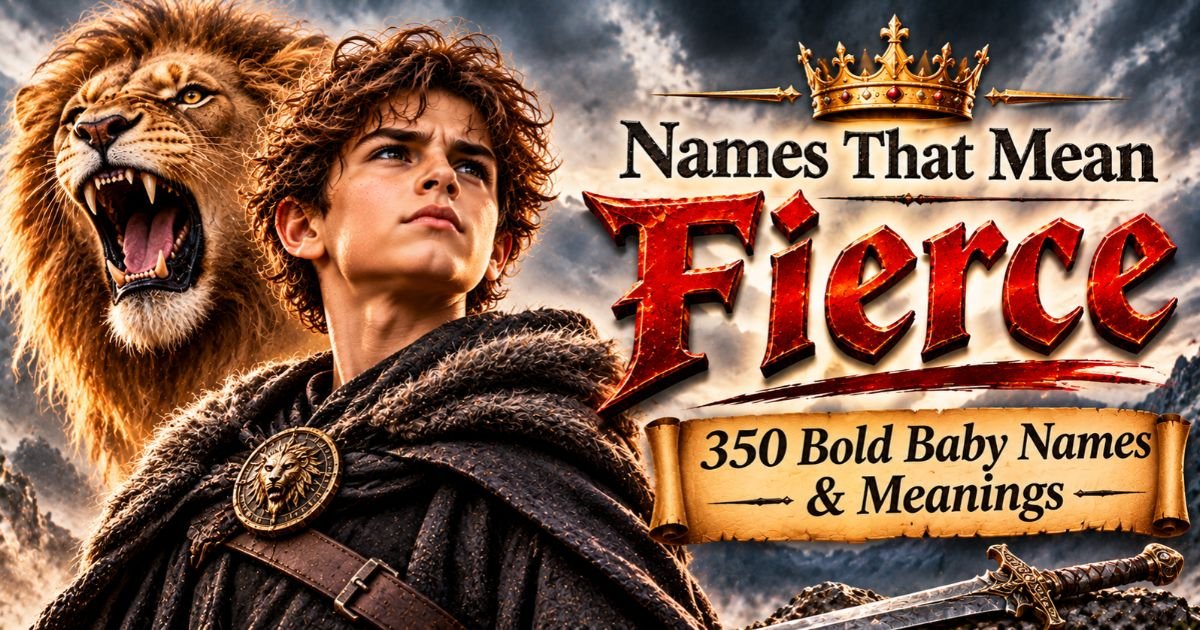
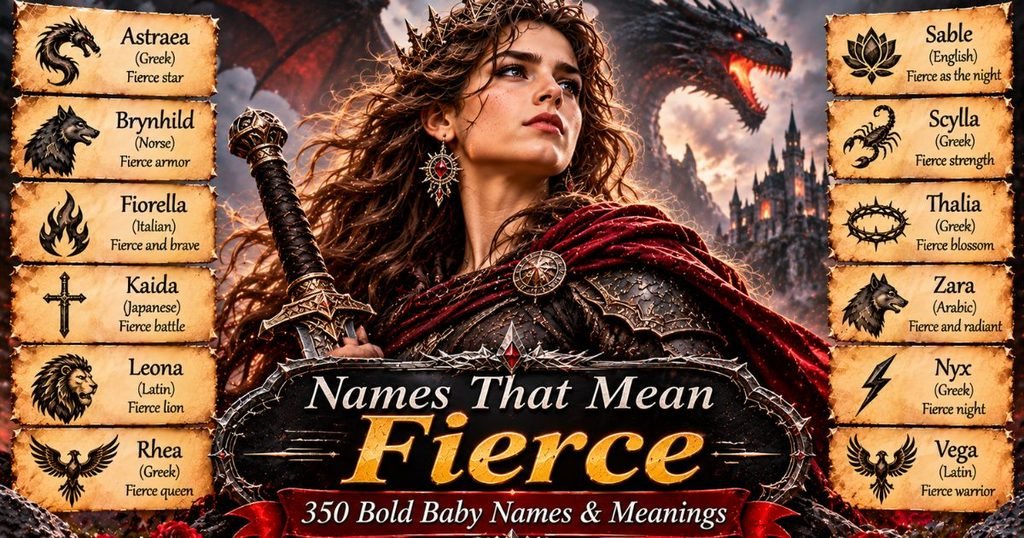
Names That Mean Fierce: 350 Bold Baby Names & Meanings
Names that mean fierce come from words for strength, battle, fire, and wild animals. Strong examples include Valeria (“strong”), Matilda (“mighty in battle”), Gideon (“mighty warrior”), Leona (“lioness”), and Ugra (“fierce”). Below, you’ll find 350 names with origins and meanings.
Girl Names That Mean Fierce, Strong, or Brave
Fierce girl names don’t have to sound harsh. Some of the strongest ones, like Valeria and Audrey, sound soft and look elegant. Their power lives in the root word, not the volume. The 30 names below all point to strength, courage, defense, or fearless independence.
- Valeria (Latin) – “strong, healthy.” Graceful sound, tough root.
- Valentina (Latin) – “strong, vigorous.” Comes from valere, “to be strong.”
- Valencia (Latin) – “strength, vigor.” Rare as a first name, which helps it stand out.
- Audrey (Old English) – “noble strength.” A classic that hides its muscle.
- Bernadette (French/Germanic) – “brave as a bear.” Nicknames include Bernie and Detta.
- Bridget (Irish) – “exalted one.” Linked to Brigid, a Celtic goddess tied to fire, craft, and poetry.
- Brianna (Irish) – “strong, noble.” Feminine form of Brian, whose root is debated.
- Andrea (Greek) – “brave, courageous.” Used for girls in the US and for boys in Italy.
- Wilhelmina (German) – “resolute protector.” Gives you Willa, Mina, and Billie.
- Firmina (Latin) – “firm, strong.” A rare saint’s name with a clear meaning.
- Zafira (Arabic) – “victorious.” Short, rhythmic, and easy to pronounce.
- Qadira (Arabic) – “powerful, capable.” Feminine form of Qadir.
- Aziza (Arabic) – “powerful, beloved.” Pairs strength with warmth.
- Shakti (Sanskrit) – “power, energy.” In Hindu tradition, Shakti is divine feminine power.
- Yaroslava (Slavic) – “fierce glory.” A literal “fierce” name with historic roots.
- Adira (Hebrew) – “strong, noble.” Modern Hebrew name with a clean sound.
- Gabriella (Hebrew/Italian) – “God is my strength.” Nicknames: Gabby, Ella, Brie.
- Petra (Greek) – “rock.” Steadfast and compact.
- Constance (Latin) – “steadfast.” Strength shown through endurance.
- Alexandra (Greek) – “defender of mankind.” Gives you Alex, Lexi, and Sandra.
- Alessia (Italian) – “defender.” A fresher spin on Alexandra.
- Gertrude (Germanic) – “spear of strength.” Vintage and underrated; Trudy is a lively nickname.
- Imara (Swahili) – “strong, firm.” Three syllables, easy to say.
- Uzma (Arabic) – “greatest, mightiest.” Common across Pakistan and the wider Muslim world.
- Bellatrix (Latin) – “female warrior.” Bold, though pop culture colors it for some readers.
- Sloane (Irish) – “raider.” From the Gaelic for a raiding party.
- Fiera (Italian) – “proud, fierce.” Based on the Italian word fiero; very rare as a name.
- Saoirse (Irish) – “freedom.” Pronounced SEER-sha or SUR-sha; fierce in spirit.
- Ramona (Spanish/Germanic) – “wise protector.” Power guided by judgment.
- Maxine (Latin) – “greatest.” Short, punchy, and confident.
Boy Names That Mean Fierce, Strong, or Brave
Boy names that mean fierce tend to lean on three ideas: bravery, strength, and endurance. Some come from Hebrew phrases about God’s strength. Others come from old Germanic words for “brave” and “bold.” A few, like Yaroslav and Lorcan, are rare matches for the word “fierce” itself.
- Ethan (Hebrew) – “firm, enduring.” Familiar, yet the meaning is solid.
- Andrew (Greek) – “manly, brave.” Nicknames: Drew, Andy.
- Valentine (Latin) – “strong, healthy.” Valentin, the Spanish and French form, works too.
- Bernard (Germanic) – “brave as a bear.” Short forms: Ben, Bernie.
- Everett (English) – “brave as a wild boar.” From the Germanic name Eberhard.
- Gerard (Germanic) – “brave with a spear.” Old-world, with the nickname Gerry.
- Richard (Germanic) – “brave ruler.” Endlessly adaptable: Rick, Rich, Dick, Ricky.
- Conrad (Germanic) – “brave counsel.” Bold and bookish at once.
- Hardy (English) – “bold, daring.” Short and tough.
- Gabriel (Hebrew) – “God is my strength.” A top-tier classic.
- Ezekiel (Hebrew) – “God strengthens.” Nicknames include Zeke.
- Uzi (Hebrew) – “my strength.” Distinctive, though some associate it with the firearm.
- Shuja (Arabic) – “brave.” Short and direct.
- Jabari (Swahili) – “brave one.” Rhythmic and confident.
- Qawi (Arabic) – “strong.” Simple root, strong sound.
- Yaroslav (Slavic) – “fierce glory.” Name of several medieval rulers of Kievan Rus’.
- Yaropolk (Slavic) – “fierce people.” Borne by a 10th-century prince of Kiev; very rare today.
- Magnus (Latin) – “great.” Popular in Scandinavia.
- Dante (Latin) – “enduring.” Short for Durante.
- Hector (Greek) – “steadfast.” The great defender of Troy in the Iliad.
- Lorcan (Irish) – “little fierce one.” One of the few names that translates directly to “fierce.”
- Fergus (Irish/Gaelic) – “man of vigor.” Warm and sturdy.
- Niall (Irish) – “champion.” Pronounced NYE-ul.
- Boaz (Hebrew) – “in him is strength.” Biblical and distinctive.
- Aziz (Arabic) – “powerful, beloved.” Widely used across South Asia and the Middle East.
- Hamza (Arabic) – “strong, steadfast.” Often linked to the lion; widely loved.
- Bahadur (Persian/Hindi/Urdu) – “brave, heroic.” A title of honor for centuries.
- Veer (Sanskrit/Hindi) – “brave, heroic.” One syllable, big impact.
- Shaurya (Sanskrit) – “bravery.” A modern favorite in India.
- Bala (Sanskrit) – “strength.” Simple and strong.
You Can Also Read: Names That Mean Wealth: 200+ Meaningful Picks From Around the World.
Unisex Names That Mean Fierce
Unisex names that mean fierce suit parents who want flexibility. Most of these come from Irish and Welsh roots, where gender-neutral naming is long-standing. A few are plain English words (Briar, Thorn, Rebel) that signal a sharp, independent streak.
- Casey (Irish) – “vigilant, brave.” Easy to spell and say.
- Valor (Latin/English) – “courage.” A virtue name with a firm sound.
- Riley (Irish) – “valiant.” Friendly on the surface, brave underneath.
- Blair (Scottish Gaelic) – “field of battle.” Often used for a clearing where battles took place.
- Sasha (Russian) – “defender of mankind.” Short form of Alexander or Alexandra.
- Alexis (Greek) – “defender.” Used for all genders.
- Aeron (Welsh) – “battle.” A quieter alternative to Aaron or Erin.
- Reese (Welsh) – “ardor, fiery enthusiasm.” From Rhys.
- Arden (Latin/English) – “ardent, burning.” One proposed root is Latin ardere, “to burn.”
- Briar (English) – “thorny shrub.” Wild and unbothered.
- Thorn (English) – “sharp-spined plant.” Short, stark, memorable.
- Rebel (English) – “one who stands against authority.” Meaning is on the nose.
- Maverick (American English) – “independent, unbranded.” From an unbranded calf, then a person who goes their own way.
- Drew (English) – “manly, brave.” Short for Andrew; works for any gender.
- Jaeger (German) – “hunter.” Strong sound with a precise meaning.
Names That Mean Fierce Warrior
Warrior names are the heart of any fierce list. Many come from Old Norse, Old English, and Germanic roots, where battle words were built into personal names. Think of the Valkyries of Norse mythology, whose name means “chooser of the slain,” or the Celtic queen Boudicca, whose name is linked to the word for “victory.” Roman names like Marcus and Martina honor Mars, the god of war.
Warrior Names for Girls
- Matilda (Germanic) – “mighty in battle.” Nicknames: Tilly, Mattie, Maud.
- Hilda (Germanic) – “battle.” Short, sharp, and enjoying a vintage revival.
- Hildegard (Germanic) – “battle guardian.” Made famous by a 12th-century abbess and composer.
- Brunhilda (Germanic) – “armored battle maiden.” From a Valkyrie in Norse and Germanic legend.
- Louisa (Germanic) – “renowned warrior.” Feminine of Louis.
- Edith (Old English) – “prosperous in war.” Old English ead (riches) plus gyth (war).
- Hedwig (Germanic) – “battle strife.” Very rare in the US, though known from Harry Potter.
- Ragnhild (Old Norse) – “battle counsel.” A Viking-age queen’s name.
- Gunhild (Old Norse) – “war battle.” The meaning stacks two battle words.
- Sigrid (Old Norse) – “beautiful victory.” Common in Scandinavia.
- Vigdis (Old Norse) – “war goddess.” Iceland elected Vigdís Finnbogadóttir president in 1980.
- Brynja (Old Norse) – “armor.” Literally a coat of mail.
- Victoria (Latin) – “victory.” Classic and regal.
- Nika (Greek) – “victory.” Short form tied to Nike, the Greek goddess of victory.
- Berenice (Greek) – “bringer of victory.” Rare, elegant, and ancient.
- Nicola (Greek) – “victory of the people.” Used for girls in the UK and Italy.
- Marcella (Latin) – “little Mars.” Soft sound with a martial root.
- Martina (Latin) – “of Mars.” Nicknames: Tina, Marti.
- Marcia (Latin) – “of Mars.” Vintage, crisp, and clear.
- Alala (Greek) – “war cry.” In myth, the personification of the battle cry.
- Griselda (Germanic) – “gray battle.” Nicknames: Zelda, Selda.
- Mechthild (Germanic) – “mighty in battle.” A medieval German form of Matilda.
- Hjördis (Old Norse) – “sword goddess.” From the Völsung saga.
- Ildikó (Hungarian) – “battle maiden.” From the Germanic root hild, “battle.”
- Brenda (Old Norse) – “sword.” Often mistaken for a Gaelic name.
- Armina (Germanic) – “soldier.” Feminine of Armin.
Warrior Names for Boys
- Marcus (Latin) – “of Mars, god of war.” Timeless and balanced.
- Marcel (French) – “little Mars.” Smooth sound, martial root.
- Martin (Latin) – “of Mars.” One of the most widely used names in Europe.
- Armando (Spanish/Germanic) – “army man.” Warm and confident.
- Herman (Germanic) – “army man.” Vintage and ripe for revival.
- Harold (Old English) – “army ruler.” King Harold II fought at Hastings in 1066.
- Walter (Germanic) – “ruler of the army.” Nickname: Walt.
- Harvey (Breton) – “battle-worthy.” Friendly sound with a battle root.
- Louis (Germanic) – “famous warrior.” Borne by eighteen French kings.
- Clovis (Frankish) – “famous warrior.” King of the Franks around AD 500.
- Gunnar (Old Norse) – “warrior.” Short, strong, and well-known across Scandinavia.
- Sigurd (Old Norse) – “victory guardian.” The dragon-slaying hero of Norse saga.
- Duncan (Gaelic) – “dark warrior.” Scottish kings carried it.
- Gideon (Hebrew) – “mighty warrior.” A biblical judge who led Israel’s army.
- Cathal (Irish) – “battle ruler.” Pronounced KA-hal.
- Kane (Irish) – “battle.” Compact and modern-sounding.
- Garrick (Old English) – “spear ruler.” Rare and dignified.
- Edgar (Old English) – “wealthy spear.” Literary and classic.
- Alexander (Greek) – “defender of the people.” Alexander the Great built one of the largest empires of the ancient world.
- Ragnar (Old Norse) – “counsel of the army.” Made famous by Viking legend.
- Ivar (Old Norse) – “bow warrior.” A common Viking-age name.
- Hjalmar (Old Norse) – “helmeted warrior.” Rare and strong.
- Baldwin (Germanic) – “bold friend.” Used by several crusader kings.
- Hereward (Old English) – “army guard.” Hereward the Wake resisted the Norman conquest.
- Brand (Old English/Norse) – “sword, fire.” Short and sharp.
- Ryder (English) – “horseman, mounted warrior.” Trendy for boys and girls alike.
- Gerald (Germanic) – “spear ruler.” Friendly nickname: Gerry.
- Wyatt (Old English) – “brave in war.” A cowboy classic.
- Armin (Germanic) – “soldier.” Straightforward and rare.
- Thane (Old English) – “warrior, retainer.” A noble rank in early Britain.
- Gunther (Germanic) – “battle army.” Strong, though often heard as dated.
- Leopold (Germanic) – “bold people.” Regal and old-fashioned.
- Ludwig (Germanic) – “famous in battle.” Beethoven’s first name.
- Lothar (Germanic) – “famous army.” Rare in English-speaking countries.

Fierce Baby Names Inspired by Lions, Wolves, and Other Animals
Animals have always stood for courage. Names meaning lion are the biggest group, and they appear in nearly every language. Leonidas, the Spartan king who held the pass at Thermopylae in 480 BCE, carried a lion in his name. Norse mythology gave us Ulf and Bjørn, while Greek mythology gave us the griffin. This section has 60 names, from classic lion names to bears, hawks, big cats, and dragons.
Names That Mean Lion
- Leo (Latin) – “lion.” Short, classic, and easy for everyone to spell.
- Leon (Greek) – “lion.” Smooth and international.
- Leonard (Germanic) – “brave lion.” Nicknames: Leo, Len, Lenny.
- Leonidas (Greek) – “son of the lion.” The Spartan king of Thermopylae.
- Lionel (French) – “little lion.” Gentle on the ear, bold in meaning.
- Leona (Latin) – “lioness.” A direct, elegant choice.
- Leonie (French) – “lion.” Softer and more lyrical than Leona.
- Leandra (Greek) – “lion woman.” Feminine of Leander.
- Ariel (Hebrew) – “lion of God.” Used for all genders.
- Aryeh (Hebrew) – “lion.” Pronounced ar-YEH.
- Kefira (Hebrew) – “young lioness.” Rare and fresh.
- Haidar (Arabic) – “lion.” An honorific for Imam Ali.
- Asad (Arabic) – “lion.” Common across South Asia and the Middle East.
- Usama (Arabic) – “lion.” Rhythmic and widely used.
- Layth (Arabic) – “lion.” Short and modern-sounding.
- Simba (Swahili) – “lion.” Instantly recognizable.
- Singh (Sanskrit/Punjabi) – “lion.” Sikh men took the name after the Khalsa was founded in 1699.
- Sher (Persian/Urdu) – “lion.” Short, strong, and famous from Sher Shah Suri.
- Simha (Sanskrit) – “lion.” The root of the word Singh.
- Lev (Russian/Hebrew) – “lion” in Russian; “heart” in Hebrew. Two meanings for one name.
- Arslan (Turkic/Persian) – “lion.” Popular in Pakistan and Turkey.
Wolf, Bear, Eagle, Big Cat, and Dragon Names
- Wolfgang (Germanic) – “wolf path.” Famous through Mozart.
- Ulf (Old Norse) – “wolf.” Brief and bold.
- Conall (Irish) – “strong wolf.” Pronounced KON-ul.
- Randolph (English) – “shield wolf.” Nickname: Randy or Rand.
- Lobo (Spanish/Portuguese) – “wolf.” Short and edgy.
- Wolf (English/German) – “wolf.” Used directly as a first name.
- Rolf (Germanic) – “famous wolf.” Compact and firm.
- Zev (Hebrew) – “wolf.” Quick to say and remember.
- Bjørn (Old Norse) – “bear.” A staple of Norse mythology and Viking-age names.
- Ursula (Latin) – “little she-bear.” Strong beneath its gentle sound.
- Dov (Hebrew) – “bear.” One syllable, plenty of weight.
- Orson (Latin) – “little bear.” Rare, with an old-film charm.
- Kuma (Japanese) – “bear.” Brief and distinctive.
- Arthur (Celtic) – possibly “bear.” Many scholars link it to the Celtic artos; the origin is debated.
- Arnold (Germanic) – “eagle ruler.” Strong, formal, and vintage.
- Aquila (Latin) – “eagle.” Also the name of a northern constellation.
- Falco (Italian/Latin) – “falcon.” Sleek and unusual.
- Hawk (English) – “predatory bird.” Used as a first name for its sharp, quick image.
- Gavin (Welsh) – “white hawk.” From Gawain of Arthurian legend.
- Kestrel (English) – “small falcon.” Light and unusual for any gender.
- Talon (English) – “claw of a bird of prey.” Sharp and memorable.
- Raven (English) – “raven.” A bird tied to omens in Norse and Celtic stories.
- Bran (Irish/Welsh) – “raven.” A giant king in Welsh legend.
- Corbin (Old French) – “raven.” Smooth but dark.
- Jaguar (Tupi-Guarani) – from the indigenous word for the big cat. Bold and unusual.
- Nahuel (Mapuche) – “jaguar.” A well-known name in Argentina and Chile.
- Drake (Old English) – “dragon.” From the Old English draca.
- Draco (Latin) – “dragon, serpent.” Also the name of a constellation.
- Ryu (Japanese) – “dragon.” Brief and powerful.
- Griffin (Latin) – “griffin,” the mythical lion-eagle. Ancient Greek art shows it guarding treasure.
- Toro (Spanish) – “bull.” Stout and bold.
- Mano (Hawaiian) – “shark.” A respected figure in Hawaiian tradition.
- Nesher (Hebrew) – “eagle.” Short and sharp.
- Shaheen (Persian/Urdu) – “falcon.” Used in Pakistan for boys and girls.
- Fahad (Arabic) – “leopard.” Elegant and agile.
- Nimr (Arabic) – “leopard, tiger.” A strong, simple name.
- Babur (Persian/Turkic) – “tiger.” Founder of the Mughal Empire in 1526.
- Shahbaz (Persian) – “royal falcon.” Regal and widely used in South Asia.
- Adler (German) – “eagle.” Brisk and cool.
Names Meaning Fire, Storm, and Thunder
Fire and storm names suit children with big energy. Fire names often signal passion and heat. Storm names suggest power that arrives fast and leaves a mark. Most of these come from Irish, Sanskrit, Greek, Arabic, and Turkish roots. All 45 entries below give you the origin and the meaning.
- Blaze (English) – “flame.” Short and eye-catching.
- Ember (English) – “glowing coal.” Soft sound, steady heat.
- Phoenix (Greek) – the mythical bird reborn from its own ashes. Popular for all genders.
- Ignatius (Latin) – “fiery.” Vintage; nickname Iggy.
- Aidan (Irish) – “little fiery one.” A top-ranked name for decades.
- Keegan (Irish) – “little fiery one.” A close cousin of Aidan.
- Kenna (Irish/Scottish) – “born of fire.” Light and modern.
- Kenneth (Scottish Gaelic) – “born of fire.” Nickname: Ken or Kenny.
- Kenzie (Scottish) – “son of the fiery one.” Often used for girls.
- Cinder (English) – “burnt coal.” Edgy and rare.
- Flint (English) – “hard stone that sparks.” Short and tough.
- Pyra (Greek) – “fire.” From pyr.
- Pyrrha (Greek) – “flame-colored.” A figure in Greek flood myth.
- Agni (Sanskrit) – “fire.” The Vedic god of fire.
- Anala (Sanskrit) – “fire.” Rare and graceful.
- Seraphina (Hebrew) – “fiery ones.” From the seraphim, whose name means “the burning ones.”
- Fiamma (Italian) – “flame.” Pronounced fee-AM-ma.
- Pele (Hawaiian) – the goddess of volcanoes and fire. A powerful cultural name.
- Sirius (Greek) – “glowing, scorching.” The brightest star in the night sky.
- Etna (Greek) – “I burn.” Named for the Sicilian volcano.
- Ateş (Turkish) – “fire.” Short and strong.
- Azar (Persian) – “fire.” Also the name of the ninth month in the Iranian calendar.
- Tempest (Latin) – “storm.” Dramatic and literary.
- Storm (English) – “storm.” A bold direct choice.
- Raiden (Japanese) – “thunder and lightning.” Popular in games and film.
- Barak (Hebrew) – “lightning.” A biblical judge named Barak led Israelite forces.
- Zephyr (Greek) – “west wind.” Light on the ear, wild in spirit.
- Gale (English) – “strong wind.” Works for any gender.
- Vidyut (Sanskrit) – “lightning.” Used for boys and girls in India.
- Barq (Arabic/Urdu) – “lightning.” Short and crisp.
- Raad (Arabic) – “thunder.” Easy to pronounce.
- Saiqa (Arabic/Urdu) – “thunderbolt.” A name used for girls in Pakistan.
- Tufan (Persian/Urdu) – “storm.” Also a boy’s name in Turkey and Pakistan.
- Rudra (Sanskrit) – “roarer, howler.” A Vedic storm god.
- Vayu (Sanskrit) – “wind.” The Vedic wind god.
- Vulcan (Latin) – the Roman god of fire and the forge. Strong but rare.
- Mistral (French/Occitan) – “master wind.” A fierce wind in southern France.
- Boreas (Greek) – “north wind.” The cold wind in Greek mythology.
- Thora (Old Norse) – “thunder.” Feminine of Thor.
- Taran (Welsh) – “thunder.” Brief and bold.
- Bronte (Greek) – “thunder.” Linked to the writing family and to the Cyclops Brontes.
- Alev (Turkish) – “flame.” Soft sound, bright image.
- Jwala (Sanskrit) – “flame.” Used for girls in India.
- Tej (Sanskrit) – “brilliance, fiery energy.” Easy to say in any language.
- Thor (Old Norse) – “thunder.” The Norse god of thunder, strength, and protection.
Mythological and Legendary Names That Mean Fierce
Greek mythology, Norse mythology, Celtic legend, and the great Indian epics are full of fierce figures. Real history adds more. Boudicca challenged Roman rule in Britain around AD 60 to 61. Joan of Arc led French forces to victory at Orléans in 1429. Tomoe Gozen fought as a samurai in Japan’s Genpei War. This section lists 60 names tied to gods, heroes, and warrior queens, with a short note on each story.
Goddesses, Warrior Queens, and Legendary Women
- Athena (Greek) – goddess of wisdom and strategic warfare in Greek mythology.
- Artemis (Greek) – goddess of the hunt and wild places.
- Bellona (Roman) – goddess of war. Her name comes from the Latin bellum, “war.”
- Enyo (Greek) – goddess of war and bloodshed, an ally of Ares.
- Eris (Greek) – “strife.” The goddess of discord.
- Hecate (Greek) – goddess of magic, night, and crossroads.
- Nyx (Greek) – “night.” A primordial goddess whom even Zeus feared in the Iliad.
- Freya (Old Norse) – “lady.” Norse goddess of love, magic, and war who claimed half of those slain in battle.
- Valkyrie (Old Norse) – “chooser of the slain.” Norse mythology’s battlefield spirits.
- Skadi (Old Norse) – giantess-goddess of winter and the hunt.
- Durga (Sanskrit) – “invincible.” A warrior goddess who defeats demons in Hindu tradition.
- Kali (Sanskrit) – “time” or “the dark one.” A fierce goddess of destruction and renewal.
- Sekhmet (Egyptian) – “the powerful one.” A lioness-headed goddess of war and healing.
- Anat (Canaanite) – warrior goddess in the texts of ancient Ugarit.
- Inanna (Sumerian) – “lady of heaven.” Goddess of love and war.
- Morrigan (Irish) – “great queen” or “phantom queen.” Celtic goddess of war and fate.
- Maeve (Irish) – anglicized from Medb, the warrior queen of Connacht in the Táin.
- Scathach (Irish) – the legendary warrior woman who trained Cú Chulainn.
- Aoife (Irish) – a warrior woman and rival of Scathach. Pronounced EE-fa.
- Boudicca (Celtic) – “victory.” Queen of the Iceni who led a revolt against Rome around AD 60 to 61.
- Zenobia (Greek) – “life of Zeus.” Queen of Palmyra who challenged Rome in the AD 270s.
- Hippolyta (Greek) – “unleasher of horses.” Queen of the Amazons.
- Andromache (Greek) – “fighter of men.” Hector’s wife in the Iliad, known for resilience.
- Atalanta (Greek) – a huntress and runner who bested heroes.
- Camilla (Latin) – a warrior maiden in Virgil’s Aeneid.
- Lagertha (Norse) – a shieldmaiden from medieval Danish legend.
- Mulan (Chinese) – “magnolia.” The heroine of an old Chinese ballad who fights in her father’s place.
- Tomoe (Japanese) – from Tomoe Gozen, a woman warrior in the 12th-century Genpei War, as told in The Tale of the Heike.
- Joan (Hebrew) – “God is gracious.” Joan of Arc led French troops in 1429 and died in 1431.
- Razia (Arabic) – “content.” Razia Sultana ruled the Delhi Sultanate from 1236 to 1240.
Gods, Heroes, and Legendary Men
- Ares (Greek) – the Greek god of war.
- Mars (Latin) – the Roman god of war.
- Odin (Old Norse) – “frenzy, fury.” Chief of the Norse gods, tied to war, wisdom, and poetry.
- Tyr (Old Norse) – the Norse god of war and justice who sacrificed his hand to bind Fenrir.
- Perseus (Greek) – the hero who slew Medusa.
- Achilles (Greek) – the greatest Greek warrior of the Trojan War.
- Hercules (Latin) – from Heracles, “glory of Hera.” Hero of the twelve labors.
- Theseus (Greek) – the hero who defeated the Minotaur.
- Ajax (Greek) – a towering Greek warrior at Troy.
- Orion (Greek) – the mighty hunter who became a constellation.
- Samson (Hebrew) – “sun.” A biblical judge famed for superhuman strength.
- Beowulf (Old English) – often read as “bee-wolf,” a poetic term for bear. The monster-slaying hero of the epic.
- Cú Chulainn (Irish) – “Culann’s hound.” The great hero of the Ulster Cycle.
- Fionn (Irish) – “fair.” Leader of the Fianna warrior band.
- Siegfried (Germanic) – “victory and peace.” The dragon-slaying hero of German legend.
- Rostam (Persian) – the greatest hero of the Shahnameh, completed around AD 1010.
- Bhima (Sanskrit) – “terrible, formidable.” The strongest of the Pandavas in the Mahabharata.
- Arjuna (Sanskrit) – “bright, clear.” The peerless archer of the Mahabharata.
- Gilgamesh (Sumerian) – the legendary king of Uruk in one of history’s oldest epics.
- Atlas (Greek) – “enduring.” The Titan who held up the sky.
- Kratos (Greek) – “strength, power.” The personification of strength.
- Spartacus (Thracian) – led a major slave revolt against Rome from 73 to 71 BCE.
- Saladin (Arabic) – “righteousness of the faith.” Retook Jerusalem in 1187.
- Khalid (Arabic) – “eternal.” Khalid ibn al-Walid, called the “Sword of God,” was a 7th-century commander.
- Hannibal (Phoenician) – “grace of Baal.” Carthaginian general who crossed the Alps in 218 BCE.
- Fenrir (Old Norse) – the giant wolf of Norse myth. The name is often read as “fen-dweller.”
- Perun (Slavic) – the Slavic god of thunder and lightning.
- Shango (Yoruba) – the Yoruba god of thunder and lightning.
- Zeus (Greek) – king of the Greek gods, linked to the sky.
- Hades (Greek) – ruler of the underworld, often glossed as “the unseen.”
Fierce Names From Around the World
Fierce names appear in every culture, and the best ones often get overlooked in English-language lists. Arabic, Persian, and Turkic traditions have many names for brave heroes. Punjabi and Sanskrit names carry strong Sikh and Hindu history. Japanese, Chinese, and Polynesian names pair strength with striking sounds. The 50 names below are grouped by region.
Arabic, Persian, and Turkic Names
- Ghazi (Arabic) – “warrior, conqueror.” An honorific for victorious fighters; common in Pakistan.
- Zulfiqar (Arabic) – the famed sword of Imam Ali. Widely used as a name in South Asia.
- Saif (Arabic) – “sword.” Brief and bright.
- Basil (Arabic) – “brave, valiant.” Not the same as the Greek Basil, which means “royal.”
- Muzaffar (Arabic) – “victorious.” A formal, dignified choice.
- Fateh (Arabic/Punjabi) – “victory.” Frequent in Sikh families.
- Mansur (Arabic) – “victorious, helped by God.” Smooth and widely used.
- Jabbar (Arabic) – “mighty.” Often used in compound names like Abdul Jabbar.
- Bahram (Persian) – “victory.” Borne by several Sasanian kings.
- Arash (Persian) – the legendary archer who shot an arrow to set Iran’s border.
- Dilawar (Persian/Urdu) – “brave, courageous.” Familiar across Pakistan.
- Pahlavan (Persian) – “hero, champion.” A traditional title for great wrestlers.
- Alp (Turkish) – “brave hero.” Compact and direct.
- Yiğit (Turkish) – “brave young man.” A top choice in Turkey.
- Batur (Turkic) – “hero, brave.” Related to Bahadur.
- Demir (Turkish) – “iron.” Strength as metal.
- Savaş (Turkish) – “war.” Bold and stark.
- Tolga (Turkish) – “helmet.” Protective and strong.
Punjabi and Sanskrit Names
- Zorawar (Punjabi/Hindi) – “strong, brave.” Honors Sahibzada Zorawar Singh, a young hero of Sikh history.
- Jujhar (Punjabi) – “warrior, fighter.” Sahibzada Jujhar Singh is remembered for his courage.
- Ranjit (Sanskrit/Punjabi) – “victorious in battle.” Maharaja Ranjit Singh, known as the Lion of Punjab, ruled the Sikh Empire in the early 1800s.
- Veera (Sanskrit) – “brave, heroic.” Feminine form of Veer.
- Vikram (Sanskrit) – “valor.” A classic, widely recognized name.
- Vikrant (Sanskrit) – “brave, powerful.” Also the name of Indian naval vessels.
- Ranveer (Sanskrit) – “brave in battle.” Rhythmic and popular.
- Abhay (Sanskrit) – “fearless.” Gentle sound, strong meaning.
- Ugra (Sanskrit) – “fierce, mighty.” One of the few names that translates directly to “fierce.”
- Bhairav (Sanskrit) – “terrifying.” A fierce form of Shiva in Hindu tradition.
East Asian and Pacific Names
- Kenzo (Japanese) – “strong and healthy.” Short and stylish.
- Takeshi (Japanese) – “warrior, fierce.” A classic Japanese boy’s name.
- Isamu (Japanese) – “courage.” Gentle on the ear.
- Tsuyoshi (Japanese) – “strong.” A traditional choice.
- Yong (Chinese) – “brave.” A single syllable.
- Gang (Chinese) – “strong, firm.” Direct and clear.
- Koa (Hawaiian) – “brave, warrior.” Also the name of a tree.
- Toa (Polynesian) – “warrior.” A respected title in Māori culture.
African, Hebrew, and Greek Names
- Zuberi (Swahili) – “strong.” Rhythmic and warm.
- Jelani (Swahili) – “mighty.” A favorite in the United States.
- Mandla (Zulu) – “strength, power.” Frequent in southern Africa.
- Kamau (Kikuyu) – “quiet warrior.” Strength without noise.
- Gibor (Hebrew) – “hero, strong man.” Rare outside Israel.
- Oz (Hebrew) – “strength.” One syllable.
- Uziel (Hebrew) – “God is my strength.” Distinctive and biblical.
- Alkis (Greek) – “strength.” A modern Greek given name.
European Names
- Boris (Slavic) – “fighter.” Common across Eastern Europe.
- Ratibor (Slavic) – “fights in battle.” Rare and powerful.
- Mstislav (Slavic) – “vengeful glory.” Borne by medieval princes of Kievan Rus’.
- Cadell (Welsh) – “battle.” Short and sturdy.
- Cadwallader (Welsh) – “battle leader.” Long, historic, and rare.
- Guerrero (Spanish) – “warrior.” Strong and surname-like.
You May Also Read: Names That Mean Doll: 250 Sweet Ideas With Real Meanings and Origins.
Final Thoughts
The best names that mean fierce match a meaning you believe in with a sound you love saying. Whether you lean toward warrior names like Matilda and Gunnar, lion names like Leona and Leo, or rare finds like Ugra and Lorcan, you now have 350 options with the origins to back them up. Bookmark this page, share your shortlist with family, or tell us your favorite in the comments. Then pick the name that feels like it already belongs to your child.
FAQs
What name means fierce?
Several names mean fierce directly. Ugra (Sanskrit) means “fierce, mighty,” Yaroslav (Slavic) means “fierce glory,” and Lorcan (Irish) means “little fierce one.” Many more come from words for strength or battle, such as Valeria (“strong”) and Matilda (“mighty in battle”).
What is the most fierce girl name?
There is no single answer, because fierce is partly a matter of taste. Yaroslava (“fierce glory”) is the closest literal match for girls. Matilda (“mighty in battle”), Bellatrix (“female warrior”), and Leona (“lioness”) are also top contenders. Choose by meaning, sound, and cultural fit.
What boy names mean fierce and strong?
Yaroslav (“fierce glory”), Lorcan (“little fierce one”), and Gideon (“mighty warrior”) are strong picks. Gabriel (“God is my strength”), Hector (“steadfast”), and Leonidas (“son of the lion”) also fit if you want strength with a classic feel.
What names mean warrior?
Boys’ names include Gunnar (“warrior”) and Wyatt (“brave in war”). Girls’ names include Hilda (“battle”) and Louisa (“renowned warrior”). Armin and Armina mean “soldier,” while Takeshi (Japanese) and Toa (Polynesian) also mean warrior.
Are there unisex names that mean fierce?
Yes. Casey (“vigilant, brave”), Riley (“valiant”), Blair (“field of battle”), Aeron (“battle”), and Sasha (“defender of mankind”) all work for any gender. Plain-word names like Briar, Thorn, and Maverick also suit this style.