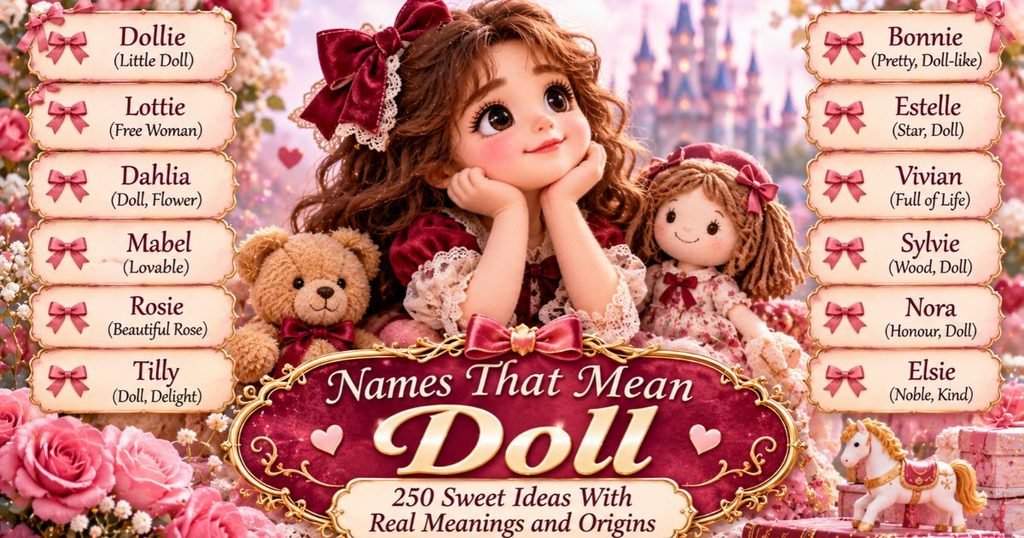
Names That Mean Doll: 250 Sweet Ideas With Real Meanings and Origins
Names that mean doll include Dolly, Poppet, Pupa, Bambola, Muñeca, Gudiya, and Ningyō. Some come straight from the word for doll in another language, while others, like Dolly (a pet form of Dorothy), shaped the English word itself. This guide gives 250 real options with origins and meanings.
Names Taken Straight From the Word
Most entries below are words rather than traditional given names. Use them as nicknames, middle names, character names, or names for dolls. If you are looking for baby names that mean doll, pair a short word with a familiar first name, such as “Isabel Pupetta.”
Doll Names From European Languages
- Dolly (English) – A pet form of Dorothy that gave English the word “doll.” Sweet, classic, and easy to say.
- Dollie (English) – A vintage spelling of Dolly with a storybook look.
- Doll (English) – The word itself. It works as a bold nickname or middle name.
- Poppet (English) – A little doll, and a British term of love for a small child. It comes from Old French poupette.
- Pupa (Latin) – “Girl” or “doll.” The root of puppet and pupil.
- Pupetta (Italian) – “Little doll,” often used as a loving nickname.
- Bambola (Italian) – “Doll.” It has a soft, musical sound.
- Bambolina (Italian) – “Little doll,” built with the tiny “-ina” ending.
- Poupée (French) – “Doll,” said poo-PAY.
- Poupette (French) – “Little doll,” a tender nickname.
- Muñeca (Spanish) – “Doll,” said moo-NYEH-kah.
- Muñequita (Spanish) – “Little doll,” common as a sweet nickname.
- Boneca (Portuguese) – “Doll,” said boh-NEH-kah.
- Bonequinha (Portuguese) – “Little doll.”
- Lalka (Polish) – “Doll.” It is also the title of Bolesław Prus’s 1890 novel The Doll.
- Laleczka (Polish) – “Little doll.”
- Kukla (Russian, Bulgarian) – “Doll” (кукла). It can also mean puppet.
- Kukolka (Russian) – “Little doll” (куколка). Russians also use it for a pretty girl.
- Lyalka (Ukrainian) – “Doll” (лялька).
- Panenka (Czech) – “Doll,” from a word for maiden.
- Lutka (Serbian, Croatian) – “Doll” or “puppet.”
- Lutkica (Serbian, Croatian) – “Little doll,” a common pet name.
- Koukla (Greek) – “Doll” (κούκλα). In everyday Greek it also means a lovely girl.
- Papusa (Romanian) – “Doll” (păpușă).
- Puppe (German) – “Doll.”
- Püppchen (German) – “Little doll,” often used as an endearment.
- Dukke (Danish, Norwegian) – “Doll.”
- Docka (Swedish) – “Doll.”
- Nukke (Finnish) – “Doll.”
- Nina (Catalan) – “Doll” and also “girl” in Catalan. In other languages Nina has different origins, so the meaning depends on the culture.
- Bábóg (Irish) – “Doll.”
Doll Names From Asia and the Middle East
- Gudiya (Hindi) – “Doll” (गुड़िया). It is also a loving nickname for a little girl.
- Guddi (Hindi, Punjabi) – A pet form of gudiya, widely used as a girl’s nickname.
- Putli (Hindi, Nepali) – “Doll” or “puppet.” It also means the pupil of the eye, just like Latin pupa.
- Putul (Bengali) – “Doll” (পুতুল), also used as a pet name.
- Bomma (Telugu) – “Doll” or “picture.”
- Bommai (Tamil) – “Doll.” It also appears in bommai kolu, the doll display at Navaratri.
- Bahuli (Marathi) – “Doll.”
- Boneka (Indonesian, Malay) – “Doll.”
- Manika (Tagalog) – “Doll.”
- Tukkata (Thai) – “Doll” (ตุ๊กตา).
- Wawa (Chinese) – “Doll” or “baby” (娃娃). It is short and playful.
- Inhyeong (Korean) – “Doll” (인형).
- Buba (Hebrew) – “Doll” (בובה).
- Arusak (Persian) – “Doll” (عروسک), literally “little bride.”
- Arousa (Arabic) – “Doll” and “bride” (عروسة).
- Dumya (Arabic) – “Doll” or small statuette (دمية).
You Can Also Read: Names That Mean Siren: 500 Mythical, Sea-Born & Enchanting Name Ideas.
Japanese Name That Means Doll
- Ningyō (人形) – “Doll,” literally “human shape.” Said nin-GYOH.
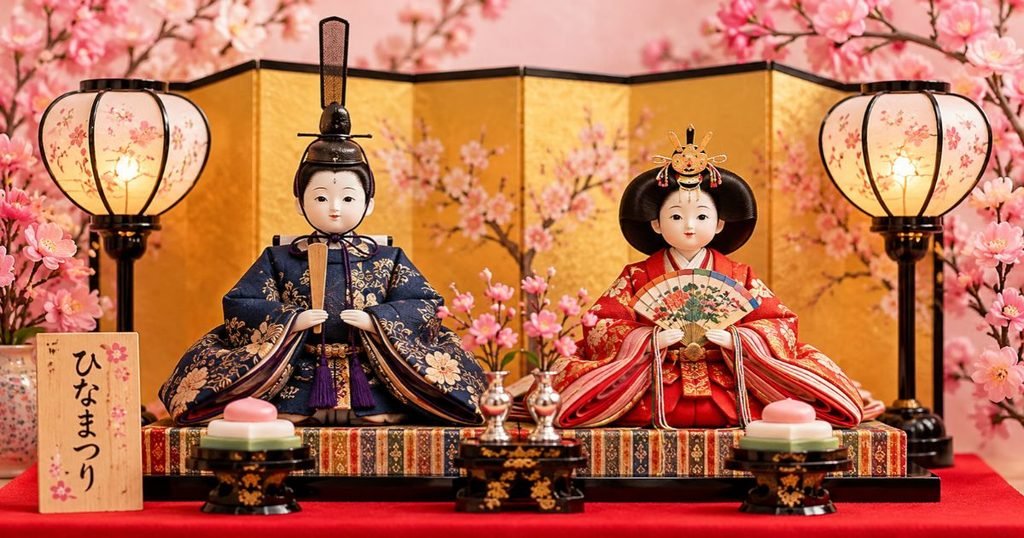
- Hina (雛) – A small doll, and the root of Hina Matsuri. It can also mean “chick,” so context matters.
- Hinako (雛子) – “Hina child,” a gentle given name tied to the festival.
- Hinano – A given name built on hina, with a flowing sound.
- Ohinasama – The respectful name for the empress doll in a Hina display.
- Odairisama – The emperor doll that sits beside her.
- Kanjo (官女) – “Court lady.” Three court-lady dolls stand on the display.
- Momo (桃) – “Peach,” linked to the Peach Festival.
- Momoko – “Peach child.”
- Kokeshi – The famous wooden doll from Tōhoku, loved for its smooth, simple shape.
- Daruma – A round, roly-poly doll based on Bodhidharma. People paint in one eye when they set a goal.
- Ichimatsu – A child-like doll with glass eyes, named after the kabuki actor Sanogawa Ichimatsu.
- Gosho – A “palace doll,” plump and white-skinned, tied to the imperial court in Kyoto.
- Karakuri – The mechanical dolls of Japan’s Edo period, such as the tea-serving doll.
- Kimekomi – Dolls whose cloth is tucked into grooves in carved wood.
- Hakata – Painted clay dolls from the Hakata area of Fukuoka.
- Nagashibina – “Floating hina,” paper dolls set on a river to carry away bad luck.
- Teruteru – From teru teru bōzu, a small cloth doll hung in a window to wish for sunshine.
- Hōko – An old protective doll made for children.
- Amagatsu – A traditional protective doll, close kin to the hōko.
Puppet and Marionette Names
A puppet is a doll that moves, and the two words share a family tree. French poupée gave us both “puppet” and “poppet.” The word marionette comes from Marion, a pet form of Marie, so a marionette is literally a “little Marion.” That makes Marion one of the best-documented names linked to dolls and puppets.
Some of these entries are everyday words for puppet, while others are famous puppet characters. We keep them in separate groups so the origin stays clear.
Words for Puppet Around the World
- Marion (French) – A pet form of Marie and the root of “marionette.”
- Marionette (French) – A puppet worked by strings.
- Mariette (French) – “Little Marie,” a close cousin of Marion.
- Marioneta (Spanish, Portuguese) – “Marionette.”
- Títere (Spanish) – “Puppet.”
- Fantoccio (Italian) – “Puppet.”
- Fantoche (Portuguese) – “Puppet.”
- Pupazzo (Italian) – A puppet or doll-like figure, from the same pupa root.
- Pantin (French) – A jointed puppet pulled by a string, a dancing toy.
- Loutka (Czech) – “Puppet.” Czech puppetry has a long, proud tradition.
- Bábka (Slovak) – “Puppet” and “doll.”
- Kathputli (Hindi, Rajasthani) – “Wood doll,” from kath (wood) and putli (doll). It names the string puppets of Rajasthan.
- Wayang (Javanese, Indonesian) – The puppet theatre of Java and Bali, including shadow puppets. UNESCO recognizes it as cultural heritage.
- Nang (Thai) – Leather shadow puppets, from the word for hide or skin.
- Bunraku (Japanese) – The classic puppet theatre of Osaka.
- Jōruri (Japanese) – The chanted storytelling that accompanies bunraku puppets.
- Kukolnik (Russian) – A puppeteer or doll-maker.
Famous Puppet Names
- Pinocchio (Italian) – Carlo Collodi’s wooden puppet, serialized from 1881. The name matches the Italian word for pine nut.
- Geppetto (Italian) – Pinocchio’s maker, a short form of Giuseppe.
- Punch (English) – The hand puppet whose show Samuel Pepys saw in London in 1662. He grew out of the Italian Pulcinella.
- Judy (English) – Punch’s wife, who was called Joan in early shows.
- Pulcinella (Italian) – The Neapolitan stage clown and ancestor of Punch.
- Petrushka (Russian) – A folk puppet and the hero of Stravinsky’s 1911 ballet.
- Guignol (French) – A glove puppet from Lyon, created in the early 1800s.
- Kasper (German) – The clever, cheeky hand puppet of German children’s theatre.
- Karagöz (Turkish) – A shadow-puppet comedian, loved across Turkey.
- Hacivat (Turkish) – Karagöz’s polite partner in the shadow plays.
- Sooty (English) – A British glove puppet beloved since 1948.
- Kermit (English) – The Muppet frog Jim Henson created in 1955.
- Lamb Chop (English) – Shari Lewis’s gentle sock puppet.
- Howdy Doody (English) – The freckled marionette star of 1940s American TV.
Boy Names That Mean Doll
- Gudda (Hindi) – “Boy doll” (गुड्डा). Children play gudda-gudiya wedding games.
- Guddu (Hindi) – A common boy’s nickname that comes from gudda.
- Ken – Barbie’s partner, named for Ruth Handler’s son Kenneth and introduced in 1961.
- Andy – Raggedy Andy, the rag-doll brother of Raggedy Ann.
- Woody – The pull-string cowboy doll in Toy Story.
- Buzz – Buzz Lightyear, the action figure named for astronaut Buzz Aldrin.
- Chucky – The horror-movie doll Charles Lee Ray, for fans of darker names.
- Charlie – Charlie McCarthy, the famous ventriloquist dummy of Edgar Bergen.
- Slappy – The wisecracking dummy in R. L. Stine’s Goosebumps books.
- Fritz – Marie’s brother in E.T.A. Hoffmann’s Nutcracker story.
- Franz – The young hero of the ballet Coppélia, who falls for a doll.
- Coppelius – The mysterious dollmaker in Coppélia.
- Drosselmeyer – The toymaker who gives the Nutcracker to Marie (Clara in the ballet).
- Joe – G.I. Joe, the 1964 toy that gave us the term “action figure.”
- Tik-Tok – The clockwork man in L. Frank Baum’s Oz books.
Names That Mean Beautiful or Pretty
- Bella (Italian) – “Beautiful.” Doll-like, but not literally doll.
- Belle (French) – “Beautiful,” with a classic porcelain-doll charm.
- Bonita (Spanish) – “Pretty.”
- Linda (Spanish, Portuguese) – “Pretty.”
- Jolie (French) – “Pretty.”
- Bonnie (Scots) – “Pretty” or “good.”
- Mirabel (Latin) – “Wonderful,” from mirabilis.
- Amabel (Latin) – “Lovable,” from amabilis.
- Annabel – Likely a variant of Amabel, and a vintage doll-name favorite.
- Clarabelle – Clara (“bright”) plus belle.
- Rosabel – “Rose” plus “beautiful.”
- Calista (Greek) – “Most beautiful.”
- Jamila (Arabic) – “Beautiful.”
- Sundari (Sanskrit) – “Beautiful woman.”
- Mei (Chinese) – “Beautiful” with the character 美. Other characters give other meanings, such as “plum.”
Names That Mean Little Girl or Little One
- Paula (Latin) – “Small.”
- Paulina (Latin) – A softer, longer form meaning “small.”
- Nena (Spanish) – “Baby girl” or “little girl.”
- Nenita (Spanish) – “Little girl.”
- Bimba (Italian) – “Baby girl.”
- Bambina (Italian) – “Little girl.”
- Bambi (Italian-derived) – From bambino, “child.”
- Bebita (Spanish) – “Little baby girl.”
- Chiquita (Spanish) – “Little one.”
- Piccola (Italian) – “Little.”
Names That Mean Darling, Dear, or Sweet
- Chérie (French) – “Dear” or “darling.”
- Mignon (French) – “Dainty” or “cute.”
- Mignonette (French) – “Little darling.” It is also a fragrant flower.
- Cara (Italian) – “Dear.”
- Carina (Italian) – “Dear” or “cute.”
- Bijou (French) – “Jewel.”
- Dulcinea (Spanish) – From dulce, “sweet.” Cervantes created it in 1605 for Don Quixote’s ideal lady.
- Dulcie (English) – “Sweet.”
- Adora (Latin) – “Adored.”
- Aiko (Japanese) – “Beloved child.”
The Dorothy Family: Where “Doll” Began
- Dorothy (Greek) – “Gift of God.” The parent name of Dolly.
- Dorothea (Greek) – The fuller form with the same meaning.
- Theodora (Greek) – The same two roots in reverse order, with the same meaning.
- Dolores (Spanish) – “Sorrows,” from the title Our Lady of Sorrows. Dolly also served as a pet form here.
- Dorotea (Spanish, Italian) – The Romance-language form of Dorothea.
Little-Version Names: -ette, -etta, and -ella
Many languages add endings like -ette or -etta to mean “little.” It is the same idea as poupette (“little doll”), so these names have a doll-sized charm.
- Rosetta (Italian) – “Little rose.”
- Violetta (Italian) – “Little violet.”
- Fiorella (Italian) – “Little flower.”
- Colette (French) – A pet form of Nicole, “victory of the people.”
- Juliette (French) – “Little Julia.”
- Giulietta (Italian) – The Italian “little Julia.”
- Antoinette (French) – A feminine diminutive of Antoine.
- Henrietta (English) – A feminine diminutive of Henry.
- Georgette (French) – A feminine form of Georges, “farmer.”
- Paulette (French) – “Little Paula.”
- Lisette (French) – “Little Lise.”
- Annette (French) – “Little Anne.”
- Babette (French) – A pet form of Barbe or Élisabeth.
- Nanette (French) – “Little Nan.”
- Marietta (Italian) – “Little Maria.”
- Jeanette (French) – “Little Jeanne.”
- Lynette (Welsh) – A name from Arthurian tales, linked to the Welsh Eluned.
- Eluned (Welsh) – “Idol” or “image,” a figure-like meaning.
- Josette (French) – “Little Josephine.”
- Nicolette (French) – “Little Nicole.”
- Suzette (French) – “Little Suzanne.”
- Charlotte (French) – A feminine diminutive of Charles.
- Pierrette (French) – A feminine form of Pierre, tied to the stage clown Pierrot.
- Lucette (French) – “Little Lucy.”
- Fifi (French) – A pet form of Josephine, with Parisian polish.
Famous Doll Names for Collectors, Writers, and Fans
If you name dolls for fun, write stories, or want a recognizable nod, famous doll names make great starting points. Barbie debuted in 1959 from Mattel and was named after Ruth Handler’s daughter Barbara. Many of the names below grew from that toy world. These are brand and character names owned by their makers, so use them for inspiration and check trademarks for any commercial project.
Fashion Dolls
- Barbie – The fashion doll Mattel launched in 1959, named for Barbara Handler.
- Skipper – Barbie’s younger sister, introduced in 1964.
- Midge – Barbie’s best friend, from 1963.
- Stacie – Another younger sister of Barbie, from 1992.
- Blythe – The big-eyed 1970s fashion doll with changing eye colors.
- Tammy – Ideal Toy Company’s teen doll from the early 1960s.
- Cissy – Madame Alexander’s tall, elegant fashion doll.
- Ginny – The small Vogue doll that charmed 1950s children.
- Polly – The tiny compact doll Polly Pocket.
- Cloe – One of the original Bratz dolls of 2001.
- Yasmin – A Bratz original.
- Sasha – A Bratz original.
- Jade – A Bratz original.
Baby, Rag, and Character Dolls
- Kewpie – Rose O’Neill’s cupid-inspired doll from 1909.
- Ann – As in Raggedy Ann, Johnny Gruelle’s red-yarn-haired rag doll.
- Betsy – Betsy Wetsy, the drink-and-wet baby doll of the 1930s.
- Cathy – Chatty Cathy, Mattel’s talking doll from 1960.
- Hitty – The wooden doll narrator in Rachel Field’s 1929 book, a Newbery Medal winner.
- Holly – Holly Hobbie, the calico-bonnet character of the 1970s.
- Strawberry – Strawberry Shortcake, the fruity favorite from 1979.
- Tressy – The 1963 doll whose hair “grew.”
- Dingle – Dolly Dingle, Grace Drayton’s early paper-doll star.
American Girl and Monster High
- Samantha – One of the first three American Girl dolls in 1986.
- Molly – An original American Girl from 1986.
- Kirsten – An original American Girl from 1986.
- Felicity – An American Girl set in colonial Virginia.
- Addy – An American Girl who escapes slavery in the Civil War era.
- Kit – An American Girl of the Great Depression.
- Josefina – An American Girl from 1824 New Mexico.
- Julie – An American Girl from 1970s San Francisco.
- Draculaura – A Monster High original from 2010.
- Clawdeen – A Monster High original.
- Frankie – Frankie Stein of Monster High.
- Cleo – Cleo de Nile of Monster High.
- Lagoona – Lagoona Blue of Monster High.
Screen Dolls and More Favorites
- Jessie – The yodeling cowgirl doll in Toy Story 2.
- Bo Peep – The porcelain shepherdess figurine in Toy Story.
- Bitty – American Girl’s baby doll line.
- Lottie – The sturdy, adventurous doll from the UK brand Arklu.
- Kelly – Barbie’s littlest sister, introduced in the 1990s.
Names From Folk Dolls, Fairy Tales, and Ballet
Dolls have shaped culture for thousands of years. Egyptians, Greeks, and Romans all made them. Today the matryoshka, the Russian nesting doll, first appeared in the 1890s. The Hopi carve kachina dolls to teach children about spirit beings. This section gathers names from those traditions and from stories where dolls come alive.
Traditional Dolls and Doll Heritage
- Matryoshka (Russian) – The nesting doll, from the name Matryona.
- Matryona (Russian) – The old peasant name behind matryoshka, from Latin matrona, “lady.”
- Babushka (Russian) – “Grandmother.” Westerners often use it as a nickname for nesting dolls.
- Motanka (Ukrainian) – A traditional rag doll made by winding cloth, often left faceless.
- Akuaba (Akan, Ghana) – A wooden fertility doll, said to mean “Akua’s child.”
- Ibeji (Yoruba) – “Twins.” Carved ibeji figures honor twins in Yoruba tradition.
- Namji (Cameroon) – A name for carved wooden dolls from northern Cameroon.
- Biiga (Mossi, Burkina Faso) – “Child,” used for Mossi dolls.
- Kachina (Hopi) – A spirit being, also carved as a doll.
- Tihu (Hopi) – The Hopi word for a carved kachina doll.
- Lele (Otomí, Mexico) – A cloth doll from Amealco, Querétaro, with braided hair and bright dress.
- Marías (Otomí, Mexico) – The “María dolls,” another Otomí cloth-doll tradition.
- Pupi (Sicilian) – The armored puppets of Sicily’s Opera dei Pupi, which UNESCO recognizes.
- Plangon (Ancient Greek) – A word for doll (πλαγγών), also used as a woman’s name.
- Kore (Ancient Greek) – “Girl” or “maiden.” Greeks also used it for a doll and for the pupil of the eye.
- Ushabti (Egyptian) – Tiny helper figures placed in tombs, not toys but doll-like figurines.
- Bleuette (French) – A beloved French doll from 1905, sold with a girls’ magazine and sewing patterns.
- Käthe (German) – For Käthe Kruse, who began making cloth dolls in 1905.
- Jumeau (French) – “Twin.” Maison Jumeau was famous for its 19th-century bisque dolls.
Living Dolls in Stories, Ballet, and Film
- Coppélia – The doll with enamel eyes in Delibes’s ballet, which premiered in Paris in 1870.
- Swanilda – The ballet’s heroine, who poses as the doll.
- Olimpia – The mechanical doll in Hoffmann’s 1816 story “The Sandman.”
- Galatea – The statue that came to life in the Pygmalion myth.
- Pygmalion – The sculptor who carved her.
- Pandora (Greek) – “All gifts.” In myth she was the first woman, shaped from clay.
- Clara – The ballet heroine of The Nutcracker (1892), meaning “bright.”
- Marie – The girl in Hoffmann’s original Nutcracker tale.
- Nussknacker (German) – “Nutcracker,” the toy soldier doll at the heart of the story.
- Thumbelina – Hans Christian Andersen’s tiny girl, from 1835.
- Vasilisa – The Russian folktale heroine whose dying mother leaves her a magic doll.
- Coraline – Neil Gaiman’s 2002 heroine, who meets button-eyed dolls.
- Sally – The stitched rag doll in The Nightmare Before Christmas (1993).
You May Also Read: Male Names That Mean Gold: 250 Golden Boy Names With Meanings.
Conclusion
You now have 250 names that mean doll or carry a real doll connection. They span words for doll in dozens of languages, Japanese traditions, famous puppets, and fairy-tale favorites. The best choice is the one that sounds right and has a story you enjoy telling. Bookmark this page, share it with a fellow name-hunter, or tell us your favorite in the comments.
FAQs
What name means doll?
Dolly, Poppet, Pupa, Bambola, Muñeca, Gudiya, and Ningyō all mean doll. Dolly is a pet form of Dorothy that gave English the word “doll.” The others are words for doll in English, Latin, Italian, Spanish, Hindi, and Japanese.
What is a Japanese name that means doll?
Ningyō (人形) is the Japanese word for doll. Hina (雛) means a small doll and names the Hina Matsuri festival on March 3. Hinako (“hina child”) works as a given name, and Kokeshi names the classic wooden doll.
What is a girl name that means doll?
Dolly, Dollie, Pupetta, Bambolina, and Gudiya literally mean doll or little doll. Names like Bella or Belle feel doll-like but mean “beautiful.” Names ending in -ette, such as Colette or Juliette, add a “little one” feel.
Are there boy names that mean doll?
Yes, but few. Gudda is the Hindi word for a boy doll, and Guddu is a common nickname from it. Famous male doll names include Ken, Andy (Raggedy Andy), Woody, and Joe, and puppet names include Pinocchio and Kasper.
What name means puppet?
Marion is the root of “marionette” and is the best-documented puppet name. Other puppet words include Marioneta (Spanish), Títere (Spanish), Fantoccio (Italian), Kathputli (Hindi), and Petrushka (Russian), plus famous puppets like Pinocchio and Punch.