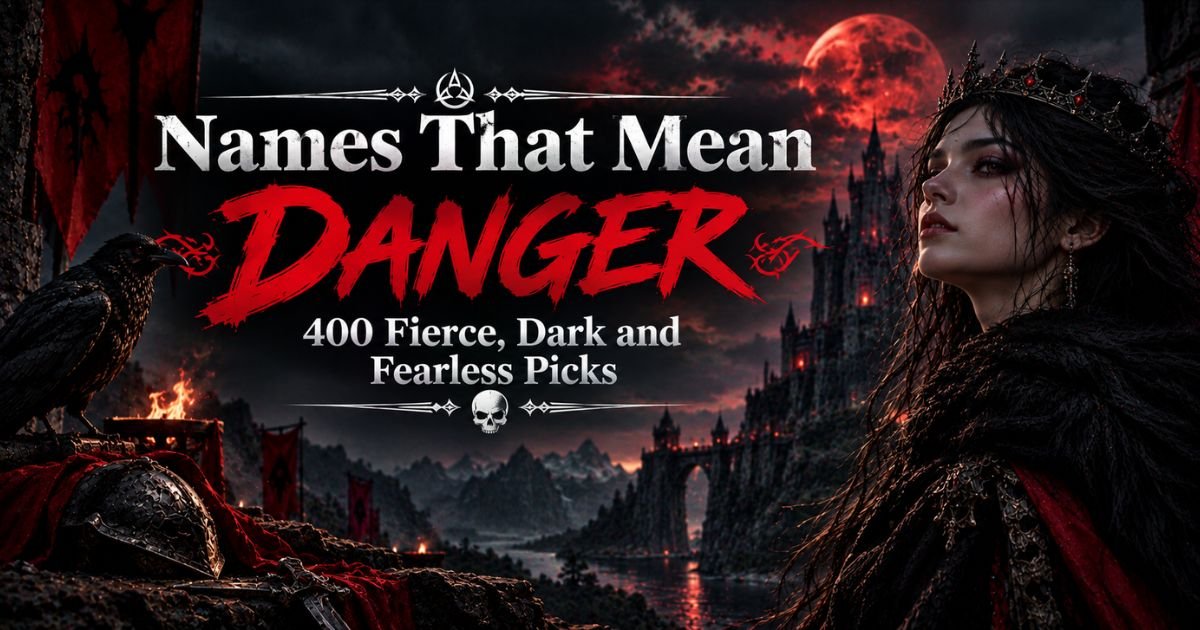
Names That Mean Danger: 400 Fierce, Dark and Fearless Picks
Names that mean danger are names whose meanings or legends point to risk, war, death, storms, or fierce beasts. Few names literally mean “danger” — Danger, Peril, and Hazard are the rare exceptions — so most picks, like Bellatrix, Fenrir, Nemesis, and Kali, earn the label through mythology and history.
Below you’ll find 400 names with origins and short meanings, grouped by vibe. You’ll also learn which meanings are literal, which are legend, and how to choose a bold name without regret.
Girl Names That Mean Danger
Girl names that mean danger often come from goddesses, sorceresses, and avenging spirits. Greek mythology gives us the Furies, the Gorgons, and the Fates. Celtic mythology adds war queens and battle crows. Hindu mythology brings in fearsome goddesses who defeat demons.
Goddesses, Furies and Sorceresses
- Bellatrix (Latin) – “female warrior”; also a bright star in Orion.
- Alecto (Greek) – “unceasing”; one of the three Furies.
- Megaera (Greek) – “grudging, jealous”; a Fury.
- Tisiphone (Greek) – “avenger of murder”; a Fury.
- Atropos (Greek) – “inflexible”; the Fate who cuts the thread of life.
- Morta (Latin) – Roman fate goddess whose name echoes mors, “death.”
- Morrigan (Irish) – often read as “phantom queen”; Celtic goddess of war and fate.
- Medusa (Greek) – “guardian”; the Gorgon whose gaze turned people to stone.
- Stheno (Greek) – “strength”; one of the Gorgon sisters.
- Euryale (Greek) – “far-roaming”; another Gorgon sister.
- Circe (Greek) – “falcon”; the sorceress who turned sailors into pigs in the Odyssey.
- Medea (Greek) – “planning, cunning”; sorceress of Greek tragedy.
- Hecate (Greek) – goddess of witchcraft and crossroads; the meaning is debated.
- Calypso (Greek) – “she who hides”; the nymph who held Odysseus on her island.
- Lilith (Akkadian) – “of the night”; night demon in Mesopotamian and Jewish lore.
- Lamia (Greek) – child-eating queen turned monster in Greek myth.
- Kali (Sanskrit) – “black” or “time”; Hindu goddess of destruction and renewal.
- Rangda (Balinese) – demon queen in Balinese myth.
- Sekhmet (Egyptian) – “the powerful one”; lioness goddess of war and plague.
- Ishtar (Akkadian) – Mesopotamian goddess of love and war.
- Nemesis (Greek) – “retribution”; goddess of divine payback.
- Eris (Greek) – “strife”; goddess of discord.
- Enyo (Greek) – war goddess with a “warlike” name.
- Pandora (Greek) – “all-gifted”; opened the jar that released troubles.
- Persephone (Greek) – often glossed “bringer of destruction”; queen of the Underworld.
- Hel (Old Norse) – “concealed”; ruler of the realm of the dead.
- Skadi (Old Norse) – giantess goddess of winter and hunting; the name may link to “harm.”
- Marzanna (Slavic) – goddess of winter and death, whose effigy is drowned or burned each spring.
- Mara (Hebrew) – “bitter”; also a nightmare spirit in Germanic folklore, the root of “nightmare.”
You May Also Read: Girl Names That Mean Dragon: 350 Fierce, Mythic and Meaningful Ideas.
Femmes Fatales, Queens and Modern Edge
- Delilah (Hebrew) – commonly glossed “delicate”; the biblical betrayer of Samson.
- Jezebel (Hebrew) – meaning debated; a biblical queen whose name became shorthand for scheming.
- Salome (Hebrew) – “peace”; tradition links the name to the dancer in the John the Baptist story.
- Clytemnestra (Greek) – “renowned wooing”; the queen who killed Agamemnon.
- Morgana (Arthurian) – possibly “sea-born”; sorceress and half-sister of King Arthur.
- Lorelei (German) – a Rhine cliff and the siren whose song wrecked sailors, created by poet Clemens Brentano around 1801.
- Siren (Greek) – bird-women who lured sailors to their deaths.
- Belladonna (Italian) – “beautiful lady”; also the poisonous deadly nightshade.
- Raven (English) – dark bird long linked to omens and death.
- Vixen (English) – a female fox; a sharp, cunning woman.
- Calamity (Latin) – “disaster”; Calamity Jane carried it into the Old West.
- Rogue (English) – a scoundrel or lone wanderer.
- Cruella (coined from “cruel”) – the villain of Dodie Smith’s 1956 novel The Hundred and One Dalmatians.
- Ursula (Latin) – “little she-bear”; also a famous fictional sea witch.
- Carmilla (literary) – the vampire of Sheridan Le Fanu’s 1872 novella.
- Medb (Irish) – “she who intoxicates”; warrior queen of Connacht.
- Scáthach (Irish) – “shadowy one”; warrior woman who trained the hero Cú Chulainn.
- Badb (Irish) – “crow”; Celtic battle spirit.
- Durga (Sanskrit) – “hard to reach”; Hindu warrior goddess who defeats demons.
- Ereshkigal (Sumerian) – “queen of the great below.”
- Izanami (Japanese) – “she who invites”; goddess who rules Yomi, the land of the dead.
Boy Names That Mean Danger
Boy names that mean danger lean on tyrants, conquerors, and villains. Many come from the Roman Empire, where emperors like Nero and Caligula earned lasting reputations. Others come from Shakespeare, Tolkien, and old demon lore. A few are blunt English words that sound like a dare.
Tyrants, Conquerors and Traitors
- Cain (Hebrew) – often glossed “acquired”; the first murderer in Genesis.
- Nero (Latin) – a Sabine word for “strong”; also Italian for “black”; the Roman emperor.
- Caligula (Latin) – “little boot”; a childhood nickname of the notorious emperor.
- Commodus (Latin) – “suitable”; the emperor who fought as a gladiator.
- Tarquin (Etruscan) – family name of Rome’s last, tyrannical king.
- Attila (Gothic) – “little father”; the Hun leader called the “Scourge of God.”
- Vlad (Slavic) – “rule”; Vlad the Impaler.
- Dracul (Romanian) – “the dragon”; title of Vlad II, father of Vlad the Impaler.
- Genghis (Mongolian) – title taken by Temujin; the meaning is debated.
- Hannibal (Phoenician) – “grace of Baal”; the general who crossed the Alps.
- Spartacus (Thracian) – the gladiator who led a slave revolt from 73 to 71 BC.
- Brutus (Latin) – “heavy, dull”; a leader of Caesar’s assassination.
- Cassius (Latin) – Roman family name; Caesar’s other key conspirator.
- Herod (Greek) – “hero-like”; the infamous king of Judea.
- Ahab (Hebrew) – “father’s brother”; a wicked king and Melville’s whaling captain.
Demons, Dark Gods and Legendary Villains
- Mordred (Welsh) – the knight who brought down King Arthur.
- Balor (Irish) – king of the Fomorians, whose evil eye destroyed whatever it saw.
- Sauron (Tolkien) – from Tolkien’s Quenya, roughly “the abhorred.”
- Loki (Old Norse) – meaning uncertain; the trickster god of Norse mythology.
- Lucifer (Latin) – “light-bringer”; the fallen angel.
- Damien (Greek) – “to tame”; also the child in the 1976 film The Omen.
- Draven (modern) – popularized by Eric Draven in The Crow comics.
- Draco (Greek) – “serpent”; the Athenian lawgiver whose harsh laws gave us “draconian.”
- Set (Egyptian) – god of chaos, storms, and the desert.
- Grendel (Old English) – the monster of Beowulf; the meaning is unclear.
- Mephisto (German) – short for Mephistopheles, the devil of the Faust legend.
- Azazel (Hebrew) – the desert demon of Leviticus; the meaning is debated.
- Belial (Hebrew) – “worthless” or “wickedness.”
- Beelzebub (Hebrew) – “lord of the flies.”
- Asmodeus (Persian) – from Avestan Aeshma, “wrath.”
- Moloch (Hebrew) – a deity linked in the Bible to child sacrifice.
Word Names, Outlaws and Literary Villains
- Danger (English) – “exposure to injury or harm”; the clearest literal pick.
- Hazard (English) – from an old French dice game; now “risk.”
- Peril (Latin) – from periculum, “trial, risk.”
- Menace (Latin) – from minaciae, “threats.”
- Dagger (English) – a short stabbing blade.
- Bandit (Italian) – an outlaw or robber.
- Outlaw (Old Norse) – someone outside the protection of the law.
- Cannon (French) – from the weapon, from “tube.”
- Gunner (Old Norse) – “bold warrior.”
- Blade (Old English) – the cutting edge of a sword.
- Bane (Old English) – from bana, “killer.”
- Savage (Old French) – from Latin for “of the woods.”
- Vandal (Germanic) – the tribe that sacked Rome in 455.
- Brigand (Italian) – “fighter” or “robber.”
- Corsair (French) – a pirate or privateer.
- Alaric (Gothic) – “ruler of all”; the Visigoth king who sacked Rome in 410.
- Tybalt (Germanic) – “bold people”; Romeo’s deadly rival in Shakespeare.
- Iago (Spanish) – a form of Jacob, “supplanter”; Othello’s betrayer.
- Macbeth (Gaelic) – “son of life”; the Scottish king who murders his way to the throne.
Unisex Names That Mean Danger
Unisex names that mean danger are the most flexible. They work for babies, characters, pets, and game handles. Many are bold word names or plants with a toxic side. Others are the plain word for “danger” in another language.
Attitude Names
- Rebel (English) – one who resists authority.
- Maverick (English) – from rancher Samuel Maverick, who left calves unbranded; now “independent.”
- Havoc (Old French) – “devastation.”
- Jinx (Latin) – from iynx, a bird used in spells; now “bad luck.”
- Chaos (Greek) – khaos, “void.”
- Riot (Old French) – “dispute, uproar.”
- Mayhem (Anglo-French) – originally “maiming.”
- Doom (Old English) – dom, “judgment or fate.”
- Hex (German) – from hexe, “witch.”
- Omen (Latin) – “sign, warning.”
- Vex (Latin) – from vexare, “to shake or trouble.”
- Wrath (Old English) – “anger.”
- Malice (Latin) – “badness.”
- Ruin (Latin) – “collapse.”
- Fury (Latin) – from furia, “rage.”
- Vendetta (Italian) – “vengeance” or “blood feud.”
- Sin (Old English) – synn, “wrongdoing.”
Poison, Thorn and Blade Names
- Venom (Latin) – from venenum, “poison.”
- Hemlock (English) – the poison that killed Socrates.
- Nightshade (English) – a plant family that includes deadly belladonna.
- Oleander (Latin) – a beautiful but toxic evergreen shrub.
- Aconite (Greek) – monkshood, a highly poisonous flower.
- Foxglove (English) – the source of digitalis; toxic if eaten.
- Thorn (Old English) – a sharp plant spike.
- Briar (English) – a thorny patch.
- Nettle (Old English) – a stinging plant.
- Razor (Old French) – from “to scrape.”
- Saber (French) – a curved cavalry sword.
- Lance (Latin) – from lancea, “light spear.”
- Katana (Japanese) – “sword”; the long, curved samurai blade.
- Rapier (French) – a slim, thrusting sword.
Danger in Other Languages
- Peligro (Spanish) – “danger.”
- Pericolo (Italian) – “danger.”
- Gefahr (German) – “danger.”
- Kiken (Japanese) – 危険, “danger.”
- Khatra (Hindi/Urdu) – “danger.”
- Tehlike (Turkish) – “danger.”
- Bahaya (Indonesian/Malay) – “danger.”
- Hatari (Swahili) – “danger.”
Demons and Daredevils
- Akuma (Japanese) – 悪魔, “devil, demon.”
- Oni (Japanese) – an ogre or demon of folklore.
- Diablo (Spanish) – “devil.”
- Dare (English) – “to risk.”
- Gambit (Italian) – from gambetto, “tripping”; a chess opening that risks a pawn.
- Raze (Old French) – “to scrape, tear down.”
- Striker (English) – one who hits.
- Rowdy (American English) – a rough, disorderly person.
- Hunter (English) – “one who hunts.”
- Ranger (Old French) – a forest keeper or wanderer.
- Risk (Italian) – from rischio, “danger, hazard.”
Dark Names That Mean Death and Darkness
Names that mean death and darkness are the shadow side of this topic. Greek mythology gives us Thanatos, Hades, and the rivers of the Underworld. Japanese folklore adds Shinigami and the words for shadow and night. Hebrew tradition brings angels of death and destruction.
Underworld Gods and Rivers
- Thanatos (Greek) – “death”; death personified.
- Hades (Greek) – often glossed “unseen”; ruler of the dead.
- Charon (Greek) – the ferryman of the dead; the name is linked to “fierce brightness.”
- Orcus (Latin) – Roman god who punished oath-breakers.
- Mors (Latin) – “death.”
- Pluto (Latin) – the Roman form of Hades; Greek for “wealth.”
- Styx (Greek) – “hateful”; river of the dead.
- Acheron (Greek) – “river of woe.”
- Erebus (Greek) – “deep darkness.”
- Nyx (Greek) – “night.”
- Nox (Latin) – “night.”
- Noctis (Latin) – “of the night.”
- Umbra (Latin) – “shadow.”
- Tenebris (Latin) – from tenebrae, “darkness.”
Angels, Reapers and Death Spirits
- Azrael (Hebrew/Arabic) – angel of death in Jewish and Islamic lore.
- Samael (Hebrew) – often read as “poison of God”; an angel of death.
- Abaddon (Hebrew) – “destruction.”
- Apollyon (Greek) – “destroyer,” from Revelation.
- Anubis (Greek) – the Greek form of the Egyptian jackal-headed guide of the dead.
- Osiris (Egyptian) – god of the afterlife and judgment of the dead.
- Yama (Sanskrit) – Hindu god of death.
- Ankou (Breton) – folklore figure who collects the souls of the dead.
- Shinigami (Japanese) – “death god.”
Shadow Names from Japan and Middle-earth
- Kage (Japanese) – “shadow.”
- Yami (Japanese) – “darkness.”
- Kuro (Japanese) – “black.”
- Morgoth (Sindarin) – “black foe”; Tolkien’s first dark lord.
- Morwen (Sindarin) – “dark maiden.”
- Morticia (coined) – a playful twist on “mortician,” made famous by the Addams Family.
Dark Word Names, Ghosts and Omens
- Sable (English) – black fur; heraldry’s word for black.
- Onyx (Greek) – “claw” or “fingernail”; a black gemstone.
- Obsidian (Latin) – black volcanic glass.
- Corvus (Latin) – “raven.”
- Crow (English) – the bird of battlefields and omens.
- Ebony (Greek) – dark, dense wood.
- Shade (Old English) – “shadow” or “ghost.”
- Shadow (Old English) – a dark shape cast by light.
- Gloom (English) – “darkness, sadness.”
- Dusk (Old English) – the dim edge of night.
- Midnight (English) – the dead center of the night.
- Eclipse (Greek) – from ekleipsis, “abandonment.”
- Specter (Latin) – from spectrum, “appearance”; a ghost.
- Wraith (Scottish) – a ghost or specter.
- Phantom (Greek) – from phantasma, “apparition.”
- Banshee (Irish) – from bean sí, “woman of the fairy mound.”
- Reaper (English) – a harvester; the Grim Reaper.
- Grim (Old English) – “fierce.”
- Scythe (Old English) – the reaper’s curved blade.
- Requiem (Latin) – “rest”; a Mass for the dead.
- Dirge (Latin) – from dirige, a funeral song.
- Lazarus (Hebrew) – “God has helped”; the man raised from the dead.
- Revenant (French) – “one who returns.”
- Lenore (literary) – the lost love in Poe’s “The Raven.”
- Draugr (Old Norse) – an undead revenant.
- Mortem (Latin) – “death,” as in post-mortem.
- Tartarus (Greek) – the deepest pit of the Underworld.
- Gehenna (Hebrew) – the valley that became a word for hell.
- Nihil (Latin) – “nothing.”
- Sorrow (Old English) – sorg, “grief.”
- Lethe (Greek) – “forgetfulness”; river of the Underworld.

Warrior Names That Mean War, Courage and Fierce Strength
Not all danger is dark. Some names that mean danger simply mean “battle.” Norse mythology is packed with them. Valkyries, war gods, and shield-maidens give us dozens of options. Celtic mythology and ancient Rome add heroes and generals.
Battle Women and Shield-Maidens
- Hilda (Germanic) – “battle.”
- Brynhild (Old Norse) – “armored battle.”
- Valkyrie (Old Norse) – “chooser of the slain.”
- Bellona (Latin) – Roman war goddess, from bellum, “war.”
- Hippolyta (Greek) – “unleasher of horses”; queen of the Amazons.
- Boudicca (Celtic) – “victory”; queen who led a revolt against Rome in AD 60–61.
- Gunnhild (Old Norse) – “war battle.”
- Gertrude (Germanic) – “spear strength.”
- Matilda (Germanic) – “mighty in battle.”
- Wilhelmina (Germanic) – “will” plus “helmet.”
- Andromache (Greek) – “battle of a man.”
- Zenobia (Greek) – “life of Zeus”; warrior queen of Palmyra.
- Tomyris (Massagetae) – queen who, per Herodotus, defeated Cyrus.
- Artemisia (Greek) – “gift of Artemis”; naval commander at Salamis.
- Mulan (Chinese) – “magnolia”; legendary woman warrior.
- Sigrid (Old Norse) – “beautiful victory.”
- Sigrun (Old Norse) – “victory secret”; a valkyrie in Eddic poetry.
- Ragnhild (Old Norse) – “counsel battle.”
- Thrud (Old Norse) – “strength”; daughter of Thor.
- Vigdis (Old Norse) – “war goddess.”
- Herja (Old Norse) – a valkyrie name, possibly “ravager.”
- Atalanta (Greek) – “equal in weight”; swift huntress and fighter.
- Nike (Greek) – “victory.”
Heroes, Generals and Gods of War
- Ragnar (Old Norse) – “warrior counsel.”
- Ivar (Old Norse) – “bow warrior.”
- Ajax (Greek) – mighty Greek hero at Troy; the meaning is uncertain.
- Achilles (Greek) – hero of Troy; the meaning is debated, often linked to “pain.”
- Hector (Greek) – “holding fast.”
- Ares (Greek) – god of war.
- Mars (Latin) – Roman god of war.
- Leonidas (Greek) – “lion’s son”; Spartan king at Thermopylae in 480 BC.
- Cuchulainn (Irish) – “hound of Culann”; Ulster’s greatest hero.
- Fergus (Irish) – “man of vigor.”
- Roland (Germanic) – “renowned land”; hero of The Song of Roland.
- Ludwig (Germanic) – “famous warrior.”
- Gunther (Germanic) – “battle warrior.”
- Harald (Old Norse) – “army ruler.”
- Garrick (Old English) – “spear ruler.”
- Maximus (Latin) – “greatest.”
- Gideon (Hebrew) – “feller” or “hewer”; a biblical warrior judge.
- Samson (Hebrew) – “sun”; the biblical strongman.
- Goliath (Philistine) – the giant of the David story.
- Sargon (Akkadian) – “true king.”
- Rustam (Persian) – hero of the Shahnameh.
- Shamsher (Persian) – “sword.”
- Odin (Old Norse) – “frenzy”; god of war and wisdom.
- Tyr (Old Norse) – god of war and justice.
- Sigurd (Old Norse) – “victory guardian.”
- Sigmund (Old Norse) – “victory protector.”
- Siegfried (Germanic) – “victory and peace.”
- Legion (Latin) – “levy of soldiers.”
- Ronin (Japanese) – “wave man”; a masterless samurai.
- Shogun (Japanese) – “general.”
- Vercingetorix (Gaulish) – chieftain who challenged Caesar at Alesia in 52 BC.
- Marius (Latin) – Roman general; the name is linked to Mars.
- Scipio (Latin) – “staff”; the general who beat Hannibal at Zama.
- Xerxes (Persian) – roughly “ruling over heroes.”
- Brand (Old English) – “sword” or “fire.”
- Bellator (Latin) – “warrior.”
- Wallace (Scots) – “Welshman”; Sir William Wallace led Scotland’s resistance.
Fierce Names Inspired by Wolves, Dragons and Monsters
Some of the scariest names come from beasts. Norse mythology gives us a wolf that kills a god. Greek mythology gives us serpents, hounds, and sea monsters. Japanese folklore adds spirits that shape-shift. These picks are great for characters, pets, and gamer tags.
Wolves and Bears
- Fenrir (Old Norse) – “fen-dweller”; the giant wolf who kills Odin at Ragnarök.
- Garm (Old Norse) – the hound guarding the gate of Hel.
- Ulf (Old Norse) – “wolf.”
- Lupo (Italian) – “wolf.”
- Lobo (Spanish/Portuguese) – “wolf.”
- Wolfgang (Germanic) – “wolf path.”
- Wolfram (Germanic) – “wolf raven.”
- Conan (Gaelic) – “little hound.”
- Beowulf (Old English) – often read as “bee-wolf,” meaning bear; the monster slayer.
- Bjorn (Old Norse) – “bear.”
- Lykos (Greek) – “wolf.”
- Lycan (Greek) – from King Lycaon, who was turned into a wolf in myth.
Serpents and Dragons
- Viper (Latin) – a venomous snake.
- Cobra (Portuguese) – from “snake with a hood.”
- Asp (Greek) – the snake linked to Cleopatra’s death.
- Adder (Old English) – a venomous snake.
- Mamba (Zulu) – from imamba, “snake.”
- Basilisk (Greek) – “little king”; a serpent whose gaze kills.
- Apophis (Greek) – the Greek form of Apep, the Egyptian serpent of chaos.
- Jormungandr (Old Norse) – “huge monster”; the world serpent fated to fight Thor.
- Nidhogg (Old Norse) – “malice striker”; the dragon gnawing the roots of Yggdrasil.
- Hydra (Greek) – “water serpent”; the many-headed beast Heracles fought.
- Python (Greek) – the serpent Apollo slew at Delphi.
- Typhon (Greek) – storm giant and “father of monsters.”
- Echidna (Greek) – “she-viper”; mother of monsters.
- Ladon (Greek) – the dragon guarding the golden apples.
- Fafnir (Old Norse) – the dragon slain by Sigurd.
- Smaug (Tolkien) – from a Germanic verb meaning “to squeeze through a hole.”
- Drago (Italian/Spanish) – “dragon.”
- Drake (Old English) – from draca, “dragon.”
- Wyvern (Old French) – from “viper.”
- Wyrm (Old English) – “serpent” or “dragon.”
- Tiamat (Babylonian) – the sea goddess and chaos dragon slain by Marduk.
- Orochi (Japanese) – “great serpent”; the eight-headed Yamata no Orochi.
- Naga (Sanskrit) – “serpent.”
- Vasuki (Sanskrit) – king of serpents in Hindu mythology.
Sea Beasts and Legendary Monsters
- Leviathan (Hebrew) – “coiled”; the sea monster of the Bible.
- Behemoth (Hebrew) – “beasts”; the giant of the Book of Job.
- Kraken (Scandinavian) – legendary sea monster of the North.
- Scylla (Greek) – the six-headed sea monster of the Odyssey.
- Charybdis (Greek) – the whirlpool monster paired with Scylla.
- Cerberus (Greek) – the three-headed hound of Hades.
- Orthrus (Greek) – the two-headed hound, brother of Cerberus.
- Chimera (Greek) – “she-goat”; a lion-goat-serpent hybrid.
- Minotaur (Greek) – “bull of Minos.”
- Manticore (Persian) – “man-eater.”
- Gorgon (Greek) – “grim, terrible.”
- Harpy (Greek) – “snatcher.”
- Griffin (Greek) – from gryps, “hooked”; a lion-eagle hybrid.
- Sphinx (Greek) – often glossed “strangler.”
- Cyclops (Greek) – “round eye.”
- Polyphemus (Greek) – the Cyclops who ate Odysseus’s men.
- Ammit (Egyptian) – “devourer”; she eats the hearts of the unworthy dead.
- Sobek (Egyptian) – the crocodile god.
- Ravana (Sanskrit) – often glossed “he who roars”; the ten-headed demon king of the Ramayana.
- Pazuzu (Mesopotamian) – demon of the southwest wind.
- Ifrit (Arabic) – a powerful jinn in Islamic folklore.
- Tengu (Japanese) – “heavenly dog”; a mountain spirit.
- Kitsune (Japanese) – “fox”; a shape-shifting spirit.
- Kaiju (Japanese) – “strange beast.”
Predator Names
- Talon (French) – “heel”; a bird’s claw.
- Fang (Old English) – from a word meaning “capture.”
- Raptor (Latin) – “robber, plunderer.”
- Scorpio (Latin) – “scorpion.”
- Panther (Greek) – a large black cat.
- Jaguar (Tupi-Guarani) – “beast that kills with one bound.”
- Tiger (Greek) – from tigris.
- Lynx (Greek) – the wildcat with piercing eyes.
- Sher (Persian/Urdu) – “lion” or “tiger.”
- Asad (Arabic) – “lion.”
Storm, Fire and Thunder Names That Mean Chaos
Nature is the oldest source of danger, and names that mean danger often borrow from it. Thunder gods turn up in nearly every culture. Fire names stretch from volcano goddesses to Norse giants who burn the world at Ragnarök. Even the desert winds have dramatic names.
Thunder and Storm Gods
- Tempest (Latin) – from tempestas, “storm.”
- Thor (Old Norse) – “thunder.”
- Raiden (Japanese) – “thunder and lightning”; also a thunder god.
- Indra (Sanskrit) – king of the Vedic gods and wielder of the thunderbolt.
- Perun (Slavic) – god of thunder and lightning.
- Taranis (Gaulish) – “thunderer.”
- Baal (Semitic) – “lord”; a storm god of the ancient Near East.
- Hadad (Semitic) – storm and rain god.
- Aeolus (Greek) – keeper of the winds.
- Boreas (Greek) – god of the north wind.
- Fujin (Japanese) – god of wind.
- Susanoo (Japanese) – storm god of Shinto myth.
- Shango (Yoruba) – god of thunder and lightning.
- Oya (Yoruba) – orisha of winds, storms, and change.
- Huracan (Maya) – storm god and the source of the word “hurricane.”
Weather Word Names
- Storm (Old English) – a violent weather system.
- Thunder (Old English) – the sound of lightning.
- Gale (English) – a strong wind.
- Cyclone (Greek) – from kyklos, “circle, coil.”
- Hurricane (Taíno via Spanish) – from huracán.
- Tornado (Spanish) – from tronada, “thunderstorm.”
- Maelstrom (Dutch) – “grinding stream.”
- Squall (Scandinavian) – a sudden violent wind.
- Blizzard (American English) – a violent snowstorm.
- Monsoon (Arabic) – from mawsim, “season.”
- Typhoon (Greek/Chinese) – a tropical storm in the western Pacific.
- Bolt (Old English) – a crossbow arrow; a lightning bolt.
- Tsunami (Japanese) – “harbor wave.”
- Vortex (Latin) – “whirlpool.”
- Deluge (Latin) – from diluvium, “flood.”
- Abyss (Greek) – “bottomless.”
Desert Winds
- Sirocco (Italian) – a hot wind from Africa, from Arabic sharq, “east.”
- Mistral (Occitan) – “masterly”; a fierce wind of southern France.
- Khamsin (Arabic) – “fifty”; a hot Egyptian wind.
- Simoom (Arabic) – from samum, “poison wind.”
Fire and Volcano Names
- Surt (Old Norse) – “black”; the fire giant who burns the world at Ragnarök.
- Pele (Hawaiian) – goddess of volcanoes.
- Etna (Greek) – often linked to “I burn”; Europe’s most active volcano.
- Vulcan (Latin) – Roman god of fire and the forge.
- Agni (Sanskrit) – “fire.”
- Ignis (Latin) – “fire.”
- Inferno (Italian) – from Latin infernus, “below”; hell.
- Blaze (Old English) – “torch, flame.”
- Pyro (Greek) – from pyr, “fire.”
- Phlegethon (Greek) – “flaming”; the fiery river of Hades.
- Ignatius (Latin) – often linked to “fiery.”
- Kagutsuchi (Japanese) – the fire god whose birth killed Izanami.
- Brimstone (Middle English) – “burning stone.”
- Scorch (English) – to burn the surface.
- Lava (Italian) – molten rock from a volcano.
- Magma (Greek) – “kneaded mass.”
More Natural Hazards
- Riptide (English) – a strong, dangerous ocean current.
- Undertow (English) – a pull beneath the waves.
- Whirlwind (English) – a spinning column of air.
- Cinder (Old English) – a burnt ember.
- Frost (Old English) – ice that bites.
- Avalanche (French) – a mountain slide of snow.
- Lightning (Old English) – the flash that precedes thunder.
- Quake (Old English) – “to shake.”
- Wildfire (English) – a fire that spreads out of control.
You Can Also Read: Girl Names That Mean Anger: 300 Fierce Names With Meanings.
Conclusion
Names that mean danger give you a deep well of bold, meaningful choices. Whether you want a Greek Fury, a Norse wolf, a storm god, or a plain word like Danger, there is a story behind every pick. Use the 400 names above to find the right fit for your baby, character, pet, or team. Bookmark this page, share your favorite in the comments, and explore more name lists on our site.
FAQs
What name means danger?
Very few names literally mean danger. The English word names Danger, Peril, and Hazard come closest, and foreign words like Peligro (Spanish) and Hatari (Swahili) work as creative picks. Most names on this list earn the label through myth, war, poison, or storms rather than dictionary meaning.
What are girl names that mean danger?
Bellatrix, Alecto, Medusa, Morrigan, Kali, Nemesis, Lilith, and Sekhmet lead the list. Each ties to a warrior, a Fury, a monster, or a goddess of destruction. Belladonna and Calamity offer modern, word-based options with a sharp edge.
What names mean death and darkness?
Thanatos (Greek, “death”), Mors (Latin, “death”), Nyx (Greek, “night”), Erebus (“deep darkness”), Yami (Japanese, “darkness”), and Kuro (“black”) are strong picks. Samael and Abaddon carry destruction themes from Hebrew tradition, while Morgoth and Morwen come from Tolkien’s Sindarin.
Can you name a baby after danger?
Yes, but check the full story first. Names like Ares, Ragnar, Hunter, and Raven are widely used. Names tied to real tyrants or demons, such as Nero, Herod, or Beelzebub, carry heavy baggage. Say it aloud, think about nicknames, and consider using a bold name as a middle name.
What is a good dangerous name for a villain or gaming character?
Pick a name that matches the character’s story. Draven, Mordred, Vendetta, Wraith, Viper, and Kraken all sound threatening and are easy to read. Short names with hard sounds like k, d, and v feel sharper, and mixing a myth name with a word name makes a handle unique.