300 Names That Mean Fairy: Real Folklore Names, Elf Names & Fairycore Picks
Names that mean fairy include Fay, Faye, Fae, Pari, Peri, and Pixie, which refer to fairies directly in English, French, and Persian. Others, like Titania, Oberon, Áine, and Mab, belong to famous fairy royalty from Shakespeare and Irish folklore. Elf names such as Alfred and Aubrey also carry fairy-folk roots.
Ever wondered which names that mean fairy are real, and which are just fantasy spelling? Here is a curated list of 300, sorted by origin, from Persian pari and Old English ælf to Irish sídhe queens and Shakespeare’s Titania. Each entry notes where the name comes from, so you can tell folklore from invention. Where a name is a modern coinage, we say so. Whether you are naming a baby, a pet, or a character in your next fantasy novel, you will find a name with real magic behind it.
Names That Mean Fairy: Direct Meanings From Around the World
These are the names whose root word is “fairy” or a close cousin such as sprite, nymph, or water spirit. They are the safest answer when someone asks which names truly mean fairy. Meanings come from the language of origin, and a few are rare as given names. We flag those.
English, French, Italian, and Spanish fairy names
- Fay — English, from Old French fae, “fairy.” Short, timeless, and instantly clear.
- Faye — Spelling variant of Fay. The extra letter gives it a softer, more modern look.
- Fae — Modern spelling of “fay,” popular in fantasy fiction and fairycore circles.
- Faerie — Archaic spelling made famous by Spenser’s The Faerie Queene (1590). Bold as a given name.
- Fey — From Old English fǣge, “fated.” It later came to mean “otherworldly,” which is why it suits fairy themes.
- Fée — French for “fairy.” Elegant, and nearly unused as a given name outside French-speaking countries.
- Fee — German for “fairy.” A real German given name, simple and light.
- Fata — Italian for “fairy,” from Latin fata. Rare as a given name, but it is the root of “fay.”
- Hada — Spanish for “fairy.” Short, two syllables, easy to say in English too.
- Faelyn — Modern coinage blending fae with the popular “-lyn” ending. Not a historical name.
- Faeryn — Modern coinage combining faery with a name-style ending. Not a historical name.
- Pixie — English folk word for a small fairy, first recorded in the 1600s, with an unknown root. Playful for a nickname or pet.
- Sprite — From Old French esprit, “spirit.” Best as a pet name or middle name.
- Sylph — Coined by the 16th-century physician Paracelsus for air spirits. A fairy-adjacent word with an elegant sound.
- Nixie — From German Nixe, a water sprite. Cute, bouncy, and well known in English.
Persian, Turkish, and Indian fairy names
- Pari — Persian and Urdu “fairy.” One of the most widely used fairy names in the world.
- Peri — Persian “winged fairy or spirit,” also a Turkish name. Quick to say, hard to forget.
- Parisa — Persian, “like a fairy.” Popular, melodic, and easy to spell.
- Pariya — Persian, “fairy-like.” A gentle variation on Pari.
- Parinaz — Persian, pari plus naz, “grace” or “delicate pride.” Means roughly “graceful fairy.”
- Parizad — Persian, “born of a fairy.” A rare name with a storybook feel.
- Parisima — Persian, pari plus sima, “face.” Means “fairy-faced.”
- Parivash — Persian, “fairy-like.” Rhythmic and distinctive.
- Parichehr — Persian, “fairy-faced.” A classic poetic compliment in Persian literature.
- Paridokht — Persian, “fairy daughter,” from dokht, “daughter.” Rare and dramatic.
- Perihan — Turkish, “fairy lady,” combining peri with a title element. Regal and rarely heard in English.
- Apsara — Sanskrit name for celestial nymphs of Hindu and Buddhist tradition. Graceful dancers of the heavens.
You May Also Read: Names That Mean Lost Soul: 400 Haunting Names With Real Meanings.
Central European, Slavic, and other fairy names
- Tünde — Hungarian, from tündér, “fairy.” Poet Mihály Vörösmarty gave it to the heroine of his play Csongor and Tünde (1830s).
- Zana — From Balkan folklore, where zana are mountain fairies. Used in Albania and neighboring regions.
- Vila — Slavic, from the vila, a fairy-like nature spirit of the Balkans.
- Diwata — Filipino, a nature spirit or fairy-like deity. Used as a given name in the Philippines.
- Nissa — Scandinavian name linked to nisse, a friendly household spirit. Sweet and compact.
- Síofra — Irish, “sprite” or “elf,” and in older usage a changeling. Pronounced roughly SHEE-fra. Rare and distinctive.
Elf Names With Old English and Norse Roots
Elves and fairies share a family tree in folklore. In Old English, ælf meant a supernatural being of the woods and hills, and many early English names were built from it. These elf names carry real history, and many belonged to kings, abbesses, and earls.
- Elfrida — Old English Ælfþryð, “elf strength.” Borne by a 10th-century English queen.
- Elfreda — Variant of Elfrida. Vintage, strong, and a little unusual today.
- Elfie — Pet form of Elfrida or Elfreda. Charming and instantly “elfin.”
- Elvina — Feminine form of Elvin, “elf friend.” Soft and old-fashioned.
- Alvina — Feminine form of Alvin, “elf friend.” A gentler alternative to Elvina.
- Ælfwynn — Old English, “elf joy.” The daughter of Æthelflæd, Lady of the Mercians.
- Ælfflæd — Old English, “elf beauty.” Borne by a 7th-century abbess of Whitby.
- Elgiva — From Old English Ælfgifu, “elf gift.” Used by several Anglo-Saxon queens.
- Alva — Scandinavian, linked to Old Norse álfr, “elf.” Short, modern, and easy.
- Alfhild — Old Norse Alfhildr, “elf battle.” A legendary shieldmaiden in Danish lore.
- Álfdís — Old Norse, “elf” plus dís, “lady” or “goddess.” Rare outside Iceland.
- Álfrún — Old Norse, “elf” plus rún, “secret” or “rune.” Used in Iceland.
- Álfheiður — Icelandic, “elf” plus heiðr, “bright.” A lovely long name with a clear meaning.
- Alfreda — Feminine form of Alfred, “elf counsel.” Stately and rare.
- Alvin — From Old English Ælfwine, “elf friend.” A friendly, approachable pick.
- Elvin — Variant of Alvin. Slightly softer on the tongue.
- Alwyn — Variant of Alvin, also used in Wales. Gentle and unfussy.
- Elwyn — Two roots: Welsh “fair brow” and Old English “elf friend.” Meaning depends on which tradition you follow.
- Ælfwine — The original Old English form of Alvin. Authentic and unmistakably “elf friend.”
- Alfred — Old English Ælfræd, “elf counsel.” Made famous by Alfred the Great, who ruled 871 to 899.
- Alfredo — Italian and Spanish form of Alfred. Warm and rhythmic.
- Alfie — Pet form of Alfred. A popular friendly nickname in the UK.
- Alf — Short for Alfred, and also Old Norse álfr, “elf.” Punchy and retro.
- Alberic — Germanic, “elf ruler.” The dwarf Alberich appears in the Nibelungenlied, and the name is the source of Oberon.
- Ælfric — Old English, “elf ruler.” Borne by the scholar Ælfric of Eynsham, who lived around 955 to 1010.
- Ælfgar — Old English, “elf spear.” Borne by an 11th-century earl of Mercia.
- Ælfheah — Old English, “elf high.” Saint Ælfheah (Alphege) was Archbishop of Canterbury until 1012.
- Alvar — From Old Norse Alfarr, “elf” plus “army.” A strong choice with a Nordic feel.
- Gandalf — From the Old Norse Dvergatal, roughly “wand-elf.” Tolkien borrowed it for his wizard.
- Elphame — Scots, “elf-home,” meaning fairyland. A 1588 witch trial mentions the “Queen of Elphame.”
Fairy Queen Names, Fairy King Names & Literary Fairy Names
Some names do not translate as “fairy,” but they belong to characters who rule fairyland. These royal and literary names come from stories, and most readers recognize them at once. Pairing a name with its story is a quick way to give it depth.
What Is the Name of the Fairy Queen?
The most famous fairy queen is Titania in Shakespeare’s A Midsummer Night’s Dream (around 1595). Mab appears in Romeo and Juliet, where Mercutio describes her as the dream-bringing fairy midwife. In Irish folklore, Áine, Clíodhna, and Oonagh are the best-known fairy queens, and Spenser’s Gloriana rules Faeryland in The Faerie Queene.
Queens and fairy ladies
- Titania — Shakespeare’s queen of the fairies. Ovid used the name for goddesses descended from the Titans.
- Mab — Fairy queen of dreams in Romeo and Juliet. Short, sharp, and uncommon.
- Gloriana — Edmund Spenser’s fairy queen in The Faerie Queene, an idealized Elizabeth I.
- Morgana — Feminine form of Morgan, tied to Morgan le Fay, “Morgan the Fairy,” of Arthurian legend.
- Nimue — Lady of the Lake in Arthurian romance. Enchanting and rarely used.
- Vivien — A Lady of the Lake in Tennyson’s Idylls of the King. Latin roots, “alive.”
- Mélusine — A fairy of French medieval romance, popularized by Jean d’Arras around 1393. Wife and serpent-woman.
- Pari Banu — The fairy bride in the “Prince Ahmed” tale of the Arabian Nights. Banu means “lady.”
- Holda — Germanic folk figure, Frau Holle, from Old High German “gracious.”
- Una — Character in Spenser’s The Faerie Queene, embodying truth. In Irish it is also linked to “lamb.”
- Ilona — Hungarian form of Helen, from the fairy-tale heroine Tündér Ilona, “Fairy Helen.”
Kings, lords, and fairy-court figures
- Oberon — Shakespeare’s fairy king, from French Auberon, from Germanic Alberic, “elf ruler.”
- Auberon — The French form of Oberon. A vintage twist.
- Finvarra — From Irish Fionnbharr, “fair head.” King of the fairies of Connacht in Irish folklore.
- Midir — Irish king of the Otherworld in “The Wooing of Étaín.” Strong and mysterious.
- Puck — Mischievous sprite in A Midsummer Night’s Dream. From Old English pūca, “goblin.”
- Tam Lin — Scottish ballad hero rescued from the Queen of Fairies. Often written Tamlin.
- Gwyn — Welsh, “white, blessed.” Gwyn ap Nudd is a king of the fairy folk in later Welsh lore.
- Huon — French form of Hugh, “mind.” Huon of Bordeaux was the knight who befriended Oberon.
Storybook and literary fairy names
- Ariel — Airy spirit in Shakespeare’s The Tempest (1611). Originally Hebrew, “lion of God.”
- Belphoebe — Spenser’s forest huntress. Means “beautiful Phoebe.”
- Amoret — Spenser’s heroine, “little love” from Old French.
- Iolanthe — The fairy heroine of Gilbert and Sullivan’s Iolanthe (1882). Greek, “violet flower.”
- Mélisande — Heroine of Maeterlinck’s play Pelléas et Mélisande (1893). Old French, “strong in work.”
- Lorelei — Enchanting Rhine siren from Brentano’s 1801 poem. Meaning debated, perhaps “murmuring rock.”
- Undine — Water spirit of Fouqué’s 1811 novella, from Latin unda, “wave.”
- Ondine — The French form of Undine. Graceful and fluid.
- Eilonwy — Princess in Lloyd Alexander’s Chronicles of Prydain (1964 to 1968). A Welsh-style invented name.
- Arwen — Tolkien’s elf-maiden. Sindarin, “noble maiden.”
- Galadriel — Tolkien’s lady of Lothlórien. Translated “maiden crowned with a radiant garland.”
- Lúthien — Tolkien’s Elf-maiden of Doriath, known as the singer who charmed the dark.
- Tinúviel — Sindarin, “nightingale.” Lúthien’s poetic byname.
- Legolas — Sindarin, “green leaf.” Tolkien’s elf archer.
- Elrond — Sindarin, “star-dome.” Master of Rivendell.
- Wendy — Popularized by J. M. Barrie’s Peter Pan (1904). Barrie’s story also introduced Tinker Bell.
- Aurora — Princess in Tchaikovsky’s ballet The Sleeping Beauty (1890). Latin, “dawn,” and fairies bless her at birth.
- Sabrina — River nymph in Milton’s Comus (1634). The Latin name of the River Severn.
- Celeborn — Sindarin, “silver tree.” Lord of Lothlórien.
- Eärendil — Tolkien’s mariner, said to mean “lover of the sea.” Also echoes Old English earendel, “shining light.”
- Florimell — Spenser’s fairy-tale beauty. Likely “flower-honey” from Latin flos and mel.
Welsh Otherworld names
- Rhiannon — Welsh heroine of the Mabinogion, from “great queen.” She rides a white horse from the Otherworld.
- Blodeuwedd — Welsh, “flower face.” She is conjured from blossoms in the Mabinogion.
- Olwen — Welsh, “white track.” White clover springs up where she walks, in Culhwch and Olwen.
- Arianrhod — Welsh, “silver wheel.” A star-goddess figure in the Mabinogion.
Irish and Scottish Fairy Names From the Sídhe Tradition
In Irish tradition, the fairy folk are the aos sí, people of the sídhe, the ancient mounds where they are said to live. Folklore often links them to the Tuatha Dé Danann, the old gods who retreated underground. Many of these names are musical, and the pronunciations are worth learning.
- Oonagh — Anglicized Úna, wife of Finvarra in Irish fairy lore. Often linked to uan, “lamb,” though the root is uncertain.
- Áine — Irish, “brightness, radiance.” A fairy queen of Munster, pronounced roughly AWN-ya.
- Clíodhna — Fairy queen of Munster and patron of the banshees of Cork. Meaning is uncertain, and it is pronounced roughly KLEE-na.
- Cliona — Anglicized spelling of Clíodhna, easier for English speakers.
- Aoibheall — Fairy woman of North Munster, tied to aoibh, “pleasant, radiant.” Pronounced roughly EE-vul.
- Aoibhinn — Irish, “beautiful, delightful.” Pronounced roughly EE-vin.
- Niamh — Irish, “bright, radiant.” In legend she carried Oisín to Tír na nÓg. Pronounced NEEV.
- Étaín — Heroine of “The Wooing of Étaín,” who is turned into a butterfly. Pronounced roughly AY-deen.
- Fand — Otherworld woman who loved Cú Chulainn. Meaning is debated, sometimes “tear.”
- Sadhbh — Irish, “sweet, goodness.” Pronounced SIVE. She is turned into a deer in the Fenian cycle.
- Fionnuala — Irish, “white shoulder.” One of the Children of Lir, turned into swans.
- Finola — Anglicized Fionnuala. Smooth and easy to say.
- Nuala — Short form of Fionnuala. Light, brief, and lyrical.
- Aoife — Irish, “radiance, beauty.” A warrior and rival figure in Irish tales. Pronounced EE-fa.
- Caer — Short for Caer Ibormeith, the swan-maiden loved by Aengus. A rare, haunting choice.
- Boann — Goddess of the River Boyne, “white cow.” Pronounced roughly BOH-an.
- Sinann — Goddess tied to the River Shannon. Soft, watery, and rare.
- Danu — Mother goddess of the Tuatha Dé Danann. Meaning is uncertain.
- Brigid — Irish, “exalted one.” Goddess of poetry, healing, and smithcraft.
- Aengus — Aengus Óg, god of love and youth, who lived at Brú na Bóinne. Often glossed “one strength.”
- Lugh — Radiant king of the Tuatha Dé Danann. Often glossed “bright, shining.”
- Oisín — Irish, “little deer.” Poet-warrior who went to the land of eternal youth. Pronounced uh-SHEEN.
- Manannán — Sea god and Otherworld ruler, linked to the Isle of Man. Meaning is uncertain.
- Bébinn — Irish, “white woman.” A fairy woman of Irish legend, pronounced roughly BAY-vin.
- Nicnevin — Scottish fairy queen figure of folklore. Its origin is debated.
- Fenella — Scottish form of Fionnghuala, “white shoulder.” Also the name of a character in Scott’s Peveril of the Peak.
- Fiona — Coined in the 1760s, likely from Gaelic fionn, “fair.” Popular and approachable.
- Ériu — Eponymous goddess of Ireland and a figure among the Tuatha Dé Danann. Pronounced AIR-yoo.
- Banba — Sister goddess of Ériu and a poetic name for Ireland. Short and unexpected.
- Fódla — The third sister goddess, another poetic name for Ireland.
- Nuada — King of the Tuatha Dé Danann with the silver hand. Meaning is debated.
- Aisling — Irish, “dream, vision.” A real, widely used name with a fairy-poem sound.
- Lir — Irish, “sea.” Father of the swan children and a figure of Otherworld water lore.
- Maeve — From Medb, “she who intoxicates.” The legendary queen of Connacht, whose name folk tradition sometimes links with Mab.
- Eithne — Irish, “kernel.” Mother of Lugh in Irish legend. Pronounced EN-ya.
- Emer — Heroine of the Ulster Cycle, wife of Cú Chulainn. Meaning is debated.
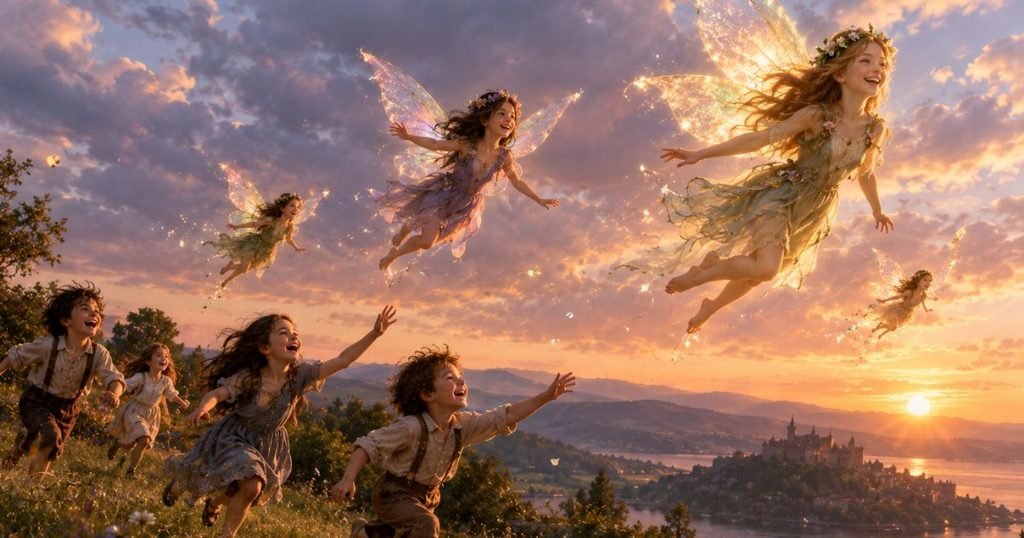
Girl Names Meaning Fairy Spirit, Nymph & Sprite
Ancient Greek and Roman writers described nymphs, minor nature spirits of springs, trees, meadows, and seas. Many scholars treat them as the ancestors of later fairy lore. These girl names come from nymphs, the Pleiades, Roman nature spirits, and Sanskrit apsaras.
- Daphne — Greek, “laurel.” A nymph who became a laurel tree.
- Echo — Greek, “reflected sound.” A mountain nymph doomed to repeat others’ words.
- Calypso — Greek, “she who conceals.” The nymph who held Odysseus on her island.
- Thetis — A Nereid, or sea nymph, and mother of Achilles. Its root is uncertain.
- Galatea — Greek, “milk-white.” Name of a Nereid in Greek myth.
- Nerissa — Used by Shakespeare in The Merchant of Venice and drawn from the Greek Nereis, “sea nymph.”
- Nereida — Spanish form of Nereid, “sea nymph.”
- Oenone — Greek, from oinos, “wine.” A mountain nymph of Mount Ida.
- Arethusa — A spring nymph of Syracuse. Its meaning is debated.
- Callisto — Greek, “most beautiful.” A nymph transformed into a bear and placed among the stars.
- Amalthea — Often glossed “tender goddess.” A nymph said to have nursed baby Zeus.
- Maia — A Pleiad nymph and mother of Hermes. Greek, “nurse, good mother.”
- Electra — Greek, “amber, shining.” Another Pleiad.
- Alcyone — Greek, “kingfisher.” A Pleiad whose name echoes calm seas.
- Merope — A Pleiad, the faintest star of the cluster. Its meaning is uncertain.
- Ianthe — Greek, “violet flower.” An Oceanid nymph.
- Eurydice — Greek, “wide justice.” The nymph bride of Orpheus.
- Aegle — Greek, “radiance, splendor.” One of the Hesperides, nymphs of the sunset garden.
- Chloris — Greek, “greenish, pale green.” A nymph of flowers who became the goddess Flora in Roman myth.
- Flora — Latin, “flower.” Roman goddess of blossoms and spring.
- Pomona — Latin, “fruit.” Roman goddess of orchards.
- Egeria — Roman spring nymph who advised King Numa Pompilius.
- Aglaia — Greek, “splendor.” The youngest of the three Graces.
- Silvana — Latin, “of the forest.” Feminine form of Silvanus.
- Melia — Greek, “ash tree.” The Meliae were nymphs of ash trees.
- Aura — Greek, “breeze.” Also a nymph in later Greek poetry.
- Nephele — Greek, “cloud.” A cloud nymph shaped by Zeus.
- Urvashi — Sanskrit, a celestial apsara of the Rigveda. Dramatic and rare.
- Menaka — Sanskrit, an apsara who was mother of Shakuntala. Elegant and distinctive.
- Tilottama — Sanskrit, from til, “sesame seed,” and uttama, “best.” An apsara shaped from the finest particles of beauty.
- Hulda — Germanic and Scandinavian, “gracious, hidden.” Linked to the huldra, a Scandinavian forest spirit.
- Xana — Asturian, from the xanas, beautiful spirits of Asturian fountains and caves. Pronounced roughly SHA-na.
- Ileana — Romanian form of Helen, and heroine Ileana Cosânzeana, a fairy-tale princess.
- Clymene — Greek, “famous.” An Oceanid nymph.
- Cyane — Greek, “dark blue.” A spring nymph in Ovid’s tale of Persephone.
- Amphitrite — Sea goddess and queen of the Nereids. Meaning is debated.
- Nysa — The mountain nymphs who raised Dionysus. Short and exotic.
- Hesperia — Greek, “western, of the evening.” Name linked to the Hesperides.
- Pleione — Oceanid nymph and mother of the Pleiades. Meaning is uncertain.
- Dione — Greek, “divine.” A Titaness and mother of Aphrodite in some versions.
Boy Names That Mean Fairy, Elf & Woodland Spirit
Boys’ names with a direct fairy meaning are rare, so this list leans on three things: elf and fairy-king roots, woodland spirits, and trees tied to fairy lore. The result is a set of strong names with a quiet touch of magic.
Woodland spirits and nature gods
- Robin — Germanic, “bright fame.” Puck was also called Robin Goodfellow.
- Hob — Medieval pet form of Robert. A hob is also a friendly household spirit.
- Sylvan — Latin, “of the woods.” The classic forest-spirit name.
- Silvanus — Roman god of woods and fields. Majestic and rarely used.
- Sylvain — French form of Silvanus. Light and polished.
- Pan — Greek god of shepherds and woods, companion of nymphs. Short and mythic.
- Faunus — Roman god of the countryside and source of the word “faun.”
- Zephyr — Greek, from Zephyrus, “west wind.” Light and airy.
Fairy-lore trees and plants
- Alder — The tree name. The “Erlking” of Goethe’s poem is often traced to a Danish word for “elf king,” misread as “alder king.”
- Rowan — Tree name. In Scottish and Irish folklore, rowan wards off fairy magic.
- Hawthorne — Tree name. Lone hawthorns are called “fairy trees” in Ireland.
- Ash — Tree name. English folk belief links oak, ash, and thorn growing together with fairy sightings.
- Oak — Tree name. The oak is part of the same “oak, ash, and thorn” tradition.
- Elm — Tree name. Strong, simple, and wood-sprite flavored.
- Linden — From Old English lind, “lime tree.” Gentle and green.
- Hollis — Old English, “dweller by the holly trees.” Holly is a classic woodland evergreen.
- Aspen — Tree name. Its leaves tremble in the slightest breeze, which suits fairy imagery.
- Birch — Tree name. Pale, delicate bark with a woodland glow.
- Cedar — Tree name. Calm, grounded, and fragrant.
- Bracken — A large wild fern. Fern seed was said to grant invisibility in English folk belief.
- Arden — The Forest of Arden in Shakespeare’s As You Like It. Meaning is debated.
Welsh, Irish, and Norse Otherworld names
- Gwydion — Welsh enchanter in the Mabinogion, who conjures Blodeuwedd from flowers.
- Gwion — Gwion Bach, the boy who gained magical wisdom and became Taliesin.
- Taliesin — Welsh, “radiant brow.” The legendary bard of Welsh tradition.
- Emrys — Welsh, “immortal.” Associated with the wizard Myrddin Emrys.
- Arawn — King of Annwn, the Welsh Otherworld. Dark, regal, and rare.
- Mabon — Welsh, “divine son,” from the Mabinogion.
- Lleu — Welsh, “light.” A hero of the Mabinogion.
- Fionn — Irish, “fair.” Legendary hero Fionn mac Cumhaill, whose tales cross into fairy mounds.
- Ogma — Irish champion of the Tuatha Dé Danann, credited with inventing the ogham script.
- Bodb — Bodb Derg, king of the fairy folk of Munster in Irish legend. Pronounced roughly BOHV.
- Freyr — Old Norse, “lord.” The gods gave him Álfheimr, the elves’ realm, as a tooth-gift.
- Wayland — Old English Wēland. In Norse verse, Völund is named “prince of elves.”
- Gandharva — Sanskrit, celestial musician spirits who accompany the apsaras.
- Álfur — Icelandic, “elf.” A real Icelandic name with a direct meaning.
- Álfgeir — Icelandic, “elf spear.” A strong, rare pick.
Gender-Neutral Fairy Names Inspired by Folklore
These names fit any child or character. Aubrey, Avery, and Morgan have real elf or fairy roots. The rest are nature and story names chosen for fairy-realm imagery. They do not translate as “fairy,” and we say so.
- Aubrey — Old French form of Alberic, “elf ruler.” The best-known gender-neutral elf name.
- Avery — A variant of Aubrey, from the same “elf ruler” root. Crisp and modern.
- Morgan — Welsh, often read as “sea-born.” Linked to Morgan le Fay, “Morgan the Fairy.”
- Wren — Songbird name. In Celtic folklore the wren is called the king of the birds.
- Lark — Songbird name. Light, quick, and joyful.
- Briar — Thorny shrub. The “briar rose” is the sleeping beauty’s flower in the Grimm tale.
- River — Water spirit’s home. Fluid, calm, and unisex.
- Rain — Soft, atmospheric, and nature-rooted.
- Sky — Open, airy, and short.
- Sage — “Wise,” and a gray-green herb. Calm and grounded.
- Ember — A glowing coal. Warm and magical.
- Indigo — Deep blue dye color. Twilight-colored and unusual.
- Clover — Lucky plant. Some folk tales say four-leaf clovers help people see fairies.
- Fable — “Story, tale.” A name made for storybook lovers.
- Lyric — “Song-like.” Musical, like fairy bells.
- Storm — A natural force, strong and bold.
- Meadow — An open grassy field. A natural fairy gathering place.
- Winter — The season of quiet, frost, and Holda’s snow.
- Wilder — “Wild, untamed.” Evokes forest freedom.
- Sparrow — Small bird. Humble and lively.
- Linnet — A small songbird of Europe. Light and old-fashioned.
- Rue — A bitter herb once called the “herb of grace.” Short and magical.
- Glade — A clearing in the woods. Peaceful and green.
- Moss — Soft green carpet of the forest floor. Quiet and earthy.
- Dew — Morning moisture on petals. Delicate and bright.
- Thistle — Prickly purple flower and Scotland’s national emblem. A tough little name.
- Fennel — A feathery herb. English folk custom hung it over doors on Midsummer Eve for protection.
- Dell — A small wooded valley. Short and sweet.
- Wynn — Old English “joy” or Welsh gwyn, “white, blessed.” Simple, bright, and balanced.
- Dusk — The hour between day and night, when fairy lore says the veil is thin.
Fairycore Nature Names for Flower, Moon & Woodland Fairies
Fairycore, the aesthetic of moss, mushrooms, and moonlight, loves flower, star, and forest names. Most of these names do not translate as “fairy,” but they sit naturally in the fairy world. Each entry explains why it fits.
Flowers, herbs, and plants
- Willow — Tree name. Slim, graceful, and linked to water spirits.
- Hazel — Tree name. Hazelnuts grant wisdom in Irish legend.
- Ivy — Evergreen vine. Clings to old stones and fairy ruins.
- Fern — Woodland plant. English folk belief held that fern seed made people invisible.
- Bluebell — Spring woodland flower. British folklore treats bluebell woods as fairy territory.
- Primrose — “First rose,” from Latin prima rosa. Folk custom placed primroses at doors to welcome fairies.
- Foxglove — Tall spiked flower. Folk tradition calls the blooms fairy gloves, though it is toxic.
- Heather — Purple moorland plant. A bold, Scottish-hills feel.
- Violet — Small purple flower. A classic spring bloom that Shakespeare’s fairies grow among.
- Marigold — Golden flower. Cheerful and old-fashioned.
- Daisy — From Old English “day’s eye.” Simple and sunny.
- Poppy — Bright red meadow flower. Cheerful and nostalgic.
- Lily — Latin lilium, a symbol of purity.
- Rosemary — From Latin ros marinus, “dew of the sea.” Herb of memory.
- Juniper — Evergreen shrub. Crisp and fragrant.
- Lavender — Aromatic purple herb. Calming and cottage-garden pretty.
- Thyme — Herb in Oberon’s famous bank of wild thyme in A Midsummer Night’s Dream.
- Columbine — From Latin columba, “dove.” A delicate, nodding woodland flower.
- Linnea — Swedish, “twinflower.” Named after the botanist Carl Linnaeus’s favorite flower.
- Lilac — Fragrant spring blossom. Soft and romantic.
- Jasmine — From Persian yasmin. Sweet-scented night bloom.
- Bryony — A climbing hedgerow vine. Unusual and vivid.
- Eglantine — Sweet briar, or wild rose. Oberon describes Titania’s bower with eglantine.
- Tansy — Yellow button-flowered herb. Quirky and cheerful.
- Sorrel — Reddish-brown leaf herb, and a horse color. Earthy and rare.
- Hyacinth — Greek myth flower. Fragrant and classic.
- Anthea — Greek, “flowery.” Elegant and vintage.
- Perdita — “The lost one,” from The Winter’s Tale. Shakespeare’s flower-giving heroine.
- Dahlia — Flower named for Swedish botanist Anders Dahl. Bold and showy.
- Iris — Greek, “rainbow,” and the messenger of the gods. Also a flower.
- Sylvie — French, “of the forest.” Pretty and soft.
- Nerine — From Greek Nereis, “sea nymph.” Also a delicate pink lily.
- Aurelia — Latin, “golden.” Gleaming and regal.
- Celandine — Spring flower from Greek chelidon, “swallow.” Bright yellow.
- Saffron — Spice from the crocus flower, from Arabic za’faran. Rich and golden.
- Amaryllis — Greek, “to sparkle.” A shepherdess in classical poetry and a bold winter bloom.
- Blossom — Plain, pretty, and nature-fresh.
- Fleur — French, “flower.” Dainty and chic.
- Blodwen — Welsh, “white flower.” Sweet and rare.
- Eirlys — Welsh, “snowdrop.” Delicate, pale, and pronounced roughly AIR-lis.
- Aster — Greek, “star.” A starry daisy-like flower.
Moon, stars, and twilight
- Luna — Latin, “moon.” The most popular moon name.
- Selene — Greek, “moon.” The Greek moon goddess.
- Stella — Latin, “star.” Bright and classic.
- Celeste — Latin, “heavenly.” Dreamy and graceful.
- Astra — Latin, “of the stars.” Short and bright.
- Elara — A figure in Greek myth, also a moon of Jupiter. Rare and celestial.
- Estelle — French, “star.” Vintage and gentle.
- Vega — Name of a bright summer star. Strong and short.
- Lyra — A constellation shaped like a lyre. Musical and starry.
- Odette — Swan-princess in Tchaikovsky’s Swan Lake (1877). From Germanic “wealth.”
You Can Also Read: Japanese Girl Names That Mean Star: 350 Celestial Ideas.
How to Choose Names That Mean Fairy
Choosing among 300 names is easier with a short process. These are the checks that matter most in real use, whether you are naming a baby, a pet, or a character.
Start With the Use Case
- For a baby: Read the name aloud with your last name. Irish names like Aoibheall and Niamh are lovely, but you will repeat the pronunciation often.
- For a pet: Short, bright names such as Pixie, Fennel, or Rue are easy to call across a yard.
- For a fantasy character: Match the name’s culture to your world. A Persian pari name suits a desert court, and an Old English ælf name suits a misty woodland kingdom.
Check the Origin
- Real folklore names, like Áine, Mélusine, and Parisa, have documented roots.
- Modern coinages, such as Faelyn and Faeryn, can be fun but have no historical meaning.
- Nature names are inspired by fairy lore, not translations of “fairy.”
Test Real-Life Fit
- Check initials, nicknames, and what the name looks like on a form.
- Say it quickly and slowly. Soft endings fade, so check that it stays clear.
- Look up the cultural background if you borrow a name from a living tradition.
Final Thoughts
Names that mean fairy range from plain, direct choices like Fay and Pari to royal ones like Titania and Oberon, and gentle nature picks like Willow and Bluebell. Whichever you choose, you now know its story. Bookmark this list, share it with a fellow fairy-lover, or leave a comment with your favorite.
FAQs
What name means fairy?
Fay, Faye, and Fae are the clearest English answers. Pari and Peri mean “fairy” in Persian, Fée in French, Hada in Spanish, and Tünde in Hungarian. Pixie and Sprite are folk words for small fairy beings. Each one points directly to fairy folklore.
What is the name of the fairy queen?
The most famous fairy queen is Titania, from Shakespeare’s A Midsummer Night’s Dream. Mab is the dream fairy in Romeo and Juliet. In Irish folklore, Áine, Clíodhna, and Oonagh rule as fairy queens, and Spenser’s Gloriana reigns in The Faerie Queene.
Are there boy names that mean fairy?
Yes, though most mean “elf” or “fairy king” rather than “fairy” itself. Oberon, Auberon, and Puck come straight from fairy lore. Alfred, Alvin, and Ælfric mean “elf counsel,” “elf friend,” and “elf ruler.” Álfur and Álfgeir are Icelandic elf names.
What does the name Faye mean?
Faye means “fairy.” It comes from Old French fae, which traces to Latin fata, the Fates. It is a spelling of Fay and also appears in Morgan le Fay, meaning “Morgan the Fairy.” It is short, graceful, and easy to spell.
What are some unique fairy names?
Try Síofra (Irish, “sprite”), Parivash (Persian, “fairy-like”), Tünde (Hungarian, “fairy”), Álfheiður (Icelandic, “elf bright”), Mélusine (French fairy of legend), or Nixie (a German water sprite). Each has a real folklore root and is rare in English.