
Names That Mean Transformation: 350 Meaningful Ideas for Babies, Characters, and More
Names that mean transformation are names whose meaning, origin, or story points to change, rebirth, or growth. Examples include Phoenix (a bird reborn from its ashes), Renata (reborn), Mariposa (butterfly), Proteus (the shape-shifting sea god), and Nova (new). Many come from Latin, Greek, Sanskrit, and Hebrew roots.
Below you will find 350 names with origins and meanings, from the butterfly-inspired Mariposa to the shape-shifting sea god Proteus. You will also learn how to pick a name that fits your story.
Girl Names That Mean Transformation and Rebirth
These 50 girl names are grouped by theme. Many of them also work for any gender.
Butterfly and Metamorphosis Names

- Mariposa (Spanish) – butterfly
- Psyche (Greek) – soul; the ancient Greeks used the same word for butterfly
- Farasha (Arabic) – butterfly
- Yara (Arabic) – often “small butterfly”; also a Tupi water-spirit name
- Cho (Japanese) – butterfly (蝶)
- Kocho (Japanese) – butterfly (胡蝶)
- Farfalla (Italian) – butterfly
- Chrysalis (Greek) – from chrysos, “gold”; the stage where change happens
- Aurelia (Latin) – golden; “aurelia” was an old word for a chrysalis
- Pulelehua (Hawaiian) – butterfly
- Imago (Latin) – “image”; the final adult stage of an insect
- Morpho (Greek) – from morphē, “form”; also a genus of blue butterflies
Rebirth and New Life Names
- Renata (Latin) – reborn
- Renée (French) – reborn
- Anastasia (Greek) – resurrection
- Neoma (Greek) – new moon
- Novella (Latin) – new, young
- Aviva (Hebrew) – springtime, fresh
- Hadasha (Hebrew) – new
- Navya (Sanskrit) – new, young
- Primavera (Italian/Spanish) – spring
- Genesis (Greek) – origin, beginning
- Zoe (Greek) – life
- Vita (Latin) – life
- Eve (Hebrew) – life, living
- Hayat (Arabic) – life
- Ostara (Germanic) – spring-linked name tied to the festival of Eostre
- Fenix (Spanish) – phoenix
- Chaya (Hebrew) – life
- Vivienne (French) – alive
- Vesna (Slavic) – spring
- Maia (Roman) – goddess linked to spring growth
You May Also Read: Names That Mean Death Bringer: 400 Dark Names With Meanings.
Change and Growth Names
- Meliora (Latin) – better
- Thalia (Greek) – to blossom
- Florence (Latin) – flourishing
- Anthea (Greek) – flower
- Padma (Sanskrit) – lotus, which rises from mud to bloom
- Kamala (Sanskrit) – lotus
- Kranti (Hindi) – revolution, sweeping change
- Nutan (Sanskrit) – new
- Naveena (Tamil/Sanskrit) – new
- Mirai (Japanese) – future
- Primrose (English) – “first rose,” from Latin prima rosa
- Flora (Latin) – Roman goddess of flowers
- Viridiana (Spanish) – from Latin viridis, “green”
- Journey (English) – travel from one stage to another
- Blossom (English) – a flower in bloom
- Ilana (Hebrew) – tree
- Esperanza (Spanish) – hope
- Aliyah (Hebrew) – ascent, rising
Boy Names That Mean Change, Growth, and New Beginnings
Wondering what boy names mean change or metamorphosis? These 40 range from the literal (“reborn”) to the symbolic (a god tied to returning spring).
Rebirth and Renewal
- Phoenix (Greek) – legendary bird reborn from its ashes
- Renatus (Latin) – reborn
- Renato (Italian/Portuguese/Spanish) – reborn
- Anastasius (Greek) – resurrection
- Lazarus (Greek, from Eleazar) – “God has helped”; the man raised from death in John 11
- Osiris (Egyptian) – god of death and rebirth; the name’s etymology is uncertain
- Neo (Greek) – new
- Neander (Greek) – new man
- Aviv (Hebrew) – spring, fresh
- Navin (Sanskrit) – new
- Arata (Japanese) – new, fresh (新)
- Zoran (Slavic) – dawn
- Vitalis (Latin) – of life
- Ankur (Hindi) – sprout
- Neville (French) – new town
- Novak (Slavic) – newcomer, new settler
- Tammuz (Mesopotamian) – god tied to the yearly death and return of plant life
- Newman (English) – newcomer
Change, Progress, and Growth
- Kairos (Greek) – the opportune moment
- Abhinav (Sanskrit) – new, modern
- Parivartan (Hindi) – change, transformation
- Ilan (Hebrew) – tree
- Rohan (Sanskrit) – ascending
- Tarun (Sanskrit) – young, youthful
- Vardhan (Sanskrit) – increasing, growing
- Utkarsh (Sanskrit) – progress, rise
- Hajime (Japanese) – beginning
- Chadash (Hebrew) – new
- Jadid (Arabic) – new
- Neophytos (Greek) – “newly planted,” the root of “neophyte”
- Aarambh (Hindi) – start
- Uday (Sanskrit) – rise, sunrise
- Evrim (Turkish) – evolution
- Devrim (Turkish) – revolution
- Pravesh (Sanskrit) – entrance
- Vikas (Hindi) – development, growth
- Zaid (Arabic) – growth, increase
- Ziyad (Arabic) – increase, abundance
- Nimith (Khmer/Cambodian) – transformation
- Haruki (Japanese) – depends on the kanji; often “spring” plus “radiance” or “tree”

Unisex Names That Mean Change and Flow
Are there unisex names that mean change? Yes. Water, fire, and weather names fit well because they never stay still.
Flowing, Fiery, and Shifting
- Nova (Latin) – new; also a star that suddenly brightens
- Ember (English) – a glowing coal that can reignite
- Ash (English) – a tree; also what remains after fire
- River (English) – ever-moving water
- Kai (Hawaiian) – sea; the name has other origins too
- Rio (Spanish) – river
- Flux (Latin) – flow
- Catalyst (Greek) – from katalysis, “dissolving”; something that speeds change
- Zephyr (Greek) – the west wind, herald of spring
- Tide (English) – the rising and falling of the sea
- Ocean (Greek) – the great encircling sea
- Rain (English) – water that renews dry land
- Storm (English) – weather’s turning point
- Cascade (French/Italian) – waterfall
- Current (English) – steady flow
Growth and Resilience
- Willow (English) – a tree whose cuttings root easily
- Fern (English) – a plant whose fronds unfurl
- Aspen (English) – a tree that regrows from its roots
- Ivy (English) – a climbing plant
- Sage (English/Latin) – an herb; also wisdom gained over time
- Robin (English) – a bird seen as a sign of spring
- Lark (English) – a bird that sings at first light
- Swan (English) – recalls Andersen’s tale “The Ugly Duckling”
- Monarch (Greek) – a butterfly famed for long migrations; also “ruler”
- Birch (English) – often the first tree to grow on cleared ground
- Ginkgo (Japanese) – an ancient tree species known for resilience
- Sequoia (Cherokee-linked) – a giant tree; fire helps its cones release seeds
- Cinder (English) – the glowing remains of a fire
- Blaze (English) – a flame; also “to blaze a new trail”
Thresholds and Turning Points
- Haven (English) – a safe harbor after change
- Solace (Latin) – comfort after loss
- Zenith (Arabic-derived) – the highest point
- Halcyon (Greek) – calm days after a storm
- Odyssey (Greek) – a long, life-changing journey
- Quest (English) – a search that changes the seeker
- Horizon (Greek) – the line where a new view begins
- Meridian (Latin) – the point where morning turns to afternoon
- Compass (English) – a tool for finding a new direction
- Voyage (French) – a trip into the unknown
- Eden (Hebrew) – “delight”; a garden of fresh starts
- Avalon (Arthurian) – the isle where King Arthur was taken to heal
- Alchemy (Arabic al-kimiya) – the art of transmuting one substance into another
- Cadence (Latin) – from cadere, “to fall”; a rhythm that resolves
- Aether (Greek) – the upper, purer air
- Evolve (Latin) – to unroll, to develop
Mythological Names That Mean Metamorphosis
Greek and Roman myths are full of change. Many of these names come straight from Ovid’s Metamorphoses, where gods, nymphs, and mortals turn into trees, birds, stones, and stars.
Shapeshifters and Changed Heroes
- Proteus (Greek) – sea god who changed shape to avoid questions
- Morpheus (Greek) – “shaper” of dreams
- Ovid (Latin) – the Roman poet who wrote the Metamorphoses
- Merlin (Welsh-linked) – wizard of Arthurian legend, famed for magical change
- Nereus (Greek) – “old man of the sea,” a shape-shifting sea god
- Vertumnus (Roman) – god of seasons and change, who appears in many disguises
- Janus (Roman) – god of doorways, beginnings, and transitions
- Loki (Norse) – trickster who takes many forms
- Hyacinthus (Greek) – youth whose death gave rise to the hyacinth flower
- Cadmus (Greek) – hero who ends his life as a serpent in Ovid’s telling
- Tithonus (Greek) – lover of the dawn goddess, later said to become a cicada
- Pygmalion (Greek) – sculptor whose statue comes to life
- Cyparissus (Greek) – youth turned into a cypress tree
- Taliesin (Welsh) – bard “reborn” after the witch Ceridwen’s shape-shifting chase
- Odin (Norse) – chief god who can change his form
- Philemon (Greek) – old man who, with his wife, becomes a tree in Ovid
Women of Myth and Magic
- Daphne (Greek) – nymph turned into a laurel tree
- Arachne (Greek) – weaver turned into a spider; the name means “spider”
- Thetis (Greek) – sea goddess who changed shape to escape capture
- Circe (Greek) – enchantress who turned sailors into animals
- Persephone (Greek) – returns from the underworld each spring
- Echo (Greek) – nymph who faded into a voice
- Callisto (Greek) – turned into a bear, then a constellation
- Io (Greek) – turned into a heifer
- Niobe (Greek) – turned into weeping stone
- Ino (Greek) – became the sea goddess Leucothea
- Galatea (Greek) – the statue that comes alive
- Alcyone (Greek) – turned into a kingfisher, the source of “halcyon”
- Clytie (Greek) – turned into a sun-following flower
- Melusine (French) – folk spirit who is part serpent
- Fionnuala (Irish) – heroine of the Children of Lir, turned into a swan
- Blodeuwedd (Welsh) – woman “made from flowers”
- Ceridwen (Welsh) – enchantress of the cauldron of change
- Dryope (Greek) – turned into a lotus tree in Ovid
- Baucis (Greek) – old woman who becomes a tree with Philemon
Names That Mean New Beginnings: Dawn, Seasons, and Nature
Every dawn is a small transformation, and every season is a bigger one. These 70 names borrow from the sky and the land.
Dawn and Light
- Aurora (Latin) – dawn
- Eos (Greek) – goddess of dawn
- Alba (Latin) – white; “dawn” in Spanish and Italian
- Zora (Slavic) – dawn
- Dawn (English) – first light
- Aube (French) – dawn
- Lucian (Latin) – from lux, light
- Lucia (Latin) – light
- Lux (Latin) – light
- Lumina (Latin) – lights
- Phoebe (Greek) – bright
- Vesper (Latin) – the evening star, marking the day’s turn
- Soleil (French) – sun
- Elio (Italian) – sun
- Helios (Greek) – the sun god
- Aurelian (Latin) – golden
- Claire (Latin) – bright, clear
- Fiammetta (Italian) – little flame
- Aydin (Turkish) – enlightened
- Prabhat (Sanskrit) – morning
- Usha (Sanskrit) – dawn
- Arun (Sanskrit) – the reddish glow of dawn
- Zorya (Slavic) – dawn
- Hikari (Japanese) – light
- Akari (Japanese) – brightness
- Asahi (Japanese) – morning sun
- Candela (Latin) – candle
- Solana (Spanish) – sunny place
- Sol (Latin) – sun
- Orla (Irish) – golden princess
Seasons and Cycles
- Autumn (English) – the season of turning leaves
- Spring (English) – the season of renewal
- Winter (English) – the rest before renewal
- Summer (English) – the season of full growth
- April (Latin-linked) – often tied to aperire, “to open”; the origin is debated
- Equinox (Latin) – “equal night,” when day and night balance
- Solstice (Latin) – “sun stands still,” the turning of the year
- Selene (Greek) – moon goddess; the moon waxes and wanes
- Luna (Latin) – moon
- Verna (Latin) – from vernus, “of spring”
Flowers and First Blooms
- Crocus (Greek) – among the first spring blooms
- Snowdrop (English) – a flower that pushes through late-winter snow
- Iris (Greek) – rainbow, which appears after a storm
- Violet (Latin) – an early-spring flower
- Lilac (Persian-derived) – a spring bloom
- Poppy (English) – a flower that thrives in disturbed soil
- Heather (English) – a hardy moorland plant
- Petal (Greek-derived) – a flower’s unfolding part
- Clover (English) – a hardy, spreading plant
- Briar (English) – a thorny shrub that grows back
- Hazel (English) – a tree with catkins in late winter
- Daffodil (Greek-derived) – a spring bulb
- Jonquil (Spanish) – a daffodil relative
- Marigold (English) – a long-blooming garden flower
Earth, Stone, and Slow Change
- Delta (Greek) – the letter Δ, the science and math symbol for change; river deltas form as silt settles
- Canyon (Spanish) – carved by a river over time
- Dune (French) – sand that shifts with the wind
- Reef (English) – built slowly by coral
- Coral (Greek) – the animal that builds reefs
- Pearl (Latin) – formed in layers around an irritant
- Amber (Arabic) – fossilized tree resin
- Diamond (Greek) – carbon changed by heat and pressure
- Crystal (Greek) – ice-like, ordered growth
- Brook (English) – a small stream
- Glacier (French) – a river of ice moving slowly
- Meadow (English) – open, flowering grassland
- Obsidian (Latin) – volcanic glass formed from rapidly cooled lava
- Opal (Sanskrit upala) – “precious stone”; opals form from silica gel
- Terra (Latin) – earth
- Gaia (Greek) – earth goddess
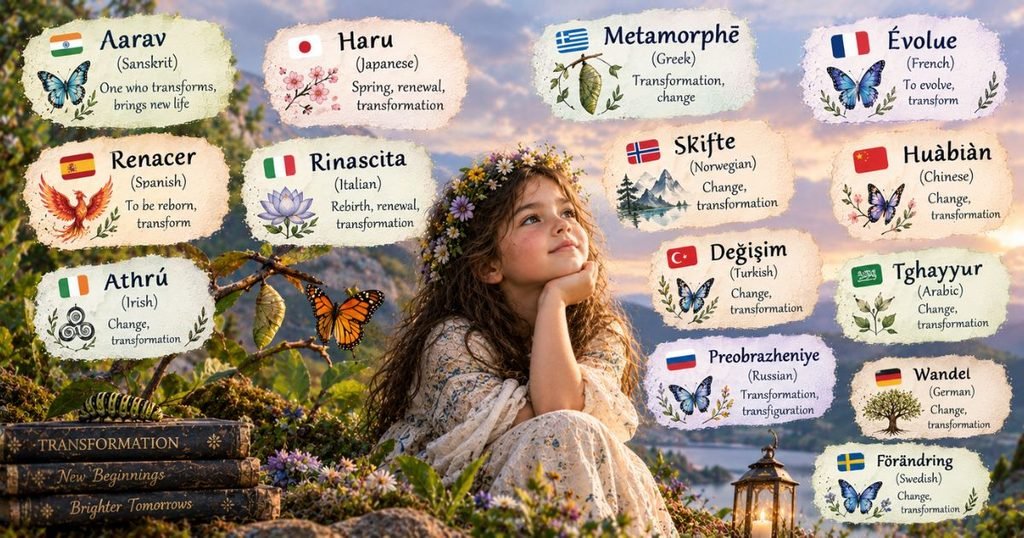
Names That Mean Transformation Around the World
Different cultures describe change in different ways. Persian speakers mark the new year at the spring equinox with Nowruz, a festival of renewal that UNESCO recognizes as intangible cultural heritage. Norse myth names the Norn of “becoming,” Verdandi. These 55 names show that range.
Hebrew
- Lior – “my light”
- Alon – oak
- Tal – dew
- Shachar – dawn
- Tikva – hope
- Geula – redemption
- Techiya – revival
- Nitzan – bud
Arabic
- Noor – light
- Fajr – dawn
- Sabah – morning
- Amal – hope
- Nahda – awakening, renaissance
- Rabi – spring
- Fath – opening, victory
- Nasim – gentle breeze
Persian and Turkish
- Bahar (Persian) – spring
- Nowruz (Persian) – “new day,” the Persian New Year
- Tan (Turkish) – dawn
- Safak (Turkish) – dawn glow
- Dogus (Turkish) – birth, rising
- Roshan (Persian) – bright
- Sahar (Arabic/Persian) – daybreak
Japanese, Chinese, and Korean
- Sakura (Japanese) – cherry blossom, a symbol of life’s fleeting beauty
- Haru (Japanese) – spring
- Aki (Japanese) – autumn
- Kaede (Japanese) – maple, whose leaves change color
- Momiji (Japanese) – autumn maple leaves
- Xin (Chinese) – new (新)
- Chun (Chinese) – spring (春)
- Hua (Chinese) – transformation (化) or flower (花), depending on the character
- Saebom (Korean) – new spring
- Saetbyeol (Korean) – morning star
African
- Nuru (Swahili) – light
- Alfajiri (Swahili) – dawn
- Tumaini (Swahili) – hope
- Jua (Swahili) – sun
- Amara (Igbo) – grace; often read as “eternal” through a Greek link
Celtic, Norse, Slavic, and Romance
- Brigid (Irish) – goddess tied to the early-spring festival of Imbolc
- Niamh (Irish) – radiance
- Aisling (Irish) – dream, vision
- Saoirse (Irish) – freedom
- Seren (Welsh) – star
- Eirlys (Welsh) – snowdrop
- Awel (Welsh) – breeze
- Idun (Norse) – goddess of youth and renewal
- Skuld (Norse) – “what shall be,” the Norn of the future
- Verdandi (Norse) – “becoming,” the Norn of the present
- Dagny (Norse) – “new day”
- Nadezhda (Russian) – hope
- Svetlana (Slavic) – light
- Novello (Italian) – new, young
- Avril (French) – April
- Amanecer (Spanish) – dawn
- Alborada (Spanish) – daybreak
Spiritual Names That Mean Awakening and Rebirth
Many traditions treat transformation as a spiritual path. Buddhism and Hinduism describe samsara, the cycle of birth, death, and rebirth, and moksha, release from it. Christianity speaks of resurrection and being “born again.” These 55 names draw on those ideas.
Sanskrit, Buddhist, and Zen
- Bodhi (Sanskrit) – awakening
- Nirvana (Sanskrit) – “blowing out,” release from craving
- Moksha (Sanskrit) – liberation
- Samsara (Sanskrit) – the cycle of rebirth
- Satori (Japanese) – sudden awakening in Zen
- Mukti (Sanskrit) – liberation
- Karma (Sanskrit) – action and its results
- Zen (Japanese) – meditation
- Prabodh (Sanskrit) – awakening
- Jagriti (Hindi) – awakening
- Sankalp (Sanskrit) – resolve
- Unnati (Sanskrit) – progress
- Pragati (Sanskrit) – progress
- Ananda (Sanskrit) – bliss
- Tara (Sanskrit) – “star”; in Buddhism, a savior figure
- Tarini (Sanskrit) – one who helps others cross over
- Shakti (Sanskrit) – power, creative energy
- Kali (Sanskrit) – goddess of time and change
- Shiva (Sanskrit) – “auspicious”; the destroyer and transformer
- Agni (Sanskrit) – fire, the sacred transformer
- Srijan (Hindi) – creation
- Dhyan (Sanskrit) – meditation
Biblical Names That Were Changed
- Israel (Hebrew) – “struggles with God”; the name given to Jacob
- Abraham (Hebrew) – “father of many”; renamed from Abram
- Sarah (Hebrew) – “princess”; renamed from Sarai
- Peter (Greek) – “rock”; renamed from Simon
- Paul (Latin) – “small”; the name Saul used in his later ministry (Acts 13)
- Joshua (Hebrew) – “the Lord saves”; renamed from Hoshea (Numbers 13)
- Barnabas (Aramaic) – “son of encouragement”; renamed from Joseph (Acts 4)
Faith, Festival, and Turning-Point Names
- Easter (English) – spring festival of resurrection
- Pascal (French) – of Easter or Passover
- Noel (French) – Christmas, birth
- Natalie (Latin) – “birthday,” from natalis
- Epiphany (Greek) – a sudden manifestation or realization
- Evangeline (Greek) – bearer of good news
- Metanoia (Greek) – a change of mind and heart
- Baptiste (French) – from “to immerse”
- Raphael (Hebrew) – “God heals”
- Tawba (Arabic) – turning back, repentance
- Hidayah (Arabic) – guidance
- Teshuva (Hebrew) – return, repentance
- Tikkun (Hebrew) – repair
- Pesach (Hebrew) – Passover, the passage from slavery to freedom
- Imbolc (Irish) – early-spring festival
- Samhain (Irish) – festival marking the turn from harvest to winter
- Beltane (Irish) – festival of early summer
- Mabon (Welsh) – autumn equinox name in modern Pagan tradition
- Yule (Old Norse) – midwinter festival
- Litha (Old English-linked) – summer solstice name in modern Pagan tradition
- Aletheia (Greek) – truth, “unconcealment”
- Soteria (Greek) – deliverance
- Jonah (Hebrew) – “dove”; swallowed by a great fish and returned to land
- Nicodemus (Greek) – the man who asks about being “born again” in John 3
- Enoch (Hebrew) – “dedicated”; said to have “walked with God” (Genesis 5)
- Zosimos (Greek) – an early alchemist of Panopolis, around AD 300
You Can Also Read: 250 Girl Names That Mean Shadow (Plus Dark, Night & Dusk Picks)
Conclusion
You now have 350 names that mean transformation, each with an origin and a meaning you can check. Some are literal, some are symbolic, and some come from myths where a person becomes a tree, a bird, or a star. Pick the one that matches the story you want to tell. Bookmark this page, share it with someone who is still choosing, or leave a comment with your favorite.
FAQs
What is a name that means transformation?
Nimith, a Cambodian (Khmer) name, is documented as meaning “transformation.” Other strong choices are Renata (“reborn”), Parivartan (“change”), and Evrim (“evolution”). Symbolic picks include Phoenix and Mariposa.
What names mean rebirth or a new beginning?
Renatus, Renata, Anastasia (resurrection), Aviva (springtime), Hajime (beginning), and Genesis all point to fresh starts. Dawn names like Aurora and Zora also fit.
What girl names mean transformation?
Renata, Mariposa, Psyche, Anastasia, Kranti, and Meliora are strong choices. Mythic options include Daphne, Galatea, and Persephone.
What boy names mean change or metamorphosis?
Proteus, Parivartan, Devrim, Zaid, and Kairos all fit. Phoenix and Renatus suit parents who want rebirth.
Are there unisex names that mean change?
Yes. Nova, Ember, River, Flux, Zephyr, Willow, and Delta all read as unisex. Delta also nods to the symbol for change in math and science.