

Names That Mean Galaxy: 260 Cosmic Names for Girls, Boys, and Every Stargazer
Names that mean galaxy include Galaxia, Galassia, Almajara, and Eunha, which literally translate to “galaxy” in Greek, Italian, Arabic, and Korean. Many more cosmic names, like Andromeda, Nova, Orion, and Cosmo, honor galaxies, stars, and the universe, giving parents a wide range of meaningful, space-inspired options.
This guide gives you 260 cosmic names, grouped by theme, with clear meanings and background. You will find direct galaxy names, star names, myth-inspired picks, and unisex options, plus tips to choose one that fits for life.
What Name Means Galaxy? 20 Names That Literally Mean “Galaxy”
The word galaxy comes from the Greek galaxias, built on gala, meaning “milk.” Ancient Greeks pictured the pale band across the night sky as spilled milk. That is why our home galaxy is called the Milky Way.
Other cultures chose different images. Korean, Japanese, and Chinese call it a “silver river.” Hindi calls it a “river of the sky.” Turkish calls it a “straw road.” That is why so many names that mean galaxy sound like water, roads, or travel.
Each entry below is a real word for galaxy or the Milky Way, or shares the same root. Some are common nouns more than given names, so we say so. We also suggest saying them aloud before you decide.
- Galaxia (Greek) – from galaxias, “milky,” the root of our word galaxy.
- Galaxy (English) – the plain word, used today as a bold modern given name.
- Galassia (Italian) – the Italian word for galaxy, with a soft, musical ending.
- Galaxie (French/German) – short and elegant, and easy to pronounce in English.
- Galaksi (Finnish/Turkish) – the everyday word for galaxy in both languages.
- Galaktika (Russian) – Russian for galaxy, with a strong, rhythmic sound.
- Galaeth (Welsh) – the Welsh word for galaxy, and very rare as a name.
- Réaltra (Irish) – Irish for galaxy, built from réalta, “star.”
- Almajara (Arabic) – a name form of al-majarra, Arabic for “the galaxy.”
- Kahkashan (Persian/Urdu) – “galaxy” or Milky Way, used for girls in Persian- and Urdu-speaking communities.
- Eunha (Korean) – 은하, “silver river,” the Korean word for galaxy.
- Mirinae (Korean) – 미리내, a native Korean word for the Milky Way.
- Ginga (Japanese) – 銀河, “silver river,” the Japanese word for galaxy.
- Yinhe (Chinese) – 银河, “silver river,” used for the Milky Way and for galaxies.
- Tianhe (Chinese) – 天河, “heavenly river,” a classical image of the Milky Way.
- Akashganga (Hindi) – “river of the sky,” Hindi for the Milky Way.
- Mandakini (Sanskrit) – the celestial Ganges, a poetic image tied to the Milky Way.
- Samanyolu (Turkish) – the Milky Way, literally “straw road.”
- Bimasakti (Indonesian) – the Indonesian name for the Milky Way.
- Galatea (Greek) – “milk-white,” sharing the root of galaxy, and also a moon of Neptune.

Girl Names That Mean Galaxy, Stars, and Constellations
Many parents want a name that feels cosmic without being hard to spell. Girls’ star names are a rich pool because Greek mythology placed so many heroines in the sky. Andromeda is the best example. She was a princess in myth, and her name now belongs to the Andromeda Galaxy, the nearest large galaxy to the Milky Way, about 2.5 million light-years away.
Classic Star and Constellation Names for Girls
- Andromeda (Greek) – mythic princess, constellation, and the name of our galactic neighbor.
- Cassiopeia (Greek) – the vain queen of myth; a W-shaped northern constellation.
- Lyra (Greek) – the lyre constellation, home to the star Vega.
- Vega (Arabic via Latin) – from “the swooping eagle”; the brightest star in Lyra.
- Nova (Latin) – “new,” a star that suddenly flares bright.
- Stella (Latin) – “star,” simple and timeless.
- Estelle (French) – a French form of “star.”
- Estrella (Spanish) – “star,” with a warm, lively sound.
- Astra (Latin) – “stars,” as in the motto ad astra, “to the stars.”
- Astraea (Greek) – “star-maiden,” the goddess of justice who rose to the sky as Virgo.
- Celeste (Latin) – “heavenly” or “of the sky.”
- Celestia (Latin) – a fuller, more fantasy-flavored form of “heavenly.”
- Aurora (Latin) – “dawn,” also the name given to the polar lights.
- Seren (Welsh) – “star,” short and popular in Wales.
- Sitara (Urdu/Hindi/Persian) – “star.”
- Tara (Sanskrit) – “star,” and also a Buddhist and Hindu goddess name.
- Hoshi (Japanese) – 星, “star.”
- Citlali (Nahuatl) – “star,” from the Aztec language.
- Danica (Slavic) – “morning star,” the old name for Venus at dawn.
- Esther (Persian/Hebrew) – often linked to a Persian word for “star,” though its origin is debated.
You May Also Read: 300 Boy Names That Mean Royalty: Kingly, Noble and Princely Picks.
Rare Bright-Star Names for Girls
- Roxana (Persian) – read as “bright dawn” or “little star,” from Roshanak.
- Suraya (Arabic) – from Thurayya, the Pleiades star cluster.
- Merope (Greek) – one of the Seven Sisters of the Pleiades.
- Electra (Greek) – “shining” or “amber,” and a star in the Pleiades.
- Alcyone (Greek) – the brightest star in the Pleiades cluster.
- Maia (Greek) – a Pleiades sister and, in myth, the mother of Hermes.
- Asteria (Greek) – “starry,” a Titaness linked to falling stars.
- Stellina (Italian) – “little star.”
- Zaniah (Arabic) – a star name in the constellation Virgo.
- Adhara (Arabic) – a brilliant blue-white star in Canis Major.
- Nashira (Arabic) – “bearer of good news,” a star in Capricornus.
- Capella (Latin) – “little she-goat,” a bright star in Auriga.
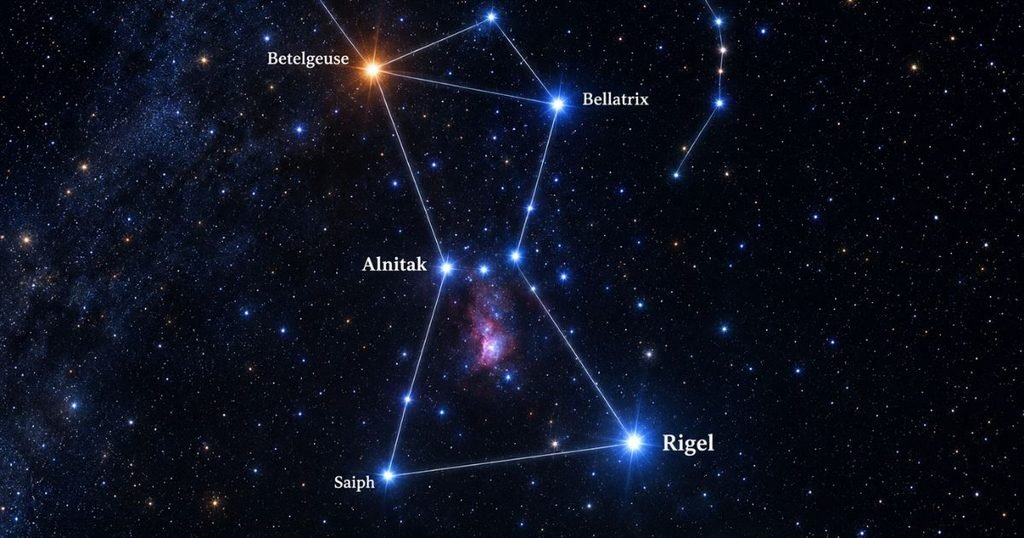
- Bellatrix (Latin) – “female warrior,” a star on Orion’s shoulder.
- Lucero (Spanish) – “bright star,” often the morning star.
- Vesper (Latin) – “evening,” also the evening star.
- Alya (Arabic) – “exalted,” and an official star name in Serpens.
- Mira (Latin) – “wonderful,” a famous pulsing star in Cetus.
- Asterope (Greek) – another Pleiades sister, a name that evokes starlight.
- Carina (Latin) – “keel,” a southern constellation home to the Carina Nebula.
- Vela (Latin) – “sails,” a constellation in the southern sky.

Boy Names That Mean Galaxy, Stars, and the Heavens
Boys’ cosmic names often come straight from the sky’s brightest stars. The International Astronomical Union (IAU) keeps the official list of approved star names. Many of these names, such as Rigel and Altair, come from Arabic, because medieval Arab astronomers named most of the bright stars we still use.
Bright-Star Names for Boys
- Orion (Greek) – the mythic hunter and the best-known constellation.
- Altair (Arabic) – “the flying eagle,” the brightest star in Aquila.
- Sirius (Greek) – “scorching,” the brightest star in our night sky.
- Rigel (Arabic) – “foot,” a blue supergiant in Orion’s foot.
- Castor (Greek) – one twin hero and a bright star system in Gemini.
- Pollux (Greek) – Castor’s twin and the brightest star in Gemini.
- Regulus (Latin) – “little king,” the heart of Leo the lion.
- Sabik (Arabic) – “the preceding one,” a star in Ophiuchus.
- Alioth (Arabic) – the brightest star in the Big Dipper’s pattern.
- Aldebaran (Arabic) – “the follower,” the red eye of Taurus the bull.
- Antares (Greek) – “rival of Mars,” a red supergiant in Scorpius.
- Arcturus (Greek) – “guardian of the bear,” the brightest star in Boötes.
- Canopus (Greek) – the second-brightest star in the sky, used by spacecraft for navigation.
- Procyon (Greek) – “before the dog,” a star in Canis Minor.
- Deneb (Arabic) – “tail,” marking the tail of Cygnus the swan.
- Alnitak (Arabic) – “the girdle,” a belt star in Orion.
- Elnath (Arabic) – “the butting one,” at the tip of the bull’s horn.
- Alcor (Arabic) – the faint companion of Mizar in the Big Dipper’s handle.
- Mizar (Arabic) – one of the first double stars ever seen through a telescope.
Star-Word and Constellation Names for Boys
- Astro (Greek) – “star,” playful and modern.
- Astrophel (Greek) – “star lover,” a variant of Astrophil from Philip Sidney’s sonnets.
- Izar (Basque) – “star.”
- Lintang (Indonesian) – “star.”
- Fetu (Samoan) – “star.”
- Tarak (Sanskrit/Bengali) – “star.”
- Namid (Ojibwe) – “star dancer.”
- Najm (Arabic) – “star.”
- Kawkab (Arabic) – “star” or “planet.”
- Caelum (Latin) – “sky” or “heaven,” also a faint southern constellation.
- Perseus (Greek) – the hero who rescued Andromeda, with a constellation beside hers.
- Hercules (Greek) – the legendary strongman, with a large summer constellation.
- Draco (Latin) – “dragon,” a northern constellation winding between the two bears.
- Cepheus (Greek) – the mythic king whose constellation gave its name to Cepheid stars. Edwin Hubble used one in the Andromeda Galaxy to prove it lies far beyond the Milky Way.
- Leo (Latin) – “lion,” a zodiac constellation.
- Bode (German) – named for Johann Bode; Bode’s Galaxy (M81) carries his name.
Unisex Names That Mean Galaxy and Night Sky
Gender-neutral names fit the cosmos well, because sky words carry no gender of their own. Many on this list are also short and easy to spell. That makes them practical for forms, email addresses, and playground shouting.
- Aster (Greek) – “star,” also a starry flower.
- Hōkūlani (Hawaiian) – “star of heaven,” from hōkū (star) and lani (heaven).
- Aries (Latin) – “ram,” the first constellation of the zodiac.
- Gemini (Latin) – “twins,” a zodiac constellation.
- Phoenix (Greek) – the firebird of myth, and a southern constellation.
- Eris (Greek) – goddess of discord, and a distant dwarf planet.
- Halley (English) – after Edmond Halley, whose comet returns about every 76 years.
- Ariel (Hebrew) – “lion of God,” and a moon of Uranus.
- Dara (Thai/Irish) – “star” in Thai, “oak” in Irish.
- Cielo (Italian/Spanish) – “sky.”
- Sky (English) – the open heavens.
- Star (English) – the plain word, bright and direct.
- Sol (Latin) – “sun,” our own star.
- Zenith (Arabic) – the highest point of the sky.
- Eclipse (Greek) – from a word for “failing,” when one body hides another.
- Comet (Greek) – “long-haired star.”
- Solstice (Latin) – “sun standing still,” the longest or shortest day.
- Indus (Latin) – a southern constellation.
- Tala (Tagalog) – “star.”
- Kiran (Sanskrit) – “ray of light.”
Names Mean Universe, Space, or Cosmos
Some of the best cosmic names do not name one object. They name the whole sky. The Greek kosmos meant “order” and became the word for the ordered universe, which is why Cosmo and Cosima share a root. Sanskrit offers several space words that also work as given names.
Sky and Cosmos Names
- Cosmo (Greek) – from kosmos, “order” and “universe.”
- Cosima (Italian) – the feminine form of Cosmas, same root.
- Cosmin (Romanian) – a Romanian form of Cosmas.
- Cosmina (Romanian) – the feminine form of Cosmin.
- Chakkrawan (Thai) – “universe” or “cosmos.”
- Akasha (Sanskrit) – “space,” “sky,” or “ether.”
- Vyom (Sanskrit) – “sky” or “space.”
- Antariksh (Hindi) – “outer space.”
- Ambar (Hindi) – “sky.”
- Gagan (Sanskrit) – “sky” or “heaven.”
- Nakshatra (Sanskrit) – “star” or lunar mansion.
- Urania (Greek) – “heavenly,” the muse of astronomy.
- Aether (Greek) – the bright upper air where gods lived.
- Atlas (Greek) – the Titan condemned to hold up the heavens.
- Caelia (Latin) – “heavenly.”
- Celestine (Latin) – “heavenly,” a classic cousin of Celeste.
- Celestino (Italian) – the masculine “heavenly.”
- Anu (Sumerian) – the ancient god of the sky.
- Rangi (Māori) – “sky,” after the sky father Ranginui.
- Lani (Hawaiian) – “sky” or “heaven.”
- Gökçe (Turkish) – “of the sky” or “heavenly.”
- Ciel (French) – “sky.”
- Soraya (Persian) – a Persian form of Thurayya, the Pleiades, also read as “jewel.”
- Sora (Japanese) – 空, “sky.”
- Tian (Chinese) – 天, “sky” or “heaven.”
Planet and Moon Names
Planet names come with a built-in story. NASA missions have visited most of the bodies below, which gives each name a real-world anchor.
- Venus (Latin) – Roman goddess of love and the brightest planet in our sky.
- Mars (Latin) – Roman god of war and the red planet.
- Jupiter (Latin) – king of the gods and the largest planet.
- Saturn (Latin) – Roman god of farming and the ringed planet.
- Neptune (Latin) – Roman sea god and the eighth planet.
- Mercury (Latin) – the messenger god and the planet closest to the Sun.
- Pluto (Latin) – god of the underworld; the IAU reclassified it a dwarf planet in 2006.
- Ceres (Latin) – the largest object in the asteroid belt, named for a grain goddess.
- Vesta (Latin) – Roman hearth goddess and a large asteroid.
- Juno (Latin) – queen of the Roman gods; NASA’s Juno probe studies Jupiter.
- Pallas (Greek) – one of the largest asteroids.
- Haumea (Hawaiian) – a dwarf planet named for a goddess of childbirth.
- Sedna (Inuit) – sea goddess and a far-flung icy world.
- Titan (Greek) – Saturn’s largest moon.
- Europa (Greek) – an icy moon of Jupiter.
- Io (Greek) – Jupiter’s volcanic moon.
- Ganymede (Greek) – the largest moon in the solar system.
- Triton (Greek) – Neptune’s largest moon.
- Oberon (Germanic) – a moon of Uranus and Shakespeare’s fairy king.
- Titania (Latin) – the largest moon of Uranus.
- Miranda (Latin) – “to be admired,” a moon of Uranus.
- Cordelia (Welsh/Celtic) – a Uranian moon named for King Lear’s daughter.
- Ophelia (Greek) – a Uranian moon named for Hamlet’s Ophelia.
- Rhea (Greek) – Saturn’s second-largest moon.
- Elara (Greek) – a moon of Jupiter named for a lover of Zeus.
Space-Word Names
- Nebula (Latin) – “cloud,” where new stars are born.
- Quasar (English) – an extremely bright galactic core powered by a black hole.
- Pulsar (English) – a fast-spinning neutron star that flashes like a lighthouse.
- Orbit (Latin) – the curved path of one body around another.
- Meteor (Greek) – “high in the air,” a shooting star.
- Astral (Latin) – “of the stars.”
- Stellar (Latin) – “starry.”
- Lumen (Latin) – “light,” also a unit of light.
- Lux (Latin) – “light.”
- Equinox (Latin) – “equal night,” when day and night match.
- Helix (Greek) – “spiral,” like a spiral galaxy and the Helix Nebula.
- Halo (Greek) – a ring of light, also the faint outer region around a galaxy.
- Meridian (Latin) – the sky line that marks local midday.
- Solaris (Latin) – “of the sun.”
- Lunaris (Latin) – “of the moon.”
Mythology Names With Cosmic Roots
Ancient myths gave us most of the sky’s names. In Greek mythology, heroes, lovers, and even a queen’s hair became constellations. Greek and Roman names dominate this list, but we also include a few from Egyptian and Hindu traditions.
Greek and Roman Names
- Selene (Greek) – the moon goddess; the word means “moon.”
- Helios (Greek) – the sun god; “sun.”
- Eos (Greek) – goddess of the dawn.
- Hyperion (Greek) – Titan of heavenly light.
- Theia (Greek) – Titaness of shining light, and the name given to the body thought to have hit early Earth.
- Thea (Greek) – a short form meaning “goddess.”
- Hesperus (Greek) – the evening star, which is Venus.
- Artemis (Greek) – goddess of the Moon and hunt; NASA’s Artemis program carries her name.
- Apollo (Greek) – god of light; NASA’s Apollo missions put twelve astronauts on the Moon.
- Luna (Latin) – “moon,” also the Roman moon goddess.
- Diana (Latin) – the Roman moon and hunt goddess.
- Astraeus (Greek) – Titan of dusk and, in Hesiod, father of the stars.
- Nyx (Greek) – goddess of night.
- Phaethon (Greek) – “shining,” the son of Helios, and an asteroid linked to the Geminid meteors.
- Ariadne (Greek) – tied to the Corona Borealis, the crown placed in the sky.
- Callisto (Greek) – a nymph turned into the Great Bear; also a moon of Jupiter.
- Arkas (Greek) – her son, placed among the stars in some versions.
- Berenice (Greek) – “bringer of victory,” for the Coma Berenices constellation, home to the Coma Cluster of galaxies.
- Orpheus (Greek) – the musician whose lyre became Lyra.
- Pleione (Greek) – mother of the Pleiades sisters.
- Pegasus (Greek) – the winged horse; the Great Square of Pegasus helps stargazers find the Andromeda Galaxy.
- Cygnus (Latin) – “swan,” the constellation of the Northern Cross.
- Phoebe (Greek) – “bright,” a Titaness and a moon of Saturn.
- Hemera (Greek) – goddess of day.
- Hecate (Greek) – goddess linked to night and the moon.
Egyptian and Hindu Names
- Aten (Egyptian) – the sun disk.
- Dhruva (Sanskrit) – “fixed,” the Pole Star of Hindu tradition.
- Arundhati (Sanskrit) – the faint star Alcor in Indian lore, paired with Mizar.
- Rohini (Sanskrit) – the star Aldebaran in Hindu astronomy.
- Surya (Sanskrit) – the sun god.
Names Honoring Astronomers and Space Pioneers
A name can carry a real story of discovery. Edwin Hubble showed in the mid-1920s that Andromeda lies far outside the Milky Way, proving the universe holds other galaxies. That single result changed how we picture the cosmos. Honoring people like him gives a galaxy-inspired name a human face.
- Hubble – Edwin Hubble, who proved other galaxies exist; the Hubble Space Telescope carries his name.
- Kepler – Johannes Kepler, who described how planets move.
- Galileo – the first to study the sky with a telescope in 1609, including the Milky Way’s many stars.
- Copernicus – Nicolaus Copernicus, who proposed a Sun-centered model in 1543.
- Herschel – William Herschel, discoverer of Uranus and cataloger of nebulae.
- Messier – Charles Messier, whose catalog of 110 objects includes many galaxies.
- Sagan – Carl Sagan, who brought the cosmos to TV audiences.
- Cassini – Giovanni Cassini, who found gaps in Saturn’s rings.
- Tycho – Tycho Brahe, who made the finest naked-eye measurements of his era.
- Hypatia – a teacher of mathematics and astronomy in ancient Alexandria.
- Vera – Vera Rubin, whose galaxy-spin studies gave key evidence for dark matter.
- Henrietta – Henrietta Leavitt, whose work on Cepheid stars let Hubble measure galaxy distances.
- Cecilia – Cecilia Payne-Gaposchkin, who showed stars are mostly hydrogen and helium.
- Caroline – Caroline Herschel, who discovered several comets.
- Edwin – for Edwin Hubble, in its given-name form.
- Johannes – for Johannes Kepler, in its given-name form.
- Katherine – Katherine Johnson, NASA mathematician behind early US spaceflight calculations.
- Mae – Mae Jemison, the first African American woman in space (1992).
- Sally – Sally Ride, the first American woman in space (1983).
- Valentina – Valentina Tereshkova, the first woman in space (1963).
- Yuri – Yuri Gagarin, the first human in space (1961).
- Neil – Neil Armstrong, the first person to walk on the Moon (1969).
- Maria – Maria Mitchell, the first American woman professional astronomer.
- Annie – Annie Jump Cannon, who classified hundreds of thousands of stars.
- Buzz – Buzz Aldrin, the second person to walk on the Moon.
Star Names From Around the World
Nearly every language has a gentle word for “star,” and each gives you a name with a different sound. This list brings together one-word star names from Asia, Africa, Europe, and the Pacific. We check each against at least two language references, and we flag the spelling most often used in English.
- Zvezdana (Serbian) – “starry.”
- Yıldız (Turkish) – “star.”
- Setareh (Persian) – “star.”
- Estrela (Portuguese) – “star.”
- Tähti (Finnish) – “star.”
- Sao (Vietnamese) – “star.”
- Bintang (Malay/Indonesian) – “star.”
- Bituin (Tagalog) – “star.”
- Asteri (Greek) – “star.”
- Nyota (Swahili) – “star.”
- Sterre (Dutch) – “star.”
- Sitora (Tajik/Uzbek) – “star.”
- Étoile (French) – “star.”
- Estrellita (Spanish) – “little star.”
- Hoshiko (Japanese) – “star child.”
- Xing (Chinese) – 星, “star.”
- Xingchen (Chinese) – “stars” and celestial bodies.
- Byeol (Korean) – 별, “star.”
- Kwezi (Zulu/Xhosa) – “morning star.”
- Zorya (Slavic) – “dawn” and star spirits in Slavic myth.
- Estela (Spanish/Portuguese) – “star.”
- Kalani (Hawaiian) – “the heavens.”
- Noelani (Hawaiian) – “mist of heaven.”
- Kochav (Hebrew) – “star.”
- Nogah (Hebrew) – “brightness,” also a Hebrew word for Venus.
You Can Also Read: Names That Mean Illusion: 300 Mystical Names With Meanings & Origins.
Final Thoughts
The right name for your child, character, or pet can carry the whole sky in a few letters. You now have 260 names, from direct words for galaxy to star names, myths, planets, and discoverers. Pick a few favorites, say them aloud, and let them sit for a week. Bookmark this page so you can return, and share your shortlist in the comments. The Milky Way will still be there when you decide.
FAQs
What name means galaxy?
Several names literally mean galaxy, including Galaxia (Greek), Galassia (Italian), Almajara (Arabic), Kahkashan (Persian and Urdu), Eunha (Korean), Ginga (Japanese), Yinhe (Chinese), and Réaltra (Irish). Many other names, such as Andromeda, honor specific galaxies or the Milky Way.
What are some girl names that mean galaxy?
Girl names that mean galaxy include Galaxia, Galassia, Kahkashan, Eunha, and Mirinae. Galaxy-inspired girl names include Andromeda, Lyra, Vega, Nova, Stella, and Cassiopeia. Each links to a galaxy, constellation, or star.
What are some boy names that mean galaxy or stars?
Boy names tied to galaxies and stars include Orion, Altair, Sirius, Rigel, Cepheus, and Bode. Bode is named for the astronomer behind Bode’s Galaxy (M81). Cosmo and Astro are simple choices linked to the universe and the stars.
Is Galaxy a real name?
Yes, Galaxy is a real word that people occasionally use as a given name. It is uncommon, so it stands out. Check current popularity in the Social Security Administration’s baby name data. Galaxia and Galassia are softer alternatives with the same meaning.
What names mean universe, space, or cosmos?
Names meaning universe, space, or cosmos include Cosmo, Cosima, Cosmin, Chakkrawan (Thai), Akasha, Vyom, and Antariksh (Sanskrit and Hindi). The Greek kosmos means “order,” which is why several of these names share a root and a meaning.