
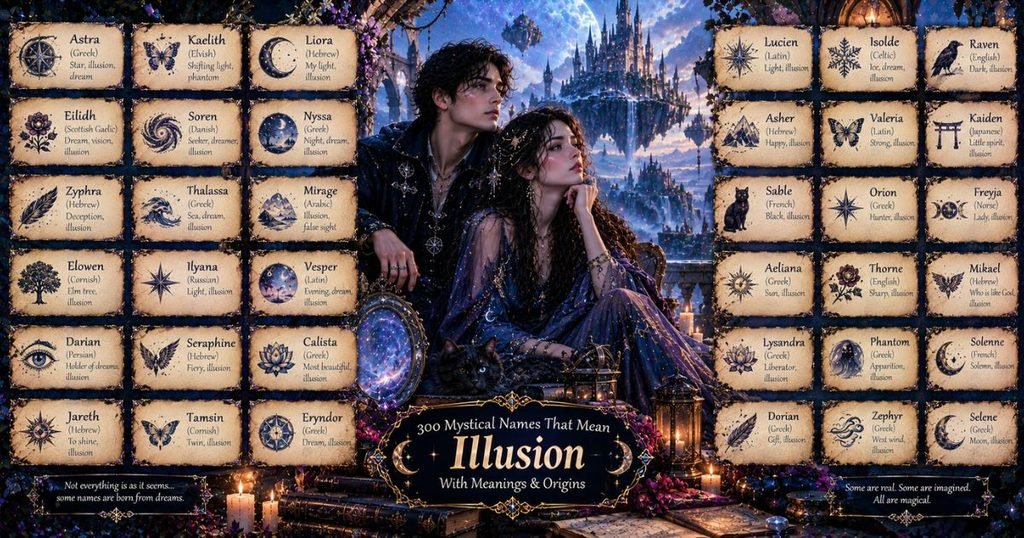
Names That Mean Illusion: 300 Mystical Names With Meanings & Origins
Names that mean illusion include Maya, a Sanskrit name for the veil of appearances in Hindu philosophy, plus Mirage, Phantasia, Morpheus, and Loki. Some names mean illusion directly, while others point to dreams, magic, mist, trickery, or shadow. Choose by origin, sound, and the kind of mystery you want.
Below you will find 300 names with origins and plain-English meanings, plus the stories behind them. Some mean “illusion” outright. Others earn their place through myth, literature, or history.
Girl Names That Mean Illusion and Enchantment
Most of these names come from enchantresses, spirits, and disguised heroines. A few mean “illusion” outright. The rest earn their place through the stories attached to them.
- Maya (Sanskrit) – “illusion” or “magic”; the veil of appearances in Advaita Vedanta.
- Mahamaya (Sanskrit) – “great illusion”; a goddess title and the Buddha’s mother.
- Yogamaya (Sanskrit) – the divine power of illusion in Hindu texts.
- Mayavati (Sanskrit) – “she who holds maya”; an alias used in a Puranic tale of hidden identity.
- Mohini (Sanskrit) – “enchantress”; Vishnu’s female form who beguiles demons.
- Menaka (Sanskrit) – a celestial dancer sent to lure a sage from his meditation.
- Illusia (modern, Latin-based) – a coined name built from illusio.
- Ilusión (Spanish) – the Spanish word for illusion, which also means hope or eager excitement.
- Phantasia (Greek) – “appearance” or “imagination.”
- Circe (Greek) – the Odyssey enchantress who turns sailors into pigs.
- Calypso (Greek) – “she who hides,” from kalyptein, “to cover.”
- Medea (Greek) – sorceress of Colchis, linked to Greek words for cunning.
- Hecate (Greek) – goddess of magic, crossroads, and night.
- Pandora (Greek) – “all-gifted”; in Hesiod, a beautiful gift that hides trouble.
- Morgana (Arthurian) – from Morgan le Fay; Fata Morgana is named for her.
- Vivien (Arthurian) – the enchantress who traps Merlin in Tennyson’s Idylls of the King.
- Nimue (Arthurian) – a Lady of the Lake figure who binds Merlin in some tellings.
- Igraine (Arthurian) – the queen deceived when Merlin’s magic gives Uther her husband’s face.
- Rhiannon (Welsh) – a figure in the Mabinogion whose magic birds lull listeners into a trance.
- Morrígan (Irish) – shape-shifting goddess who appears as crow, eel, wolf, and cow.
- Cerridwen (Welsh) – witch of the Taliesin legend, famous for her cauldron and shape-shifting chase.
- Blodeuwedd (Welsh) – a woman conjured from flowers by the magicians Math and Gwydion.
- Isolde (Celtic/Germanic legend) – heroine of Tristan and Isolde, bound by a love potion.
- Melusine (French) – a water spirit of medieval legend who hides her serpent form.
- Lorelei (German) – the Rhine siren of Romantic legend whose song lures boatmen.
- Sirena (Spanish/Italian) – “siren,” from Greek seiren.
- Ligeia (Greek) – “clear-voiced”; the name of one of the Sirens.
- Maeve (Irish) – from Medb, “she who intoxicates.”
- Alcina (Italian) – the sorceress in Orlando Furioso whose island paradise hides decay.
- Armida (Italian) – the enchantress in Tasso’s Jerusalem Delivered who traps knights in a magic garden.
- Duessa (English) – in Spenser’s Faerie Queene, a false beauty who masks ugliness.
- Dulcinea (Spanish) – from dulce, “sweet”; the peasant woman Don Quixote imagines as a noble lady.
- Titania (Shakespearean) – the fairy queen in A Midsummer Night’s Dream, where a potion rewrites perception.
- Viola (Latin) – “violet”; she disguises herself as Cesario in Twelfth Night.
- Rosalind (Germanic) – hides as Ganymede in As You Like It.
- Imogen (Shakespearean) – disguised as the page Fidele in Cymbeline.
- Odette (French) – the spell-bound swan princess of Swan Lake.
- Odile (French) – the ballet’s “black swan,” who impersonates Odette to fool the prince.
- Illyria (Latin) – the setting of Twelfth Night, a land of disguise and mistaken identity.
- Miranda (Latin) – “worthy of wonder”; it shares the mirari root with mirage.
- Mireille (Provençal) – from mirar, “to admire”; Mistral’s poem heroine.
- Mirabelle (Latin) – from mirabilis, “wonderful.”
- Mira (Latin) – “wonderful,” and “peace” in some Slavic languages.
- Iris (Greek) – “rainbow,” light playing tricks across rain.
- Faye (Old French) – “fairy,” from fae.
Boy Names That Mean Illusion and Trickery
Boy names for illusion often come from sorcerers, impostors, and thinkers who questioned what is real. Many are literary or historical. They suit characters, middle names, and bold baby-name picks.
- Merlin (Welsh/Latin) – the legendary wizard, from Myrddin.
- Prospero (Italian/Latin) – “fortunate”; the sorcerer in The Tempest who stages illusions.
- Oberon (Germanic) – fairy king in A Midsummer Night’s Dream; from Alberich, “elf ruler.”
- Faust (Latin) – “fortunate”; the scholar who trades his soul for magical power.
- Dorian (Greek) – “of Doris”; Wilde’s Dorian Gray hides his corruption behind a perfect face.
- Alberich (Germanic) – “elf ruler”; the dwarf whose Tarnhelm grants invisibility in Wagner’s Ring.
- Siegfried (Germanic) – “victory and peace”; in the Nibelungenlied he wears a cloak of invisibility.
- Gyges (Greek) – owner of the Ring of Gyges, a ring of invisibility in Plato’s Republic.
- Indrajit (Sanskrit) – “conqueror of Indra”; a Ramayana warrior who fights with illusions.
- Mayasura (Sanskrit) – Maya the asura, a legendary architect and illusionist.
- Maricha (Sanskrit) – the demon who becomes a golden deer in the Ramayana.
- Shambara (Sanskrit) – an asura famed for his illusions in Hindu legend.
- Sinon (Greek) – the soldier whose lies persuade Troy to take in the wooden horse.
- Odysseus (Greek) – the trickster behind the Trojan Horse.
- Magus (Latin) – from Old Persian maguš, a priest, and the root of “magic.”
- Cyprian (Latin) – “of Cyprus”; legend says Saint Cyprian of Antioch was a sorcerer before his conversion.
- Thaumas (Greek) – “wonder”; the root of thaumaturge, a miracle-worker.
- Gwydion (Welsh) – magician in the Mabinogion who conjures false horses, hounds, and ships.
- Taliesin (Welsh) – “radiant brow”; the shape-shifting bard of Welsh legend.
- Zeuxis (Greek) – the painter said to paint grapes so lifelike that birds pecked them (per Pliny).
- Parrhasius (Greek) – the rival who fooled Zeuxis with a painted curtain.
- Penrose (Cornish) – a place name, and the name behind the impossible Penrose triangle.
- Rubin (German/Yiddish) – surname of Edgar Rubin, who published the vase-and-faces figure in 1915.
- Thurston (Old Norse) – “Thor’s stone”; Howard Thurston was a famed American stage magician.
- Escher (Dutch) – the artist M.C. Escher, known for impossible staircases.
- Pygmalion (Greek) – the sculptor whose ivory statue comes alive in Ovid’s Metamorphoses.
- Mesmer (German) – Franz Mesmer, whose “animal magnetism” gave us the word mesmerize.
- Quixote (Spanish) – Cervantes’ hero who mistakes windmills for giants.
- Ruggiero (Italian) – the knight freed from Alcina’s enchantments in Orlando Furioso.
- Astolfo (Italian) – the knight with a magic book and horn in the same epic.
- Atlante (Italian) – the wizard whose enchanted castle fools knights with false visions.
- Archimago (Latin-coined) – “arch-magician”; Spenser’s deceiver in The Faerie Queene.
- Comus (Greek) – “revel”; the enchanter with a magic cup in Milton’s masque.
- Figaro (Italian) – the scheming barber of Beaumarchais, Rossini, and Mozart.
- Sebastian (Greek) – “venerable”; mistaken for his twin in Twelfth Night.
- Cesario (Latin) – the male alias Viola adopts in Twelfth Night.
- Ganymede (Greek) – the alias Rosalind uses in As You Like It.
- Cyrano (French) – the poet who lends his words to another man under a balcony.
- Zorro (Spanish) – “fox”; a masked hero with a secret identity.
- Gatsby (English) – Fitzgerald’s self-invented millionaire, born James Gatz.
- Truman (English) – “faithful man”; the hero of The Truman Show, who lives in a staged world.
- Neo (Greek) – “new”; the hero freed from a simulated reality in The Matrix.
- René (French) – “reborn”; Descartes imagined a deceiving demon in his 1641 Meditations.
- Plato (Greek) – “broad”; author of the allegory of the cave.
- Zhuang (Chinese) – the philosopher Zhuangzi, who dreamed he was a butterfly and doubted which was real.
Unisex Illusion Names and Magical Word Names
These short names work for any child, pet, or character. Many are English words that already feel like a spell.
- Mirage (French) – a trick of light over hot air or sand.
- Phantasm (Greek) – from phantasma, “apparition.”
- Phantom (Greek via French) – a ghostly appearance.
- Ariel (Hebrew) – “lion of God”; the spirit in The Tempest who stages illusory banquets.
- Mayavi (Sanskrit) – “possessing maya”; an illusionist.
- Pepper (English) – “Pepper’s ghost” is a stage illusion popularized by John Henry Pepper in 1860s London.
- Ripley (English) – a place name; Highsmith’s Tom Ripley is a talented impostor.
- Sylph (Latin-coined) – an air spirit named by Paracelsus in the 1500s.
- Fable (Latin) – from fabula, “story.”
- Morgan (Welsh) – tied to Morgan le Fay and the Fata Morgana mirage.
- Robin (English) – Robin Goodfellow is a prankster sprite of English folklore.
- Glamer (Scots) – an old word for a spell that alters how things look; the root of glamour.
- Mystic (Greek) – from mystikos, “secret.”
- Enigma (Greek) – from ainigma, “riddle.”
- Cipher (Arabic) – from ṣifr, “empty” or “zero,” later a secret code.
- Charm (Latin) – from carmen, “song” or “incantation.”
- Marvel (Latin) – from mirabilia, “wonderful things.”
- Wonder (Old English) – from wundor, “marvel.”
- Spectre (Latin) – from spectrum, “appearance.”
- Eidolon (Greek) – “phantom” or “image.”
- Mercury (Latin) – the Roman messenger god, matched with trickster Hermes.
- Fey (Old English) – once “fated,” later “otherworldly.”
- Rune (Old Norse) – from rún, “secret.”
- Harlequin (Italian) – from Arlecchino, the masked trickster of commedia dell’arte.
- Pierrot (French) – the white-faced dreamer clown of French theater.
Mythological Names for Dreams, Deception, and Shape-Shifters
Myths around the world give us gods who rule dreams and tricksters who bend reality. Some figures below are sacred in living traditions. Use those names with respect and learn their stories first.
- Morpheus (Greek) – from morphē, “form”; in Ovid’s Metamorphoses, the god who shapes human figures in dreams.
- Phantasos (Greek) – appears in dreams as rocks, water, and trees, per Ovid.
- Phobetor (Greek) – also called Ikelos; appears in dreams as beasts and birds.
- Hypnos (Greek) – god of sleep.
- Somnus (Latin) – Roman god of sleep.
- Apate (Greek) – spirit of deceit.
- Dolos (Greek) – spirit of trickery and craft.
- Metis (Greek) – Titaness of cunning counsel.
- Proteus (Greek) – the sea god who changes shape to avoid questions.
- Hermes (Greek) – the messenger god who steals Apollo’s cattle as a newborn.
- Vertumnus (Roman) – disguises himself as an old woman to woo Pomona in Ovid.
- Daedalus (Greek) – “cunningly wrought”; builder of the Labyrinth.
- Autolycus (Greek) – master thief said to disguise stolen goods.
- Sisyphus (Greek) – famed for cunning, even tricking Death.
- Prometheus (Greek) – “forethought”; tricks Zeus over the sacrifice.
- Dionysus (Greek) – god of wine and ecstasy who deceives Pentheus in the Bacchae.
- Thetis (Greek) – the sea goddess who shifts forms to escape Peleus.
- Pan (Greek) – wild god whose unseen presence gives us the word panic.
- Loki (Norse) – the shape-shifting trickster of Norse mythology.
- Odin (Norse) – from óðr, “frenzy”; he travels in disguise.
- Freya (Norse) – said in the sagas to have taught the gods seiðr, a kind of magic.
- Manannán (Irish) – sea god who wields a cloak of mist.
- Arawn (Welsh) – Otherworld king who swaps appearances with Pwyll for a year.
- Pwyll (Welsh) – “prudence”; rules in Arawn’s likeness.
- Gwion (Welsh) – the boy who changes into hare, fish, and grain before becoming Taliesin.
- Narada (Sanskrit) – the sage who learns the power of Vishnu’s maya firsthand.
- Lila (Sanskrit) – “divine play”; the world as cosmic play, closely tied to maya.
- Hanuman (Sanskrit) – the monkey hero who shrinks and grows at will.
- Vamana (Sanskrit) – “dwarf”; Vishnu’s avatar who tricks King Bali with three steps.
- Wukong (Chinese) – “awakened to emptiness”; the Monkey King has 72 transformations.
- Daji (Chinese) – the fox spirit consort in the Ming novel Fengshen Yanyi.
- Anansi (Akan) – the spider trickster of West African and Caribbean tales.
- Eshu (Yoruba) – the orisha of crossroads and trickery.
- Coyote (Native American) – a trickster in many Native nations’ stories.
- Raven (Native American) – a transformer and trickster in Pacific Northwest traditions.
- Nanabozho (Anishinaabe) – trickster and culture hero.
- Iktomi (Lakota) – the spider trickster.
- Maui (Polynesian) – the shape-shifting demigod who fishes up islands.
- Heka (Egyptian) – god and personification of magic.
- Tezcatlipoca (Nahuatl) – “smoking mirror”; an Aztec god linked to sorcery and deception.
- Puck (English) – a mischievous sprite from folklore and Shakespeare.
- Mab (English) – the fairies’ midwife in Romeo and Juliet, who delivers dreams.
- Reynard (French) – the cunning fox of medieval fables.
- Till (German) – Till Eulenspiegel, the prankster of a 1500s German folk book.
- Nasreddin (Turkish) – the wise-fool trickster of Turkish and Persian tales.
Names That Mean Dream, Vision, and Imagination
Dream and vision names capture illusion’s softer side. They suit parents who want mystery without a trickster edge. They also work for any reader who likes a gentle name with a faraway feel.
- Aisling (Irish) – “dream” or “vision”; also a poetic genre of vision-poems.
- Oneira (Greek) – “dreams,” from oneiros.
- Reverie (French) – a daydream.
- Somnia (Latin) – “dreams.”
- Roya (Persian) – “dream” or “vision.”
- Ahlam (Arabic) – “dreams.”
- Hayal (Turkish) – “dream” or “imagination.”
- Sanja (Slavic) – “dream.”
- Kalpana (Sanskrit) – “imagination.”
- Swapna (Sanskrit) – “dream.”
- Swapnil (Sanskrit) – “dreamlike.”
- Sapna (Hindi) – “dream.”
- Álmos (Hungarian) – “dreamy”; the legendary prince whose mother dreamed of a falcon.
- Emese (Hungarian) – “mother”; the dreamer in the Álmos legend.
- Chimera (Greek) – a fire-breathing hybrid; today also a fanciful dream.
- Sibyl (Greek) – a prophetess who sees visions.
- Cassandra (Greek) – a seer whose true visions no one believed.
- Tiresias (Greek) – the blind seer of Thebes.
- Pythia (Greek) – the priestess of the Oracle at Delphi.
- Rüya (Turkish) – “dream.”
- Hülya (Turkish) – “daydream.”
- Ilham (Arabic) – “inspiration.”
- Yeraz (Armenian) – “dream.”
- Drishti (Sanskrit) – “sight” or “vision.”
- Darshan (Sanskrit) – “sight,” especially of the divine.
- Mengqi (Chinese) – 梦 “dream” plus 琪 “fine jade.”
- Mengyao (Chinese) – 梦 “dream” plus 瑶 “jade.”
- Joseph (Hebrew) – the biblical dream interpreter.
- Daniel (Hebrew) – “God is my judge”; interprets dreams and visions in the Book of Daniel.
- Ezekiel (Hebrew) – a prophet known for vivid visions.
- Yusuf (Arabic) – the Quranic form of Joseph, in a surah about a dream.
- Khayal (Arabic/Urdu) – “imagination” or “apparition.”
- Uni (Finnish) – “sleep” or “dream.”
- Svajonė (Lithuanian) – “dream” or “reverie.”
- Utopia (Greek-coined) – “no place,” coined by Thomas More in 1516.
- Arcadia (Greek) – a Greek region that poets turned into an ideal dreamland.
- Avalon (Welsh/Latin) – the misty island of Arthurian legend.
- Alice (Old French) – the dreamer of Wonderland.
- Elysia (Greek) – from Elysium, the blessed afterlife.
- Solomon (Hebrew) – “peace”; God appears to him in a dream in 1 Kings 3.
- Jacob (Hebrew) – dreams of a ladder to heaven in Genesis.
- Sigmund (Germanic) – “victory protector”; Freud’s Interpretation of Dreams appeared around 1900.
- Endymion (Greek) – the shepherd granted endless sleep.
- Joel (Hebrew) – the prophet who wrote that “young men shall see visions.”
- Netra (Sanskrit) – “eye.”
Japanese Names That Mean Illusion, Dream, and Mist
Japanese has rich words for illusion and fleeting beauty. Many appear in The Tale of Genji and in classical poetry. Some are everyday given names, and others are literary words that read like names.
- Maboroshi (幻) – “illusion” or “phantom”; a chapter of The Tale of Genji.
- Yume (夢) – “dream.”
- Yumeko (夢子) – “dream child.”
- Yumemi (夢見) – “seeing a dream.”
- Yumeno (夢乃) – “of dreams.”
- Yumeji (夢二) – the name of Takehisa Yumeji, a Taishō-era artist.
- Mugen (夢幻) – “dream and illusion.”
- Yūgen (幽玄) – deep, mysterious beauty.
- Kasumi (霞) – “mist” or “haze.”
- Kiri (霧) – “fog.”
- Utsusemi (空蝉) – “cicada shell,” a symbol of fleeting life and another Genji chapter.
- Utsutsu (現) – “waking reality,” the opposite of a dream.
- Tamamo (玉藻) – the nine-tailed fox who disguises herself as a court lady in legend.
- Kitsune (狐) – “fox,” a shape-shifter in Japanese folklore.
- Kuzunoha (葛の葉) – the legendary fox-wife of Japanese tales.
- Seimei (晴明) – “clear brightness”; Abe no Seimei was a Heian-era court diviner of legend.
- Kagerō (陽炎) – “heat shimmer,” also the Kagerō Nikki diary of the 900s.
- Shinkirō (蜃気楼) – “mirage.”
- Gen’ei (幻影) – “phantom image.”
- Urashima (浦島) – the fisherman who returns from a sea palace to find the world has aged.
- Kagami (鏡) – “mirror.”
- Shiranui (不知火) – “unknown fire,” mysterious lights seen over the Yatsushiro Sea.
- Utakata (泡沫) – “foam” or “bubble,” a symbol of the fleeting.
- Hōrai (蓬莱) – a legendary island of immortals.
- Baku (獏) – the dream-eating creature of Japanese folklore.
- Nemu (眠) – “sleep” or “slumber.”
Names Inspired by Mist, Mirrors, Shadows, and Mirage
These names feel like illusion even when the word itself is missing. They are drawn from light, haze, reflection, and the places where mirages appear.
- Sarab (Arabic) – “mirage.”
- Narcissus (Greek) – the youth who falls for his own reflection in Ovid.
- Echo (Greek) – the nymph who can only repeat others’ words.
- Nyx (Greek) – goddess of night.
- Erebus (Greek) – “darkness.”
- Umbra (Latin) – “shadow.”
- Umbriel (English) – a gloomy sprite in Pope’s The Rape of the Lock.
- Shade (English) – a shadow or ghost.
- Nebula (Latin) – “mist” or “cloud.”
- Misty (English) – hazy with fine drops.
- Haze (English) – a thin, blurring mist.
- Aether (Greek) – the pure upper air the gods breathe.
- Nephele (Greek) – “cloud”; Zeus shapes a cloud into Hera’s image to fool Ixion.
- Ixion (Greek) – the man tricked by that cloud.
- Helen (Greek) – in one ancient version, a phantom Helen goes to Troy while the real one waits in Egypt.
- Prism (Greek) – from prisma, a bender of light.
- Spectra (Latin) – plural of spectrum, “appearance.”
- Opal (Sanskrit) – a gem whose colors shift as you turn it.
- Wisp (English) – as in will-o’-the-wisp, the light that misleads travelers.
- Ignis (Latin) – “fire,” from ignis fatuus, “foolish fire,” another name for the will-o’-the-wisp.
- Caligo (Latin) – “mist” or “fog.”
- Nimbus (Latin) – “cloud.”
- Bruma (Spanish/Portuguese) – “mist.”
- Perseus (Greek) – watched Medusa only in his shield’s reflection.
- Carroll (Irish) – a surname; Lewis Carroll wrote Through the Looking-Glass (1871).
- Monet (French) – Claude Monet, whose paintings dissolve scenes into light.
- Brumaire (French) – “foggy month” in the French Revolutionary calendar.
- Vesper (Latin) – “evening,” when light plays tricks.
- Selene (Greek) – moon goddess.
- Luna (Latin) – “moon.”
- Halo (Greek) – a ring of light around the sun or moon.
- Aurora (Latin) – “dawn,” and the name of the polar lights.
- Messina (Italian) – the strait where Fata Morgana mirages are often seen.
- Oasis (Greek/Egyptian) – the thing a desert mirage imitates.
- Sahara (Arabic) – “desert,” a famous home of mirages.
- Elara (Greek) – in some versions, a nymph whom Zeus hides underground.
- Arcana (Latin) – “secrets.”
- Obscura (Latin) – “dark,” as in camera obscura, the “dark chamber” that casts images on a wall.
- Phantasma (Greek) – “apparition.”
Invented Illusion Names for Characters and Fantasy Worlds
The names below are modern coinages. They have no historical meaning. We built each from the real roots shown: mira (“wonder”), phant (“appear”), umbra (“shadow”), nebula (“mist”), somn (“sleep”), oneir (“dream”), spect (“see”), eido (“image”), vel (“veil”), glam (“glamour”), fey, aether, and illud (“to mock or play”). Check trademarks and domains before using one for a brand.
- Mirazel – mira + -el
- Mirelune – mira + lune (“moon”)
- Mirovane – mira + vane
- Phantora – phant + -ora
- Phantessa – phant + -essa
- Phantiel – phant + -iel
- Umbrelle – umbra + -elle
- Umbrael – umbra + -ael
- Umbren – umbra + -en
- Nebriel – nebula + -iel
- Nebulyn – nebula + -yn
- Somnara – somn + -ara
- Somniel – somn + -iel
- Oneirah – oneir + -ah
- Oneiron – oneir + -on
- Spectria – spect + -ria
- Spectran – spect + -an
- Eidolyn – eido + -lyn
- Eidoren – eido + -ren
- Velisse – vel + -isse
- Velmora – vel + mora
- Velune – vel + lune
- Glamryn – glam + -ryn
- Glamerin – glam + -erin
- Feyren – fey + -ren
- Feyleth – fey + -leth
- Aetherin – aether + -in
- Aethis – aether + -is
- Illudra – illud + -ra
- Illuvane – illud + vane
You May Also Read: 250 Girl Names That Mean Shadow (Plus Dark, Night & Dusk Picks)
Final Thoughts
Names that mean illusion let you choose a story, not just a sound. Whether you want the Sanskrit depth of Maya, the stage-magic flair of Thurston, or a made-up name for your next character, you now have 300 options with real roots. Bookmark this page, share your favorite in the comments, or browse our related name lists for more inspiration.
FAQs
What name means illusion?
Maya is the best-known name that means illusion. It comes from Sanskrit and also means “magic.” Related names include Mahamaya (“great illusion”), Mayavati, and the modern coinage Illusia.
Is Maya a name that means illusion?
Yes. In Sanskrit, māyā means illusion or magic, and in Advaita Vedanta it describes the veil that makes the world seem separate and solid. Maya is also the Buddha’s mother in Buddhist tradition. Unrelated names spelled Maya or Maia exist in other languages, so check the origin.
What god or goddess represents illusion?
No single deity does. Maya and Mahamaya are Hindu concepts and titles, Apate is the Greek spirit of deceit, Morpheus and Phantasos shape dream-images in Greek myth, and Loki is the Norse shape-shifting trickster.
Are there boy names that mean illusion?
A few boy names link directly to illusion, including Mayavi (“possessing maya”), Mayasura, and Shambara from Hindu legend. Prospero, Merlin, and Indrajit are strong story-based choices.
What are good names for a magician or illusionist character?
Thurston, Mesmer, Prospero, Merlin, and Gwydion suit magicians and sorcerers. Ripley, Gatsby, and Figaro suit impostors and schemers. Umbrael and Illuvane are invented options for fantasy settings.