Names That Mean Death Bringer: 400 Dark Names With Meanings
Names that mean death bringer are names tied to gods, angels, spirits, or words for death, doom, and destruction. Top picks include Thanatos (Greek death), Azrael (angel of death), Hades (underworld king), Morrigan (Celtic death goddess), Kali (Hindu destroyer), and Yama (Hindu lord of death).
This guide lists 400 names that mean death bringer, each with its origin and meaning. Many trace back to texts like Hesiod’s Theogony, written more than 2,500 years ago, and the Book of Revelation. You’ll meet death gods, angels of death, and boy, girl, and unisex picks. You’ll also see names that mean destroyer or reaper, plus simple tips for choosing a name that fits your story, your game, or your family.
What is the name of the god of death?
That depends on the culture. Greeks used Thanatos for death itself and Hades for the king of the underworld. Romans said Mors and Pluto. Hindus say Yama. Norse tales name Hel as the goddess of the dead. Egyptians name Anubis and Osiris, and the Aztecs named Mictlantecuhtli.
Greek Death Gods and Spirits
- Thanatos (Greek): death personified; Hesiod calls him a child of Night.
- Hades (Greek): king of the underworld; the name is often read as “the unseen.”
- Persephone (Greek): queen of the dead; ancient writers tied her name to bringing destruction, though the root is debated.
- Charon (Greek): the ferryman of souls; the name is sometimes read as “keen gaze.”
- Keres (Greek): spirits of violent death who haunt battlefields.
- Moros (Greek): personified doom, listed by Hesiod among Night’s children.
- Nyx (Greek): goddess of night and mother of Thanatos.
- Erebus (Greek): primeval darkness, the shadowy gateway to Hades.
- Hecate (Greek): goddess of ghosts, crossroads, and witchcraft.
- Melinoe (Greek): underworld goddess in an Orphic hymn, a sender of phantoms.
- Atropos (Greek): “she who cannot be turned,” the Fate who cuts the thread of life.
- Achlys (Greek): the death-mist that clouds dying eyes.
- Macaria (Greek): goddess of blessed death; in some sources a daughter of Hades.
- Styx (Greek): the river and goddess of the oath; the name suggests “hateful.”
- Tisiphone (Greek): a Fury, “avenger of murder.”
- Alecto (Greek): a Fury, “unceasing.”
- Megaera (Greek): a Fury, “grudging.”
- Eurynomos (Greek): a corpse-eating demon in Pausanias’s account of a painting at Delphi.
You May Also Read: Names That Mean Illusion: 300 Mystical Names With Meanings & Origins.
Roman Death Gods
- Mors (Latin): “death,” the Romans’ personified Death.
- Orcus (Roman): punisher of oath-breakers; also a poetic name for the underworld.
- Pluto (Roman): from Greek Plouton, “giver of wealth,” lord of the dead.
- Dis Pater (Roman): “Rich Father,” another title for the underworld’s king.
- Libitina (Roman): goddess of funerals and burial.
- Letum (Latin): a poetic word for death, also personified.
- Proserpina (Roman): the Roman form of Persephone, queen of the dead.
- Mania (Roman): goddess of the dead and mother of the Lares, the household spirits.
- Nenia (Roman): goddess of funeral laments.
- Morta (Roman): one of the Parcae, the Roman Fates; her name echoes “death.”
Norse and Germanic Death Figures
- Hel (Norse): ruler of the realm of the dead, which shares her name.
- Odin (Norse): god of war, poetry, and the slain; his name relates to “frenzy.”
- Freyja (Norse): goddess of love who claims half of the battle-slain.
- Fenrir (Norse): the giant wolf fated to kill Odin at Ragnarök.
- Rán (Norse): sea goddess who snares drowned sailors in her net.
- Surtr (Norse): the fire giant whose name means “black”; he burns the world at Ragnarök.
- Níðhöggr (Norse): the dragon who gnaws Yggdrasil’s roots; “malice-striker.”
- Skuld (Norse): a Norn and valkyrie; her name means “debt” or “what shall be.”
- Garm (Norse): the hound who guards the gates of Hel.
- Gunnr (Norse): a valkyrie whose name means “war.”
Celtic Death and War Figures
- Morrigan (Irish): goddess of war and fate; the name is read as “phantom queen” or “great queen.”
- Badb (Irish): war goddess who appears as a crow; the name means “crow.”
- Macha (Irish): one of the war and sovereignty goddesses, tied to Emain Macha in Ulster.
- Nemain (Irish): war goddess whose name means “frenzy.”
- Arawn (Welsh): king of Annwn, the Otherworld.
- Balor (Irish): the one-eyed giant whose single glance destroyed armies.
- Donn (Irish): “the dark one,” who gathers the dead in his house.
- Ankou (Breton): death personified, who drives a cart to collect souls.
- Gwyn (Welsh): Gwyn ap Nudd, leader of the Wild Hunt and guardian of souls.
- Cailleach (Gaelic): “veiled one,” a hag goddess of winter and death.
Egyptian, Mesopotamian, and Canaanite Death Gods
- Anubis (Egyptian): jackal-headed god of embalming who guides souls.
- Osiris (Egyptian): king of the dead and judge of the afterlife.
- Nephthys (Egyptian): mourning goddess, “lady of the house.”
- Ammit (Egyptian): “devourer of the dead,” who eats hearts that fail judgment.
- Sekhmet (Egyptian): lioness goddess, “the powerful one”; her rage nearly ended humanity in myth.
- Serqet (Egyptian): scorpion goddess who guarded the dead and healed venom.
- Seth (Egyptian): god of storms and chaos who murders Osiris.
- Ereshkigal (Sumerian): queen of the underworld, “lady of the great below.”
- Nergal (Mesopotamian): god of plague, war, and the underworld.
- Namtar (Mesopotamian): Ereshkigal’s vizier, a personified fate and plague.
- Mot (Canaanite): the god of death, whose name means “death”; he swallows Baal in the Ugaritic texts.
Hindu, Buddhist, and East Asian Death Gods
- Yama (Sanskrit): lord of death and judge of the dead in Hindu and Buddhist tradition.
- Kali (Sanskrit): goddess of time and destruction; the name links to “black” and “time.”
- Shiva (Sanskrit): “auspicious,” the destroyer in the Hindu trinity.
- Kala (Sanskrit): “time,” also “death”; an epithet of Yama.
- Mrityu (Sanskrit): “death,” personified in Vedic texts.
- Kalaratri (Sanskrit): “night of death,” a fierce form of Durga.
- Bhairava (Sanskrit): “terrifying,” a fierce form of Shiva.
- Chamunda (Sanskrit): the goddess who slew the demons Chanda and Munda.
- Rudra (Sanskrit): Vedic storm god of arrows and disease; often read as “howler.”
- Enma (Japanese): king of hell, rooted in the Indian Yama.
- Izanami (Japanese): goddess who died and rules Yomi; in the Kojiki she vows to kill 1,000 living people a day.
- Yanluo (Chinese): king of the underworld, derived from Yama.
- Mahakala (Sanskrit): “great black” or “great time,” a wrathful Buddhist protector.
- Yamantaka (Sanskrit): “ender of death,” a Tibetan Buddhist deity.
Slavic, Baltic, and Finnic Death Figures
- Morana (Slavic): goddess of winter and death, from a root tied to death and plague.
- Chernobog (Slavic): “black god,” known mainly from medieval chroniclers.
- Marzanna (Polish): a form of Morana; a straw effigy is drowned each spring to end winter.
- Koschei (Russian): “the Deathless,” a villain whose death hides inside a needle.
- Giltinė (Lithuanian): goddess of death; the name is linked to “to sting.”
- Tuoni (Finnish): god of the dead who rules Tuonela.
- Tuonetar (Finnish): Tuoni’s wife and queen of the dead.
- Kalma (Finnish): personified death and decay; the word also means a grave smell.
- Louhi (Finnish): the witch-queen of the North in the Kalevala, who sends sickness.
Death Figures From the Americas, Africa, and Oceania
- Mictlantecuhtli (Aztec): “Lord of Mictlan,” god of the dead.
- Mictecacihuatl (Aztec): “Lady of Mictlan,” queen of the dead.
- Xolotl (Aztec): dog-headed god who guides the dead.
- Ah Puch (Maya): a death god, often drawn as a skeletal figure.
- Supay (Quechua): lord of the underworld; the word also means “shadow” or “spirit.”
- Owuo (Akan): death personified.
- Oya (Yoruba): orisha of storms who guards the gateway of the dead.
- Baron Samedi (Haitian Vodou): the lwa of the dead, who guards the graveyard crossroads.
- Whiro (Māori): god of darkness and death.
- Hine-nui-te-pō (Māori): “Great Woman of the Night,” who rules the underworld and slays Māui.
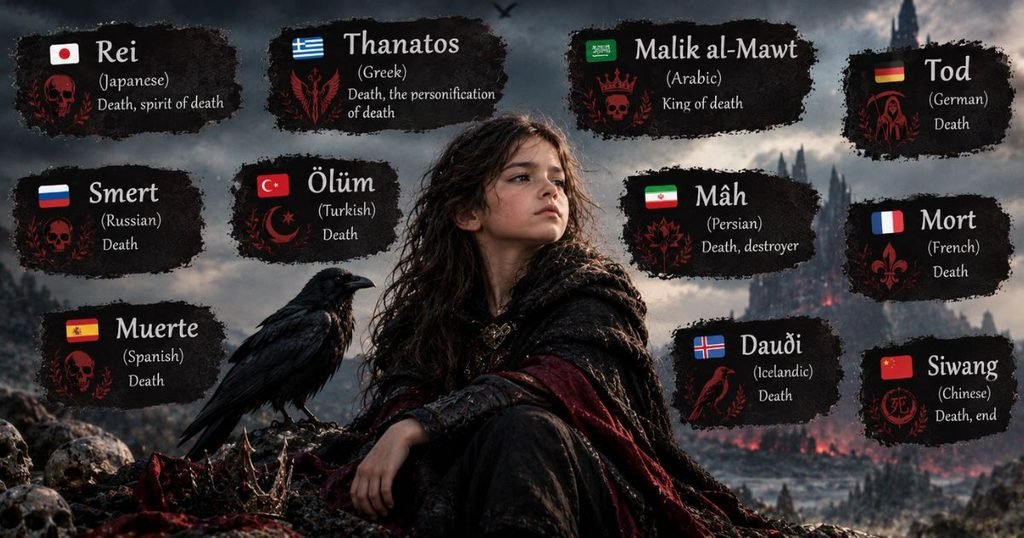
Angel of Death Names and Names That Mean Destroyer
The Grim Reaper is only one image of death. Many traditions picture an angel or a spirit who carries out death or destruction. The names below come mostly from Jewish, Christian, Islamic, and Zoroastrian texts, plus Greek and Roman war and vengeance figures. The first group holds angels and demons. The second holds names that mean slayer, avenger, and destroyer.
Angels and Demons of Death
- Azrael (Hebrew): angel of death in Jewish and Islamic lore; often glossed “whom God helps.”
- Izrail (Arabic): the Arabic and Turkish form of Azrael.
- Abaddon (Hebrew): “destruction”; Revelation 9:11 names him king of the abyss.
- Apollyon (Greek): “destroyer,” the Greek name for the same figure in Revelation.
- Samael (Hebrew): angel of death and accuser in Jewish lore; sometimes read as “venom of God.”
- Azazel (Hebrew): the scapegoat spirit of Leviticus 16, later a fallen angel.
- Dumah (Hebrew): “silence”; an angel over the spirits of the dead in the Talmud.
- Mastema (Hebrew): “hostility,” leader of demons in the Book of Jubilees.
- Camael (Hebrew): “he who sees God”; some angel lists make him an angel of destruction.
- Mashchit (Hebrew): “the destroyer” of Exodus 12:23.
- Lilith (Hebrew): “of the night,” a night demon of Jewish lore.
- Naamah (Hebrew): a dangerous demoness in medieval Jewish mysticism.
- Agrat (Hebrew): Agrat bat Mahlat, a demon queen who commands destroying angels in the Talmud.
- Belial (Hebrew): “worthless”; the chief of darkness in the Dead Sea Scrolls.
- Malik (Arabic): “king”; the angel who guards Hell in Islamic tradition.
- Ahriman (Persian): the Zoroastrian “destructive spirit,” Angra Mainyu.
- Astvihad (Avestan): the Zoroastrian demon of death; the name is read as “bone-dissolver.”
- Dahak (Persian): the three-headed dragon king of Iranian myth.
- Asmodeus (Hebrew): the demon in the Book of Tobit who kills Sarah’s seven husbands.
- Ketev (Hebrew): “destruction,” the noonday plague of Psalm 91.
Names That Mean Slayer, Avenger, and Destroyer
- Nemesis (Greek): “retribution,” the goddess who punishes pride.
- Alastor (Greek): “avenger,” a spirit of vengeance.
- Poine (Greek): payment for blood; the spirit of punishment.
- Adrasteia (Greek): “inescapable,” a title of Nemesis.
- Phonos (Greek): “murder,” a child of Strife in Hesiod.
- Enyo (Greek): goddess of war and destruction.
- Ate (Greek): “ruin,” the goddess of reckless folly.
- Eris (Greek): “strife.”
- Bellona (Roman): war goddess, from Latin bellum, “war.”
- Ares (Greek): god of war and bloodshed; the root may be tied to “ruin.”
- Mars (Roman): the war god, who also gave us the month of March.
- Aeron (Welsh): “battle” or “slaughter.”
- Agrona (Brittonic): “slaughter,” a war and death goddess.
- Apollo (Greek): god of light whose arrows bring plague in the opening of the Iliad.
- Skadi (Norse): “harm,” goddess of winter and the hunt.
- Erinys (Greek): singular of the Furies; often glossed “angry.”
- Perseus (Greek): the hero who beheaded Medusa; the name may mean “destroyer.”
- Bellerophon (Greek): killer of the Chimera; the name is read as “slayer of Bellerus.”
- Achilles (Greek): Hector’s killer; the name may link to achos, “grief.”
- Orestes (Greek): “mountain-dweller”; he kills his mother to avenge his father.
- Gideon (Hebrew): “hewer,” one who cuts down.
- Bana (Old Norse): “slayer.”
- Bane (English): from Old English bana, “slayer.”
- Bale (English): from Old English bealu, “evil” or “harm.”
- Arindam (Sanskrit): “subduer of enemies.”
- Deianira (Greek): “man-destroyer”; her poisoned robe kills Heracles.
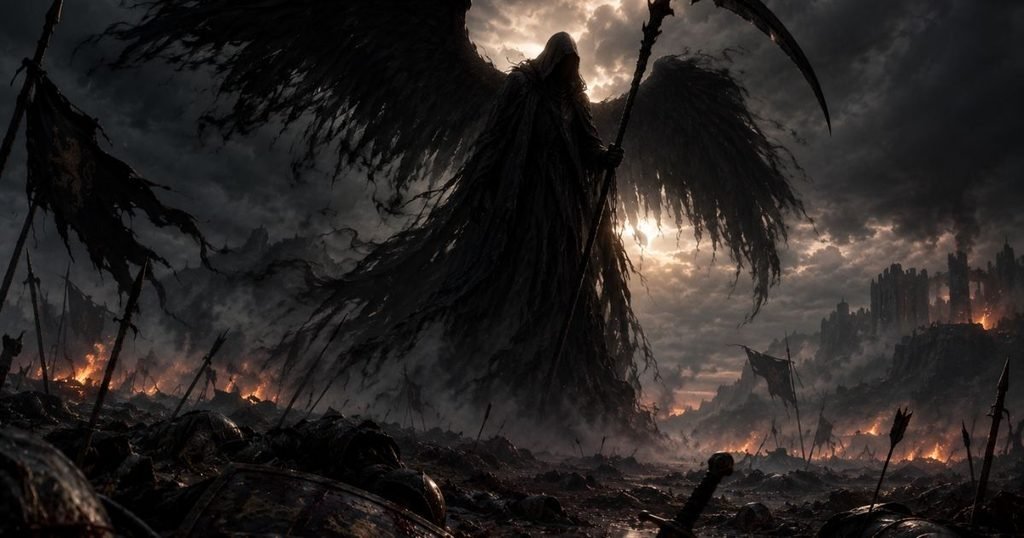
Boy Names That Mean Death Bringer and Other Dark Boy Names
Few real boy names mean “death” outright. Most mean “dark,” “raven,” “slayer,” or “grave,” and a few come straight from the Bible or Sanskrit. That makes them practical for babies, characters, and gamer tags alike. Each entry names its source. Modern coinages are marked as such.
Boy Names That Mean Death or the End
- Azmaveth (Hebrew): “death is strong”; one of King David’s warriors in 2 Samuel.
- Hazarmaveth (Hebrew): “court of death,” a region named in Genesis 10.
- Ahimoth (Hebrew): “brother of death,” a Levite in 1 Chronicles.
- Kritanta (Sanskrit): “ender,” an epithet of Yama.
- Antaka (Sanskrit): “ender”; another title for death and for Yama.
- Mrityunjay (Sanskrit): “conqueror of death,” a title of Shiva.
- Yamaraj (Sanskrit): “King Yama,” lord of death.
- Ajal (Arabic): the appointed time of death.
- Lefu (Sesotho): the word for death.
- Mort (French): “death.”
- Mortimer (Norman): from the place name Mortemer; often read as “dead water” or “still water.”
- Nekros (Greek): “corpse.”
- Dáinn (Old Norse): “dead”; a name in the Eddic lists of dwarves.
- Cain (Hebrew): “acquired”; the first murderer in Genesis.
- Grim (Old Norse): from Grímr, “masked one,” a byname of Odin; today it evokes the Grim Reaper.
- Lazarus (Hebrew): “God has helped”; the man raised from death in John 11.
- Thanos (Greek): a short form of Athanasios, “immortal”; it echoes Thanatos.
Dark and Raven Boy Names
- Ciaran (Irish): “little dark one.”
- Duncan (Gaelic): “brown” or “dark warrior.”
- Dougal (Gaelic): from Dubhghall, “dark stranger.”
- Corbin (French): “raven,” a bird long tied to omens of death.
- Bran (Welsh and Irish): “raven.”
- Blake (English): from Old English words for “black” or “pale,” so the root is two-sided.
- Cole (English): “coal,” and so “dark.”
- Sullivan (Irish): meaning debated: “little dark eye,” “hawk-eyed,” or “one-eyed.”
- Donovan (Irish): “dark brown” or “dark one.”
- Doyle (Irish): from Dubhghall, “dark foreigner.”
- Duff (Scots Gaelic): from dubh, “black.”
- Corvus (Latin): “raven”; also a constellation.
- Tamas (Sanskrit): “darkness,” one of the three gunas; also the Hungarian form of Thomas.
- Dante (Italian): short for Durante, “enduring”; the poet who wrote the Inferno in the early 1300s.
- Kuro (Japanese): “black.”
More Dark Boy Names With Grave and Reaper Themes
- Draven (modern): a coinage popularized by Eric Draven in The Crow.
- Reaper (English): “one who cuts grain,” and the title of the Grim Reaper.
- Harrow (English): “to plunder or ravage”; also the medieval Harrowing of Hell.
- Sexton (English): the church officer who digs graves.
- Barrow (English): a burial mound.
- Duane (Irish): “little dark one.”
- Cairn (Gaelic): a pile of stones, often a grave marker.
- Wake (English): the vigil kept beside the dead.
- Corvin (Latin): “raven,” from corvinus.
- Cormac (Irish): “charioteer” or “raven’s son”; scholars disagree.
- Kerwin (Irish): often glossed “little dark one.”
- Dunstan (Old English): “dark stone” or “hill stone.”
- Nigel (English): probably from Latin niger, “black”; also linked to the Irish Niall.
- Nero (Italian): “black”; the emperor’s name likely comes from a Sabine word for “strong.”
Girl Names That Mean Death and Darkness
Girl names tied to death often come from sorrow, night, or fatal women of myth. Some are real names with old roots, like Mara and Dolores. Others come from stories, like Lenore from Edgar Allan Poe’s 1845 poem “The Raven.” We split the list by theme so you can find the mood you want.
Girl Names Tied to Death and Sorrow
- Mara (Sanskrit, Hebrew): “death” in Sanskrit; “bitter” in the Book of Ruth.
- Morticia (Latin root): from mors, “death”; the matriarch of The Addams Family TV series.
- Dolores (Spanish): “sorrows,” from Our Lady of Sorrows.
- Mallory (Old French): “unfortunate” or “ill-omened.”
- Desdemona (Greek): “ill-fated”; the heroine of Shakespeare’s Othello.
- Lethe (Greek): “forgetfulness,” the river of the underworld.
- Lenore (English): Poe’s lost love in “The Raven.”
- Amaia (Basque): “the end.”
- Ultima (Latin): “last.”
- Kore (Greek): “maiden,” a title of Persephone.
- Lacrimosa (Latin): “tearful,” from the Requiem Mass sequence.
- Carmilla (coined): the vampire of Sheridan Le Fanu’s 1872 novella.
Girl Names of Deadly Women in Myth and Legend
- Bellatrix (Latin): “female warrior”; a star in Orion.
- Lamia (Greek): a child-stealing monster queen of Greek myth.
- Medusa (Greek): “guardian” or “ruler,” whose gaze turns people to stone.
- Lorelei (German): a rock on the Rhine and the siren of Heinrich Heine’s 1824 poem.
- Jael (Hebrew): “mountain goat”; she killed Sisera with a tent peg in Judges 4.
- Delilah (Hebrew): meaning debated; Samson’s betrayer.
- Judith (Hebrew): “praised”; she beheaded Holofernes in the Book of Judith.
- Tomyris (Scythian): the queen who, in Herodotus, defeats and kills Cyrus the Great.
- Salome (Hebrew): “peace”; the name tradition gives the dancer who asked for John the Baptist’s head.
- Electra (Greek): “amber” or “bright”; she plots to avenge her father’s death.
- Clytemnestra (Greek): “famed wooing”; she kills Agamemnon.
- Medea (Greek): “cunning”; the sorceress of Euripides’s tragedy.
- Gorgo (Greek): “grim” or “terrible”; also the name of Leonidas’s queen.
- Pandora (Greek): “all-gifted”; she opens the jar that releases evils.
- Maeve (Irish): from Medb, “intoxicating”; the warrior queen of the Tain.
Girl Names for Fates, Valkyries, and Night
- Valkyrie (Old Norse): “chooser of the slain.”
- Brynhild (Old Norse): “armored battle,” a valkyrie.
- Moira (Greek): “fate” or “share.”
- Clotho (Greek): “spinner,” the Fate who spins life’s thread.
- Lachesis (Greek): “apportioner,” the Fate who measures it.
- Eurydice (Greek): “wide justice”; Orpheus’s wife, taken to Hades.
- Alcestis (Greek): she dies in place of her husband and is brought back by Heracles.
- Rhiannon (Welsh): “great queen”; her birds wake the dead and lull the living.
- Vesper (Latin): “evening.”
- Umbra (Latin): “shadow.”
- Gloaming (Scots, English): “twilight.”
- Nocturne (French): from Latin “of night”; a night piece in music.
- Nyctimene (Greek): the maiden turned into an owl in Ovid.
Unisex Gothic Names Tied to Death, Mourning, and Poison
Unisex gothic names often come from mourning words, birds of omen, graveyard trees, and poison plants. They are short, easy to read, and flexible for any gender. For a novel or a tabletop game, one-word names like Raven or Shade read cleanly on the page.
Gothic Word Names and Mourning Names
- Raven (English): the bird long tied to battle and death in Norse and Celtic stories.
- Sable (English): black fur and the heraldic color black.
- Nox (Latin): “night”; Nox was also a Roman goddess.
- Maveth (Hebrew): “death.”
- Omega (Greek): the last letter; “the end.”
- Requiem (Latin): “rest,” the Mass for the dead.
- Elegy (Greek): a poem of mourning.
- Dirge (Latin): from dirige, a funeral song.
- Onyx (Greek): “claw” or “fingernail”; a black stone.
- Shade (English): “shadow,” and the ghost of the dead in classical poetry.
- Wraith (Scots): a ghost or apparition.
- Veil (English): the cloth of mourning and the thin line between worlds.
- Dusk (English): the fading hour of day.
- Crow (English): a scavenger bird often seen as an omen.
- Rook (English): a crow-like bird that gathers in loud flocks.
- Spectre (Latin): from spectrum, a ghost.
Plant, Stone, and Ash Names
- Ashe (English): from the ash tree, and from ashes.
- Cypress (Greek): the evergreen planted in Mediterranean cemeteries; a symbol of mourning.
- Yew (English): the long-lived tree found in old churchyards; every part but the fleshy aril is poisonous.
- Phoenix (Greek): the bird that dies in flame and is reborn.
- Ember (English): the glowing coal left after a fire.
- Hollow (English): “empty.”
- Belladonna (Italian): “beautiful lady”; a toxic plant.
- Hemlock (English): the poison that killed Socrates in 399 BCE.
- Nightshade (English): the plant family that includes belladonna.
- Aconite (Greek): monkshood, nicknamed the “queen of poisons.”
- Marrow (English): the inside of bone.
- Cinder (English): burnt remains.
- Elysian (Greek): of Elysium, the blessed afterlife in Greek myth.
- Obsidian (Latin): black volcanic glass.
Names That Mean Death in Other Languages and Cultures
A word for death in another language can make a striking name. Many fantasy writers and game designers borrow these words. They sound rare, but they carry real meaning. We grouped them by language family. Some entries mean “death” directly. Others mean the underworld, a ghost, or a burial.
Latin and Greek Words for Death
- Nex (Latin): violent death.
- Obitus (Latin): a going down; death.
- Funus (Latin): funeral rites and death.
- Exitium (Latin): ruin and destruction.
- Caedes (Latin): slaughter.
- Interitus (Latin): ruin and death.
- Pestis (Latin): plague.
- Manes (Latin): the spirits of the dead.
- Olethros (Greek): destruction and ruin.
- Loimos (Greek): plague.
Hebrew and Arabic Words for Death
- Sheol (Hebrew): the realm of the dead.
- Rephaim (Hebrew): the shades of the dead.
- Tzalmavet (Hebrew): “shadow of death,” from Psalm 23.
- Mawt (Arabic): “death.”
- Manaya (Arabic): fates and deaths.
- Rada (Arabic): ruin and perdition.
- Fana (Arabic): “passing away.”
- Barzakh (Arabic): the barrier between death and resurrection in Islamic belief.
Persian, Turkish, Sanskrit, and Hindi Words for Death
- Marg (Persian): “death.”
- Olum (Turkish): “death.”
- Nidhana (Sanskrit): “end” and “death.”
- Pralaya (Sanskrit): the cosmic dissolution at the end of an age.
- Maran (Hindi): “dying” and “death.”
- Shmashana (Sanskrit): the cremation ground.
East Asian Words for Death and the Dead
- Shi (Japanese): “death.”
- Yomi (Japanese): the land of the dead.
- Shinigami (Japanese): “death god.”
- Meido (Japanese): the netherworld.
- Yurei (Japanese): a faint spirit, or ghost.
- Mukuro (Japanese): a corpse or remains.
- Jeoseung (Korean): the afterlife, realm of the dead.
- Gui (Chinese): “ghost.”
- Huangquan (Chinese): the “Yellow Springs,” the classical underworld.
- Diyu (Chinese): the “earth prison,” the underworld.
Romance and Germanic Words for Death
- Muerte (Spanish): “death.”
- Parca (Spanish): a Fate, used for Death personified.
- Calavera (Spanish): “skull.”
- Sepultura (Spanish): grave and burial.
- Morte (Italian, Portuguese): “death.”
- Tenebre (Italian): “darkness.”
- Fantasma (Italian): “ghost.”
- Macabre (French): grim; from the danse macabre, a mural painted in Paris in 1424.
- Revenant (French): one who returns from the dead.
- Trepas (French): a passing, a death.
- Faucheuse (French): “female reaper,” the French Grim Reaper.
- Tod (German): “death.”
- Sensenmann (German): “scythe-man,” the German Grim Reaper.
Celtic, Old English, and Old Norse Words for Death
- Bas (Irish): “death.”
- Samhain (Irish): the festival when the veil between worlds thins.
- Angau (Welsh): “death,” personified.
- Annwn (Welsh): the Otherworld.
- Wyrd (Old English): “fate.”
- Cwealm (Old English): death and pestilence.
- Bealu (Old English): evil and harm.
- Valr (Old Norse): “the slain.”
- Draugr (Old Norse): the walking dead.
- Haug (Old Norse): a burial mound.
- Nastrond (Old Norse): “corpse shore.”
- Naglfar (Old Norse): the ship made from dead men’s nails.
- Valhalla (Old Norse): “hall of the slain.”
Finnish, Slavic, Hawaiian, and African Words for Death
- Kuolema (Finnish): “death.”
- Manala (Finnish): the underworld.
- Tuonela (Finnish): the land of the dead.
- Smert (Russian): “death.”
- Nav (Slavic): the realm of the dead in Slavic lore, though sources are thin.
- Milu (Hawaiian): ruler of the underworld.
- Kifo (Swahili): “death.”
- Ukufa (Zulu): “death.”
- Iku (Yoruba): “death.”
- Onwu (Igbo): “death.”
Dark Fantasy Names Built From Death Roots
Writers and game designers often need a name no one else has. The safest way to build one is to start from a real root. In Latin, the ending -fer means “bearing” or “bringing.” Lucifer is “light-bringer.” By the same pattern, mortifer means “death-bringing,” which is exactly the idea behind names that mean death bringer.
Latin “Bringer” and Killer Names
- Mortifer (Latin): “death-bringing,” from mors plus -fer.
- Letifer (Latin): “death-bringing,” a poetic Roman word.
- Pestifer (Latin): “plague-bringing.”
- Necator (Latin): “killer.”
- Necatrix (Latin): “female killer.”
- Letalis (Latin): “deadly,” the root of “lethal.”
- Funereus (Latin): “deadly” or “mournful.”
- Atrox (Latin): “savage” or “dreadful.”
- Vorax (Latin): “devouring.”
- Cruor (Latin): spilled blood.
- Falcifer (Latin): “scythe-bearer,” a poet’s title for Saturn, the Roman god of harvest.
- Mortifera (Latin): the feminine form of Mortifer.
- Letifera (Latin): the feminine form of Letifer.
- Exitus (Latin): “departure” and “death”; doctors still write exitus letalis for a fatal outcome.
- Noctifer (Latin): “night-bringer,” an old poetic word for the evening star.
- Umbrifer (Latin): “shadow-bringing.”
Greek-Built Death Names
- Thanaton (coined): thanatos, “death,” plus the ending -on.
- Necrion (coined): nekros, “corpse,” plus -ion.
- Keron (coined): Ker, a death-spirit, plus -on.
- Androphon (Greek): from androphonos, “man-slaying,” a Homeric title.
- Thanatophor (Greek): “death-bearer,” from thanatephoros.
- Lethon (coined): from Lethe, “oblivion.”
- Stygion (coined): “of the Styx.”
Sanskrit and Norse-Built Names
- Kalantaka (Sanskrit): “ender of time,” a title of Shiva.
- Kalagni (Sanskrit): “fire of doom.”
- Mrityudev (Sanskrit): “god of death,” from mrityu and deva.
- Pralayan (coined): “of the great dissolution,” from pralaya.
- Valgrim (coined): Old Norse valr “the slain” plus Grímr “masked one.”
- Helgrim (coined): Old Norse Hel plus Grímr, “masked one of Hel.”
Underworld Places Used as Names
- Tartarus (Greek): the deepest pit of the Greek underworld.
- Acheron (Greek): the “river of woe.”
- Cocytus (Greek): the “river of lamentation.”
- Phlegethon (Greek): the “river of fire.”
- Avernus (Latin): a lake near Cumae, treated as a gate to the underworld in Virgil’s Aeneid.
- Gehenna (Hebrew): from the valley of Hinnom; later a word for hell.
- Niflheim (Norse): “mist home,” the cold realm of the dead.
- Helheim (Norse): “home of Hel.”
- Duat (Egyptian): the underworld the dead must cross.
- Irkalla (Mesopotamian): the land of the dead.
- Xibalba (Maya): the underworld, often glossed “place of fright.”
- Mictlan (Aztec): the land of the dead.
- Naraka (Sanskrit): the hell realms.
Spirits, Plague Bringers, and Restless Dead Names
Not every death bringer is a god. Folklore is full of plague spirits, ghosts, ghouls, and guides of the dead. These names suit villain names that mean death, monsters in a campaign, and gamer tags that mean death. Each comes from a documented tradition. Some, like Lich, are better known from modern fantasy than from the old texts.
Plague and Disease Bringers
- Resheph (Canaanite): god of plague and war.
- Erra (Akkadian): god of plague and war in the Epic of Erra.
- Shitala (Hindu): “the cool one,” goddess of smallpox and of healing.
- Mariamman (Tamil): goddess of disease and rain.
- Pazuzu (Mesopotamian): a wind demon who brings drought and plague yet guards against other demons.
Ghosts, Guides, Demons, and the Walking Dead
- Banshee (Irish): “woman of the fairy mound,” whose wail foretells a death.
- Dullahan (Irish): a headless rider whose call marks a death.
- Hermes (Greek): the god who guides souls to the underworld.
- Oni (Japanese): an ogre-like demon.
- Jikininki (Japanese): a “man-eating ghost.”
- Rakshasa (Sanskrit): flesh-eating demons of the Indian epics.
- Pishacha (Sanskrit): a flesh-eating demon of Indian lore.
- Vetala (Sanskrit): a spirit that inhabits corpses.
- Preta (Sanskrit): a “hungry ghost.”
- Ghoul (Arabic): a desert demon and grave robber.
- Ifrit (Arabic): a powerful fiery jinn.
- Strigoi (Romanian): an undead spirit.
- Moroi (Romanian): a living vampire or a restless dead soul.
- Vrykolakas (Greek): a vampire-like revenant.
- Upir (Slavic): the old East Slavic root of the word “vampire.”
- Lich (English): from Old English līc, “corpse”; the undead wizard of fantasy.
- Wight (English): from Old English “creature”; the barrow ghost.
- Charun (Etruscan): a death demon who carries a hammer.
- Vanth (Etruscan): a winged female spirit of death.
- Tuchulcha (Etruscan): an underworld demon with snakes for hair.
- Apophis (Egyptian): the Greek form of Apep, the serpent who tries to devour the sun.
- Valravn (Danish): “raven of the slain,” from folk tales.
- Sluagh (Gaelic): the “host” of the restless dead.
Beasts and Plants of the Underworld
- Cerberus (Greek): Kerberos, the three-headed hound of Hades.
- Strix (Latin): a screech owl, said to feed on blood in Roman lore.
- Ascalaphus (Greek): the keeper of Hades’s orchard, turned into an owl in Ovid.
- Asphodel (Greek): the flower of the underworld meadows.
- Mandrake (English): a root of folklore said to scream with deadly force.
- Rue (English): a bitter herb; the word also means “regret.”
You Can Also Read: Names That Mean Brown: 230+ Meanings, Origins & Ideas.
Final Thoughts
Names that mean death bringer give a character, a game, or a family a story from the first syllable. You now have 400 options, from Thanatos and Azrael to Kali, Hel, and Yama, each with its source and meaning. Start with the tone you want, check the pronunciation, and keep the origin handy for when someone asks. Bookmark this page, share it with a fellow writer or gamer, and tell us your favorite pick in the comments.
FAQ
What name means death bringer?
No single name owns that meaning, but strong matches include Thanatos (Greek for death), Azrael (angel of death), Abaddon and Apollyon (destroyer), and Mortifer, a Latin word meaning death-bringing. Ancient writers also tied Persephone’s name to bringing destruction, though scholars debate its root.
What is the name of the god of death?
It depends on the culture. Greek myth names Thanatos for death and Hades for the underworld’s king. Romans said Mors and Pluto. Hindus say Yama, Egyptians say Anubis and Osiris, and the Aztecs said Mictlantecuhtli. Norse tales give the role to a goddess, Hel.
What is the name of the angel of death?
Azrael is the best-known name. It appears in Jewish and Islamic folklore rather than in the Hebrew Bible or the Quran. Islamic tradition also uses the title Malak al-Mawt, and Jewish lore names Samael and Dumah in related roles.
What girl name means death?
Mara means death in Sanskrit and bitter in Hebrew. Morticia comes from the Latin word for death. Goddess names like Morana, Giltinė, and Hel also tie to death. Kali, a Hindu goddess of time and destruction, is another strong pick.
Can you name a baby a name that means death?
In most places, yes, but rules vary. Iceland keeps an approved-names list, and registrars in Germany and New Zealand can refuse names they judge harmful or offensive. Check your local registry first, and test the full name aloud with your surname.