Girl Names That Mean Magic: 350 Enchanting Ideas With Meanings
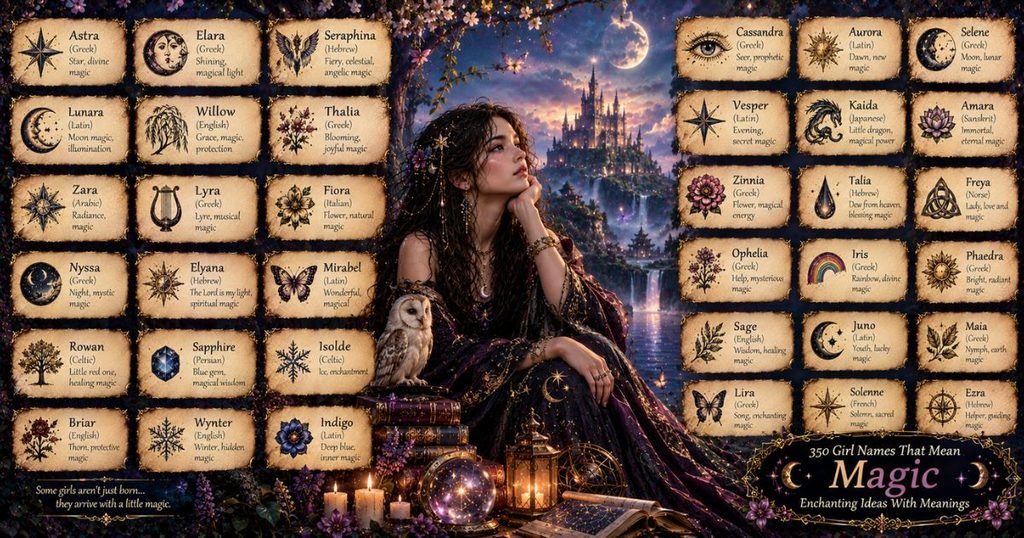
Picture a name that sounds like a spell. That is the pull of girl names that mean magic. Some carry the word itself, like Maya and Kesem. Others point to witches, fairies, goddesses, or the night sky. I sorted this list the way I would want to browse it myself: by theme, with the origin and meaning beside every name. Whether you are naming a baby, a character, or a pet, you will find 350 options below, plus tips for choosing one that still feels magical on a grown-up.
Girl Names That Mean Magic: The Most Direct Picks
- Maya (Sanskrit) – māyā, “magic,” “illusion,” or the creative power behind the world.
- Kesem (Hebrew) – “magic” or “charm.”
- Carmen (Latin/Spanish) – Latin carmen means “song” or “incantation,” and it gave English the word “charm.”
- Charmaine (French) – from Greek charma, “joy,” with a built-in echo of “charm.”
- Runa (Old Norse) – “secret lore” or “rune,” the symbols tied to Norse magic.
- Siddhi (Sanskrit) – “supernatural power” or “attainment” in Hindu and Buddhist traditions.
- Mohini (Sanskrit) – “enchantress,” also the bewitching female form of the god Vishnu.
- Shakti (Sanskrit) – “power” or “divine energy.”
- Miranda (Latin) – “worthy of wonder,” the name Shakespeare gave Prospero’s daughter in The Tempest.
- Mirabel (Latin) – “wonderful,” and the heroine of Disney’s Encanto, set in a magical house.
- Aisling (Irish) – “dream” or “vision.”
- Sibyl (Greek) – the sibyls were prophetesses of the ancient world.
- Veleda (Germanic) – a seeress named by the Roman historian Tacitus.
- Thessaly (Greek) – a region of Greece that ancient writers linked to witches.
- Avalon (Celtic/Arthurian) – the legendary island where Morgan le Fay is said to dwell.
- Vala (Old Norse) – recalls völva, the seeress of Norse tradition.
- Merlynn (Welsh) – a feminine take on Merlin, the wizard of Arthurian tales.
Witchy Girl Names That Mean Magic and Sorceress Names
Witches and sorceresses appear in nearly every storytelling tradition. This section covers legendary enchantresses, famous witches from books and screens, and darker names with a gothic edge. For the oldest picks, Greek mythology is the best place to dig.
- Circe (Greek) – the sorceress who turned Odysseus’s crew into pigs. The name is often linked to kirkos, “hawk.”
- Medea (Greek) – the sorceress who helped Jason win the Golden Fleece.
- Morgana (Latinized Welsh) – the Arthurian enchantress Morgan le Fay, often glossed “sea-born.”
- Morgause (Arthurian) – sorceress and half-sister of King Arthur.
- Nimue (Arthurian) – the Lady of the Lake, who in some tellings traps Merlin.
- Viviane (French) – another name for the Lady of the Lake. From Latin “alive.”
- Calypso (Greek) – the nymph who kept Odysseus on her island. “She who conceals.”
- Hecate (Greek) – goddess of witchcraft and crossroads. The meaning is debated.
- Aradia (Italian) – the witch-messiah of Charles Leland’s 1899 book Aradia, or the Gospel of the Witches.
- Cerridwen (Welsh) – the enchantress who brewed a cauldron of inspiration in the tale of Taliesin.
- Cassandra (Greek) – the prophetess cursed never to be believed.
- Angitia (Italian) – an ancient goddess tied to snake charming and healing magic.
- Pasiphae (Greek) – the sorceress queen of Crete. “She who shines for all.”
- Freya (Norse) – the goddess linked to seiðr, Norse magic.
- Melusine (French) – the water spirit of legend who is half serpent.
- Rhiannon (Welsh) – the Mabinogi heroine with magical birds. “Great queen.”
- Blodeuwedd (Welsh) – a woman conjured from flowers by the magicians Gwydion and Math. “Flower face.”
You Can Also Read: Names That Mean Pain: 500 Meaningful Picks With Origins.
Witches From Books, Film, and TV
- Hermione (Greek) – “of Hermes,” and the brilliant witch of Harry Potter.
- Minerva (Latin) – Roman goddess of wisdom and Professor McGonagall’s first name.
- Glinda (Invented) – the Good Witch of L. Frank Baum’s Oz books.
- Elphaba (Invented) – Wicked’s green witch, named for Baum’s initials (L-F-B).
- Endora (Greek) – Samantha’s witch mother on Bewitched, echoing the biblical Witch of Endor.
- Samantha (Aramaic) – the friendly witch of Bewitched (1964).
- Sabrina (Latin) – the teenage witch of Archie Comics. Also the Latin name of the River Severn.
- Willow (English) – Buffy’s witch friend Willow Rosenberg. Also a tree.
- Wanda (Slavic/Germanic) – Marvel’s Scarlet Witch, Wanda Maximoff.
- Matilda (Germanic) – “mighty in battle,” and Roald Dahl’s telekinetic girl.
- Piper (English) – Piper Halliwell of Charmed, who can freeze time.
- Phoebe (Greek) – “bright,” and the premonition-gifted sister in Charmed.
- Prue (Latin) – short for Prudence, and the telekinetic eldest Charmed sister.
- Paige (English) – Paige Matthews, the half-witch sister in Charmed.
- Bonnie (Scots) – “good,” and Bonnie Bennett, a powerful witch in The Vampire Diaries.
- Tabitha (Aramaic) – “gazelle,” and the witch daughter on Bewitched.
- Zatanna (Invented) – the DC Comics stage magician who casts spells by speaking backward.
- Yennefer (Invented) – the sorceress of Andrzej Sapkowski’s Witcher books.
- Ciri (Polish) – Cirilla, the young sorceress of the same saga.
- Tiffany (Greek) – “appearance of God,” and Tiffany Aching, Terry Pratchett’s young Discworld witch.
- Winifred (Welsh) – “blessed reconciliation,” and the lead Sanderson sister in Hocus Pocus.
- Kiki (Japanese) – the young witch of Miyazaki’s Kiki’s Delivery Service.
- Sophie (Greek) – “wisdom,” and Sophie Hatter, cursed by a witch in Howl’s Moving Castle.
- Ursula (Latin) – “little bear,” and Disney’s sea witch.
- Serafina (Hebrew) – “fiery ones,” and the witch queen Serafina Pekkala in Philip Pullman’s His Dark Materials.
- Agatha (Greek) – “good,” and Marvel’s witch Agatha Harkness.
- Sally (English) – “princess,” and Sally Owens in Practical Magic.
Dark Magic and Gothic Girl Names
- Lilith (Mesopotamian/Hebrew) – from lilitu, a night spirit in Mesopotamian and Jewish folklore.
- Morrigan (Irish) – the goddess of war and fate. “Phantom queen” or “great queen.”
- Bellatrix (Latin) – “female warrior,” and a star in Orion.
- Belladonna (Italian) – “beautiful lady,” and the deadly nightshade of witch lore.
- Lamia (Greek) – a Libyan queen turned child-devouring monster in myth.
- Sycorax (Shakespearean) – Caliban’s witch mother in The Tempest.
- Raven (English) – the bird of omens.
- Umbra (Latin) – “shadow.”
- Melisandre (French/Germanic) – the Red Woman of Game of Thrones. Linked to Mélisende, “strong in work.”
- Salem (Hebrew) – from shalom, “peace,” and the Massachusetts town of the 1692 witch trials.
- Medusa (Greek) – the Gorgon. Often glossed “guardian” or “ruler.”
- Carmilla (Invented) – the vampire of J. Sheridan Le Fanu’s 1872 novella.
- Lenore (English) – the lost love in Poe’s “The Raven.”
- Ligeia (Greek) – a Siren’s name, and the will-defying heroine of Poe’s 1838 story.
- Eris (Greek) – the goddess of discord.
- Hel (Norse) – ruler of the realm of the dead.
- Ereshkigal (Sumerian) – queen of the underworld.
- Sable (English) – the black fur, dark and elegant.
- Corvina (Latin) – “raven-like.”
- Mara (Slavic/Norse) – a folk spirit who sits on sleepers’ chests, source of the word “nightmare.”
- Scylla (Greek) – the sea monster, once a nymph transformed by Circe’s potion in Ovid.
- Lorelei (German) – the Rhine rock and the enchantress who lured sailors in legend.
Fairy, Elf, and Woodland Names for Girls
Fairy names for girls come from Celtic folklore, Shakespeare, and Slavic and Persian tales. This section also covers Tolkien-inspired names, forest nymphs, and plants and gems with magical lore.
Fairy and Fae Names
- Faye (Old French) – fae, “fairy.”
- Titania (Latin) – “daughter of the Titans,” and queen of the fairies in A Midsummer Night’s Dream.
- Mab (Celtic) – the fairy queen in Mercutio’s speech in Romeo and Juliet.
- Aine (Irish) – “brightness,” and a fairy queen tied to summer.
- Niamh (Irish) – “bright,” and the fairy princess who leads Oisín to Tír na nÓg.
- Oonagh (Irish) – the anglicized Úna, a queen of the fairies in Irish folklore.
- Pari (Persian) – “fairy.”
- Aziza (Fon/Arabic) – a forest spirit in Dahomey folklore. In Arabic, “cherished.”
- Pixie (English) – the small fairy of Devon and Cornwall.
- Nixie (German) – a water sprite.
- Undine (Latin) – from unda, “wave,” a water spirit.
- Selkie (Scots) – the seal-woman who sheds her skin.
- Asrai (English) – a water fairy said to melt in sunlight.
- Rusalka (Slavic) – a water spirit of rivers and lakes.
- Zana (Romanian) – from zână, “fairy.”
- Elfrida (Old English) – “elf strength.”
- Gloriana (Latin) – the fairy queen of Spenser’s The Faerie Queene.
Tolkien-Inspired Names
J.R.R. Tolkien built whole languages for his elves, and many of his female names are now popular choices.
- Arwen (Sindarin) – “noble maiden.”
- Galadriel (Sindarin) – “maiden crowned with a garland of radiant light.”
- Éowyn (Old English) – “horse-joy,” the shieldmaiden of Rohan.
- Elanor (Sindarin) – “sun-star,” the golden flower of Lothlórien.
- Celebrían (Sindarin) – “silver queen.”
- Tauriel (Sindarin) – “daughter of the forest,” created for The Hobbit films.
- Idril (Sindarin) – “sparkling brilliance,” an elf princess of Gondolin.
- Yavanna (Quenya) – “giver of fruits,” the Vala of growing things.
Nymphs and Woodland Spirits
- Daphne (Greek) – “laurel,” the nymph who became a laurel tree.
- Echo (Greek) – the nymph who can only repeat others’ words.
- Eurydice (Greek) – “wide justice,” the nymph wife of Orpheus.
- Silvana (Latin) – “forest.”
- Sylvie (French) – “forest.”
- Egeria (Latin) – the nymph who advised King Numa in a sacred grove.
- Amalthea (Greek) – the nymph who nursed baby Zeus. Her horn became the cornucopia.
- Oenone (Greek) – the mountain nymph and healer who loved Paris.
- Arethusa (Greek) – the nymph turned into a spring.
- Galatea (Greek) – the name later given to the statue Pygmalion carved, which Aphrodite brought to life.
Plant, Herb, and Gemstone Names With Magical Lore
- Rowan (Gaelic) – the tree long used in folk charms against enchantment.
- Hazel (English) – the tree whose nuts hold wisdom in Irish lore.
- Elowen (Cornish) – “elm.”
- Briar (English) – the thorny rose of the “Briar Rose” fairy tale.
- Ivy (English) – the evergreen, a symbol of eternal life.
- Holly (English) – an evergreen long hung to guard the home.
- Juniper (Latin) – the shrub burned in folk cleansing rituals.
- Sage (Latin) – the herb burned in smudging. Also “wise.”
- Rosemary (Latin) – “dew of the sea,” the herb of remembrance.
- Lavender (Latin) – the fragrant herb tucked into sachets and charms.
- Jasmine (Persian) – from yasmin, the night-scented flower.
- Violet (Latin) – the small purple flower.
- Marigold (English) – “Mary’s gold,” which guides spirits on Mexico’s Day of the Dead.
- Primrose (Latin) – “first rose,” a flower tied to fairy-realm folklore.
- Verbena (Latin) – vervain, a sacred herb in Roman and Druidic lore.
- Clover (English) – the lucky four-leaf plant.
- Fern (English) – folklore says its “seed” grants invisibility.
- Phoenix (Greek) – the firebird reborn from its ashes.
- Aurelia (Latin) – “golden,” the metal alchemists chased.
- Opal (Sanskrit) – upala, “precious stone,” long thought to hold mystical power.
- Amber (Arabic) – fossil resin used in ancient amulets.
- Pearl (Latin) – the sea gem tied to the moon in folklore.
- Jade (Spanish) – the green stone prized as protective in Chinese tradition.
- Ruby (Latin) – “red.”
- Beryl (Greek) – the crystal that scryers used for gazing.
- Crystal (Greek) – “ice,” the clear quartz of crystal balls.
- Ember (English) – a glowing coal.
- Marina (Latin) – “of the sea.”
- Coral (Greek) – the sea gem Romans hung on infants as a protective charm.
- Iris (Greek) – the rainbow goddess and messenger between worlds.
- Laurel (Latin) – Apollo’s sacred plant, chewed by the Delphic oracle.
- Bluebell (English) – the wildflower of English fairy woods.
- Poppy (Latin) – the flower tied to sleep and dreams in Greek myth.
- Lotus (Greek) – the sacred bloom of Egyptian and Indian symbolism.
- Rue (English) – the “herb of grace,” used against evil in folklore.
- Garnet (Latin) – the deep-red gem, named for the pomegranate.
- Amethyst (Greek) – “not drunken,” a stone once thought to prevent intoxication.
- Emerald (Greek) – the green gem tied to the legendary Emerald Tablet of alchemy.
- Sapphire (Greek) – the blue gem prized in medieval Europe as a protective stone.
- Topaz (Greek) – topazos, a stone prized in antiquity.

Celestial Girl Names That Mean Magic
Moon names for girls and star names have always felt magical. Many come from Greek mythology and from the moons and stars named after its heroines. Browse more names that mean moon for extra ideas.
- Luna (Latin) – “moon,” and the Roman moon goddess.
- Selene (Greek) – the Greek moon goddess.
- Artemis (Greek) – goddess of the hunt and the wild, linked to the moon.
- Celeste (Latin) – “heavenly.”
- Stella (Latin) – “star.”
- Estella (Latin) – “star,” and Dickens’s heroine in Great Expectations.
- Astra (Greek) – “star.”
- Aster (Greek) – “star,” and the star-shaped flower.
- Nova (Latin) – “new,” and a star that suddenly brightens.
- Vega (Arabic) – linked to a phrase for “swooping eagle,” and a bright star in Lyra.
- Lyra (Greek) – the constellation of Orpheus’s lyre.
- Andromeda (Greek) – the constellation and the princess rescued by Perseus.
- Cassiopeia (Greek) – the constellation and the vain queen of myth.
- Callisto (Greek) – “most beautiful,” and a moon of Jupiter.
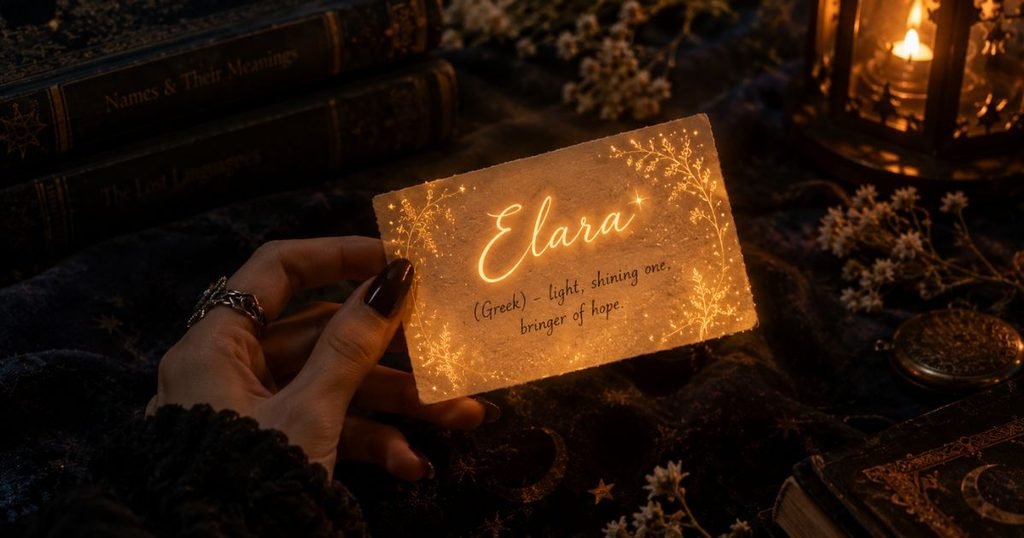
- Elara (Greek) – a moon of Jupiter, named for one of Zeus’s lovers.
- Io (Greek) – a moon of Jupiter and a priestess loved by Zeus.
- Europa (Greek) – a moon of Jupiter and a Phoenician princess of myth.
- Dione (Greek) – “divine,” and a moon of Saturn.
- Maia (Greek) – the eldest Pleiad and mother of Hermes.
- Electra (Greek) – a Pleiad. Linked to “amber” or “shining.”
- Alcyone (Greek) – the brightest star of the Pleiades.
- Seren (Welsh) – “star.”
- Soraya (Persian) – a form of Surayya, the Pleiades.
- Aurora (Latin) – the Roman goddess of dawn.
- Eos (Greek) – the Greek goddess of dawn.
- Nyx (Greek) – the goddess of night.
- Vesper (Latin) – “evening” and the evening star.
- Helia (Greek) – “sun.”
- Zorya (Slavic) – the guardian goddesses of dawn and dusk.
- Usha (Sanskrit) – “dawn,” the Vedic goddess Ushas.
- Chandra (Sanskrit) – “moon.”
- Mahina (Hawaiian) – “moon.”
- Hina (Polynesian) – a moon goddess in several island traditions.
- Tsukiko (Japanese) – “child of the moon.”
- Kamaria (Swahili) – “like the moon.”
- Nokomis (Ojibwe) – “grandmother,” and the Moon’s daughter in The Song of Hiawatha.
- Galaxy (Greek) – from galaxias, “milky.”
- Cosima (Greek) – “order” or “harmony of the cosmos.”
- Tara (Sanskrit) – “star,” and a Buddhist goddess of compassion.
Goddess Names for Girls With Divine Magic
Goddess names carry power and a built-in story. Greek mythology, Celtic folklore, and Egyptian, Hindu, and Yoruba traditions all give us strong choices here. Many parents like a goddess name because the legend gives it depth.
- Isis (Egyptian) – “throne,” the goddess of magic and healing.
- Nephthys (Egyptian) – “lady of the house,” a guardian goddess.
- Bastet (Egyptian) – the cat goddess and protector.
- Athena (Greek) – goddess of wisdom and craft.
- Persephone (Greek) – queen of the underworld, whose return brings spring.
- Hestia (Greek) – goddess of the hearth.
- Gaia (Greek) – the Earth itself.
- Rhea (Greek) – the Titaness who saved baby Zeus.
- Theia (Greek) – the Titaness of sight and shining light.
- Brigid (Irish) – “exalted one,” goddess of poetry, healing, and smithcraft.
- Danu (Irish) – the mother goddess of the Tuatha Dé Danann.
- Arianrhod (Welsh) – “silver wheel.”
- Ostara (Germanic) – a spring goddess.
- Frigg (Norse) – the queen of the Aesir, who knows all fates.
- Idun (Norse) – keeper of the apples of youth.
- Sif (Norse) – the golden-haired wife of Thor.
- Kali (Sanskrit) – goddess of time and transformation.
- Saraswati (Sanskrit) – goddess of knowledge and music.
- Durga (Sanskrit) – “invincible,” the warrior goddess.
- Amaterasu (Japanese) – “shining in heaven,” the sun goddess.
- Inanna (Sumerian) – queen of heaven.
- Ishtar (Akkadian) – goddess of love and war.
- Anahita (Persian) – “immaculate,” goddess of waters.
- Oshun (Yoruba) – river goddess of love and abundance.
- Yemaya (Yoruba) – mother of the waters.
- Oya (Yoruba) – goddess of storms and change.
- Pele (Hawaiian) – the volcano goddess.
- Mazu (Chinese) – the sea goddess who protects sailors.
- Ixchel (Maya) – goddess of the moon, weaving, and medicine.
- Fortuna (Latin) – goddess of luck.
- Vesta (Latin) – goddess of the hearth.
- Juno (Latin) – queen of the Roman gods.
- Diana (Latin) – “divine,” goddess of the hunt and the moon.
- Flora (Latin) – goddess of flowers and spring.
- Ceres (Latin) – the grain goddess who gave us “cereal.”
- Hebe (Greek) – goddess of youth.
- Maat (Egyptian) – goddess of truth and cosmic order.
- Aphrodite (Greek) – the love goddess, often linked to aphros, “foam.”
- Demeter (Greek) – the grain goddess.
- Hera (Greek) – queen of the Greek gods.
Magical Girl Names From Around the World
Magic looks different in every culture. Celtic folklore gives us swan maidens and fairy queens. Persian tales give us storytellers, and Hawaiian names pair sea and sky. Here are magical names and meanings from five regions.
Celtic, Norse, Baltic, and Slavic Names
- Étaín (Irish) – the heroine turned into a butterfly by a jealous sorceress, then reborn.
- Maeve (Irish) – “intoxicating,” and the warrior queen of Connacht.
- Clíodhna (Irish) – a queen of the banshees in Munster lore.
- Olwen (Welsh) – “white footprint,” for the clover that sprang where she walked.
- Eirlys (Welsh) – “snowdrop.”
- Branwen (Welsh) – “white raven,” a Mabinogion heroine.
- Eluned (Welsh) – the Arthurian healer who carries a ring of invisibility.
- Deirdre (Irish) – the heroine whose fate a druid foretold.
- Fionnuala (Irish) – “white shoulder,” a child of Lir turned into a swan by a spell.
- Aoife (Irish) – “beauty,” and the stepmother who cast that swan spell.
- Alva (Swedish) – “elf,” from Old Norse álfr.
- Hulda (Germanic) – Holda, the folklore figure of Frau Holle.
- Morana (Slavic) – goddess of winter and death.
- Vesna (Slavic) – goddess of spring.
- Vasilisa (Russian) – “queenly,” the fairy-tale heroine with a magic doll.
- Vila (Slavic) – a nymph-like spirit of mountains and clouds.
- Laima (Baltic) – goddess of fate.
- Svetlana (Slavic) – “light,” popularized by Zhukovsky’s 1813 ballad.
Middle Eastern and South Asian Names
- Shahrzad (Persian) – the storyteller of One Thousand and One Nights.
- Parisa (Persian) – “like a fairy.”
- Afsaneh (Persian) – “legend” or “fairy tale.”
- Layla (Arabic) – “night,” from Layla and Majnun.
- Samira (Arabic) – “evening companion.”
- Ayla (Turkish) – “moonlight halo.”
- Sahar (Arabic) – the hour before dawn.
- Zahra (Arabic) – “radiant.”
- Qamar (Arabic) – “moon.”
- Kalpana (Sanskrit) – “imagination.”
- Menaka (Sanskrit) – the celestial nymph who enchanted a sage.
- Urvashi (Sanskrit) – a celestial nymph.
- Amrita (Sanskrit) – “immortal,” the nectar of the gods.
- Chandni (Hindi) – “moonlight.”
- Yamini (Sanskrit) – “night.”
- Nandini (Sanskrit) – “delightful,” and the wish-granting divine cow.
East Asia, the Pacific, Africa, and the Americas
- Kaguya (Japanese) – the moon princess of The Tale of the Bamboo Cutter.
- Kasumi (Japanese) – “mist.”
- Hoshi (Japanese) – “star.”
- Miko (Japanese) – echoes the shrine maidens of Shinto.
- Ling (Chinese) – “spirit.”
- Chang’e (Chinese) – the moon goddess of the elixir of immortality.
- Leilani (Hawaiian) – “heavenly flowers.”
- Kailani (Hawaiian) – “sea and sky.”
- Nalani (Hawaiian) – “the heavens.”
- Hōkūlani (Hawaiian) – “heavenly star.”
- Mawu (Fon) – a creator goddess linked to the moon.
- Aja (Yoruba) – a forest spirit and herbal healer.
- Citlali (Nahuatl) – “star.”
- Xōchitl (Nahuatl) – “flower.”
- Itzel (Maya) – variously translated as “rainbow lady” or “dew of the sky.”
- Orenda (Iroquois) – “spiritual power.”
- Luz (Spanish) – “light.”
- Iara (Tupi) – a Brazilian water spirit.
- Quetzalli (Nahuatl) – “precious feather.”
What Is a Rare Girl Name That Means Magic?
If you want a rare name with real mythic roots, try one of these.
- Hesperia (Greek) – “evening land,” tied to the Hesperides, who guarded the golden apples.
- Aegle (Greek) – “radiance,” one of the Hesperides.
- Pleione (Greek) – the mother of the Pleiades.
- Asteria (Greek) – the Titaness of falling stars and night oracles.
- Pythia (Greek) – the title of the oracle at Delphi.
- Alcina (Italian) – the enchantress in Orlando Furioso and Handel’s 1735 opera.
- Armida (Italian) – the enchantress in Tasso’s Jerusalem Delivered.
- Psyche (Greek) – “soul,” the heroine who completed impossible tasks in the tale of Eros and Psyche.
- Zephyrine (French) – from Zephyr, the west wind.
- Elysia (Greek) – Elysium, the blessed afterlife realm of Greek myth.
- Fata (Italian) – “fairy,” as in Fata Morgana.
- Milagros (Spanish) – “miracles.”
- Estrella (Spanish) – “star.”
Fantasy Girl Names From Stories and Fairy Tales
Some of today’s most magical names come from stories we grew up with. These fantasy girl names come from storybooks, anime, games, and fantasy novels.
Classic Fairy-Tale and Storybook Girls
- Dorothy (Greek) – “gift of God,” the girl who reached Oz.
- Alice (Germanic) – “noble,” and the girl of Carroll’s Wonderland.
- Wendy (English) – popularized by J. M. Barrie’s Peter Pan (1904).
- Coraline (English) – the heroine of Neil Gaiman’s 2002 novella. Gaiman has said the name began as a typo for Caroline.
- Lucy (Latin) – “light,” the first Pevensie to find Narnia.
- Belle (French) – “beautiful,” at home in an enchanted castle.
- Ariel (Hebrew) – “lion of God,” and the air spirit in The Tempest and Disney’s mermaid.
- Elsa (Germanic) – short for Elizabeth, “God is my oath,” and the ice-wielding queen of Frozen.
- Fleur (French) – “flower,” and Fleur Delacour, part-Veela in Harry Potter.
- Odette (French) – the cursed swan princess of Swan Lake.
- Odile (Germanic) – “wealth,” and the Black Swan of the ballet.
- Isolde (Celtic) – the Arthurian-era heroine of the love-potion legend.
- Isadora (Greek) – “gift of Isis,” the goddess of magic.
- Gretel (German) – short for Margarethe, “pearl,” the girl who outwits the witch.
- Eilonwy (Welsh) – the princess with a glowing bauble in Lloyd Alexander’s Prydain books.
Anime, Game, and Fantasy Novel Heroines
- Arya (Sanskrit) – “noble,” and Arya Stark of Game of Thrones.
- Alanna (Irish) – the magic-gifted knight of Tamora Pierce’s Song of the Lioness.
- Daenerys (Invented) – the dragon queen of George R. R. Martin’s novels.
- Zelda (Germanic) – Princess Zelda of the Nintendo games, named for Zelda Fitzgerald.
- Katara (Invented) – the waterbender of Avatar: The Last Airbender.
- Korra (Invented) – the Avatar of The Legend of Korra.
- Sakura (Japanese) – “cherry blossom,” the card-capturing heroine of Cardcaptor Sakura.
- Madoka (Japanese) – the heroine of Puella Magi Madoka Magica.
- Chihiro (Japanese) – the girl of Spirited Away.
- Aerith (Invented) – the flower girl of Final Fantasy VII.
- Yuna (Japanese) – the summoner of Final Fantasy X.
- Annabeth (English) – the daughter of Athena in the Percy Jackson books.
- Thalia (Greek) – “to flourish,” and the Muse of comedy.
- Merida (Spanish) – the archer princess in Pixar’s Brave, who triggers a witch’s curse.
- Moana (Polynesian) – “ocean,” and the heroine chosen by the sea.
- Illyana (Slavic) – Illyana Rasputin, the sorceress Magik of Marvel’s X-Men.
- Marinette (French) – the heroine of Miraculous: Tales of Ladybug & Cat Noir.
- Alina (Slavic) – Alina Starkov, who summons light in Shadow and Bone.
- Celaena (Invented) – the assassin of Sarah J. Maas’s Throne of Glass.
- Feyre (Invented) – the heroine of A Court of Thorns and Roses.
- Aelin (Invented) – Celaena’s true name and fire-wielding queen identity.
- Vin (English) – the Allomancer of Brandon Sanderson’s Mistborn.
- Saphira (Invented) – the sapphire-blue dragon of Eragon.
- Nynaeve (Invented) – the channeler of The Wheel of Time.
- Egwene (Invented) – another channeler of The Wheel of Time.
- Moiraine (Invented) – the Aes Sedai of The Wheel of Time.
- Elayne (Arthurian) – the queen and channeler of The Wheel of Time.
- Lessa (Invented) – the dragonrider of Anne McCaffrey’s Dragonflight.
- Lirael (Invented) – the Clayr librarian of Garth Nix’s Old Kingdom books.
- Sabriel (Invented) – the necromancer heroine of Garth Nix’s Sabriel.
- Rowena (Old English) – Rowena Ravenclaw, Hogwarts founder.
- Nymphadora (Greek) – “gift of the nymphs,” the shape-shifting Tonks of Harry Potter.
You May Also Read: 250 Names That Mean Misfortune: Dark, Tragic, and Unforgettable.
Final Thoughts
You now have 350 girl names that mean magic, from the literal (Maya, Kesem) to the legendary (Circe, Hecate) to the celestial (Luna, Vega). Pick the group that matches your taste, say your favorites out loud, and test them with your surname. Bookmark this page, share it with a co-parent or co-author, or explore more boy names that mean magic next.
FAQs
What girl name means magic?
Maya (Sanskrit), Kesem (Hebrew), and Siddhi (Sanskrit) come closest to meaning “magic” outright. Maya means “magic” or “illusion,” Kesem means “magic” or “charm,” and Siddhi means “supernatural power.”
What is the most magical girl name?
Luna is the best-known pick, followed by Aurora and Willow. For legendary depth, Circe, Hecate, and Morgana have the strongest ties to magic in myth.
What girl names mean enchantress or sorceress?
Mohini means “enchantress” in Sanskrit. Circe, Medea, and Morgana are the best-known sorceresses of myth and legend. Hecate is the Greek goddess of witchcraft.
What is a rare girl name that means magic?
Hesperia, Pleione, Asteria, Pythia, Alcina, and Armida are rare names rooted in Greek myth and Renaissance epics.
Are magical girl names a good choice for a real baby?
Yes. Luna, Aurora, Hazel, and Ivy are common and easy to wear. For rarer or fantasy-only names, check spelling, nicknames, and pop-culture baggage first.