Names That Mean Broken: 450+ Meaningful Picks and Their Real Origins
Names that mean broken are names that express shattering, sorrow, or heartbreak, either literally or through myth and story. Only a few, like Riven and Sheber, truly mean ‘broken.’ Most, such as Mara, Dolores, and Tristan, symbolize grief, loss, and resilience. They suit babies, fictional characters, and gaming usernames.
Why would anyone want names that mean broken? Because a crack tells a story. Novelists use these names to hint at a hidden past. Parents choose them to honor resilience. Gamers use them for a username with edge. While reviewing the top-ranking lists on this topic, we noticed a problem. Very few of the names actually mean ‘broken,’ and several lists repeat the same name again and again. So we traced each name to a language, a myth, or a book.
Below you will find 450+ names, honest meanings, and the stories behind them, plus tips for choosing one that fits.
Real Names and Surnames With a Broken Meaning
- Riven (English, from Old Norse rífa): split or torn apart. The clearest modern ‘broken’ name.
- Sheber (Hebrew): ‘breaking’ or ‘fracture.’ A son of Caleb in 1 Chronicles 2:48.
- Breakspear (English surname): a nickname for a fierce fighter. Nicholas Breakspear became Pope Adrian IV, the only English pope.
- Fractus (Latin): ‘broken,’ the root of fracture and fragment. Meteorologists use it for ragged clouds.
- Lorn (English, from Old English leosan): forsaken or lost. It survives in the word forlorn.
- Wrack (English): wreckage or ruin, from Old English wræc. The same root gives wreck.
- Shikasta (Persian): ‘broken.’ Also the name of a flowing calligraphy style.
Word-Names for Splitting and Shattering
These are English words used as names, popular with fantasy writers and gamers.
- Sunder (Old English sundrian): to split apart.
- Cleave (Old English clēofan): to split. Its twin clifian means ‘to cling,’ so one word holds two opposite meanings.
- Shard (Old English sceard): a sharp fragment.
- Splinter (Middle Dutch splinte): a thin broken piece.
- Sliver (from Old English slīfan, ‘to split’): a long, thin cut-off piece.
- Rift (Scandinavian origin): a crack or gap, as in a rift valley.
- Cleft (from Old English clēofan): a split or crack.
- Fray (Old French fraier, ‘to rub’): to wear and unravel at the edges.
- Rend (Old English rendan): to tear apart.
Names for Broken Things Made Whole
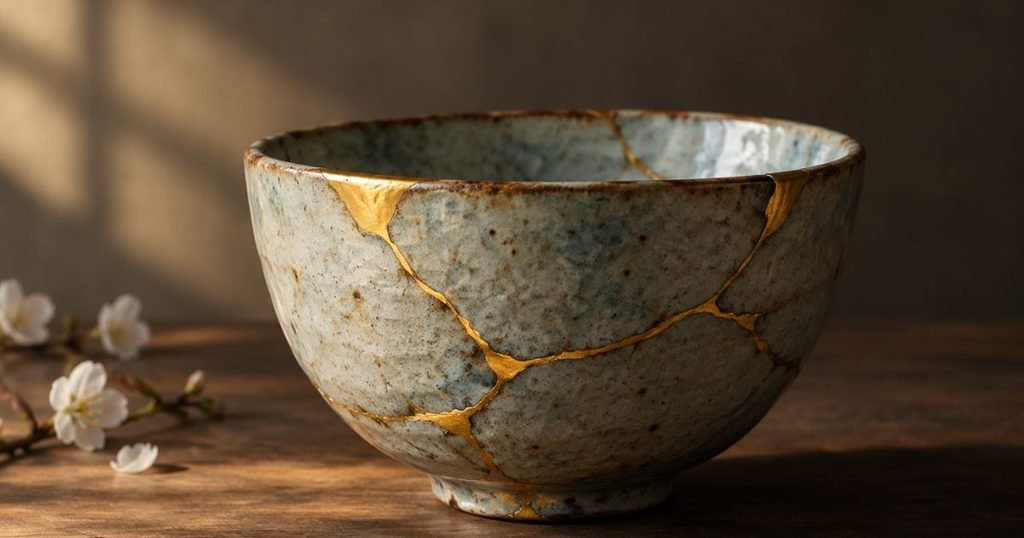
Kintsugi is the Japanese craft of mending cracked pottery with lacquer dusted in gold. It is traditionally linked to the late 15th century. The idea is simple: the repair becomes part of the object’s story.
- Kintsugi (Japanese 金継ぎ): ‘golden joinery.’ Cracks are mended with gold-dusted lacquer.
- Kintsukuroi (Japanese 金繕い): ‘golden repair,’ a closely related term.
- Wabi (Japanese 侘): beauty in simplicity and imperfection.
- Sabi (Japanese 寂): beauty that comes with age and wear. Together, wabi-sabi.
- Imladris (Sindarin): Tolkien’s name for Rivendell, ‘deep dale of the cleft.’
- Narsil (Tolkien’s Elvish): the sword shattered in battle, named from words for flame and light.
- Andúril (Tolkien’s Elvish): ‘Flame of the West,’ the blade reforged from Narsil’s shards.
Names That Mean Broken Heart: Tragic Lovers From Legend and Literature
Heartbreak is the most storied kind of broken. Folk traditions on three continents turn it into names. We found that the strongest picks come from stories where a heart truly breaks, so we sorted them by character instead of by guesswork. A good test is to say the name in dialogue. If it sounds like a real person, it works.
What Name Means Broken Heart?
No common name translates exactly as ‘broken heart.’ The closest matches come from stories in which a heart truly breaks. Branwen (Welsh) and Nanna (Norse) both die of grief in their source texts. Elaine of Astolat dies of unrequited love, and Deirdre is remembered as ‘Deirdre of the Sorrows.’ For a literal link, Hebrew uses shevurei lev for the brokenhearted, which shares a root with Sheber above.
Girl Names From Tragic Love Stories
- Isolde (Cornish/Welsh legend): Tristan’s lover in the medieval romance. The tale is older than Wagner’s 1865 opera, and her story ends in grief.
- Branwen (Welsh): ‘white raven.’ In the Mabinogion she dies of a broken heart after war ruins two islands on her account.
- Deirdre (Irish): the heroine of ‘Deirdre of the Sorrows,’ a tale retold by J. M. Synge in 1910. The name’s own meaning is debated.
- Nanna (Norse): Baldr’s wife. In Snorri’s Prose Edda (c. 1220), her heart bursts with grief at his funeral.
- Liadan (Irish): an early Irish poet-lover whose story with Cuirithir ends in loss.
- Layla (Arabic): ‘night.’ The beloved in Nizami’s 1188 poem Layla and Majnun.
- Heer (Punjabi): heroine of Waris Shah’s 1766 epic. Often glossed as ‘diamond.’
- Sohni (Punjabi): ‘beautiful.’ She drowns crossing the Chenab River to reach Mahiwal.
- Sassi (Sindhi): lost in the desert while searching for her beloved Punhun, in Shah Abdul Latif Bhittai’s poetry.
- Shirin (Persian): ‘sweet.’ The heroine of Nizami’s Khosrow and Shirin.
- Zulaikha (Arabic/Persian): her longing for Yusuf drives Jami’s 1483 poem.
- Juliet (English, from Julia): the lover in Shakespeare’s tragedy, first printed in 1597.
- Ophelia (Greek, ‘help’): her grief and loss in Hamlet made her the face of Shakespearean heartbreak.
- Desdemona (Greek, ‘ill-fated’): the doomed wife in Othello.
- Cordelia (Latin, possibly from cor, ‘heart’): King Lear’s loyal daughter. The heart link is a folk etymology.
- Lenore (English, from Eleanor): the lost beloved in Poe’s ‘The Raven’ (1845).
- Annabel (Latin, ‘lovable’): inspired by Poe’s ‘Annabel Lee’ (1849).
- Mariana (Spanish/Latin): Tennyson’s 1830 poem about a woman left waiting and forgotten.
- Elaine (Old French form of Helen): the ‘Lily Maid of Astolat,’ who dies of unrequited love for Lancelot.
- Marianne (French): Austen’s heartbroken heroine in Sense and Sensibility (1811), who recovers in the end.
- Violetta (Italian, ‘little violet’): the doomed heroine of Verdi’s La Traviata (1853).
- Mimi (Italian): Puccini’s La Bohème (1896). Her real name is Lucia.
- Tess (short for Theresa): Hardy’s 1891 heroine, wronged and then judged by her society.
- Gretchen (German pet form of Margarete, ‘pearl’): Goethe’s abandoned heroine in Faust.
- Guinevere (Welsh Gwenhwyfar, ‘white phantom’): Camelot’s queen, whose love and betrayal break the Round Table.
- Thisbe (Greek): Pyramus’s lover in Ovid’s tale of secret love and a tragic mistake.
- Francesca (Italian, ‘Frenchwoman’): Francesca da Rimini, who meets Dante in the second circle of the Inferno.
- Héloïse (French): the brilliant scholar parted from Abelard. Their letters survive from the 12th century.
- Criseyde (Middle English): the heroine of Chaucer’s Troilus and Criseyde, written in the 1380s.
- Angelica (Latin, ‘angelic’): the woman who drives Orlando mad with love in Orlando Furioso (1516).
You Can Also Read: 350 Girl Names That Mean Magic: Enchanting Ideas With Meanings.
Boy Names From Tragic Love Stories
- Tristan (Celtic Drustan): later linked to Latin tristis, ‘sad.’ In several medieval versions he is named for the sorrow of his birth.
- Romeo (Italian, ‘pilgrim to Rome’): Shakespeare’s young lover.
- Majnun (Arabic, ‘possessed’ or ‘mad’): the nickname of the poet Qays, driven to despair by his love for Layla.
- Ranjha (Punjabi): the lover in the Heer epic. Also a clan name.
- Mahiwal (Punjabi, ‘buffalo herder’): Sohni’s beloved.
- Punhun (Sindhi): Sassi’s beloved, central to the Shah Jo Risalo, an 18th-century collection of Sufi poetry.
- Farhad (Persian): the sculptor who carves through a mountain for Shirin and dies on false news of her death.
- Cuirithir (Irish): the poet-lover of Liadan. Their story ends in loss.
- Lancelot (French, origin uncertain): the knight whose love for Guinevere shatters Camelot.
- Werther (German): the hero of Goethe’s 1774 novel of unrequited love.
- Heathcliff (English): Brontë’s brooding hero in Wuthering Heights (1847), made bitter by loss.
- Edmond (Old English, ‘wealthy protector’): Edmond Dantès, betrayed and imprisoned in The Count of Monte Cristo (1844).
- Cyrano (French): the poet who hides his love behind another man’s words, in Rostand’s 1897 play.
- Dante (short for Durante, ‘enduring’): the poet whose lifelong love for Beatrice shaped the Divine Comedy.
- Leander (Greek): swam the Hellespont each night to see Hero, until a storm drowned him.
- Pyramus (Greek): the Babylonian lover in Ovid’s tale, who misreads a scene and loses everything.
- Troilus (Greek): the Trojan prince betrayed in love in Chaucer’s poem.
- Orlando (Italian form of Roland): driven mad by love for Angelica in Orlando Furioso.
- Abelard (Old French): the philosopher forced apart from Héloïse.
- Sydney (English): Sydney Carton in Dickens’s A Tale of Two Cities (1859) gives up his life for the woman he loves.
- Quasimodo (Latin, ‘in the manner of’): Hugo’s bell-ringer of Notre-Dame (1831), named for the Sunday on which he was found.
- Hamlet (from Danish Amleth): the prince whose grief unravels everything around him, including Ophelia.
- Gatsby (English): Fitzgerald’s 1925 hero, undone by a love he cannot recover.
- Pip (nickname for Philip): Dickens’s hero, whose love for Estella goes unreturned.
- Paolo (Italian, ‘small’): Francesca’s lover in Dante’s Inferno.
Heartbreak in the Classic Novel
These names come from novels where loss shapes the whole story.
- Estella (Latin, ‘star’): Dickens’s heartbreaker in Great Expectations (1861), raised to hurt others.
- Fantine (French): Hugo’s mother in Les Misérables (1862), who gives up everything for her child.
- Éponine (French): Hugo’s street-born heroine, who loves Marius without return.
- Esmeralda (Spanish, ’emerald’): Hugo’s dancer in Notre-Dame de Paris, loved by all the wrong people.
- Hester (form of Esther, ‘star’): Hawthorne’s Scarlet Letter heroine (1850), shamed but unbroken.
- Anna (Hebrew, ‘grace’): Tolstoy’s Anna Karenina (1878), torn between love and society.
- Emma (Germanic, ‘whole’ or ‘universal’): Flaubert’s Madame Bovary (1857), crushed by her own longing.
- Jude (Hebrew, ‘praised’): Hardy’s Jude the Obscure (1895), thwarted at every turn.
- Nell (short for Helen or Eleanor): Dickens’s Little Nell in The Old Curiosity Shop (1841).
- Cathy (short for Catherine): Catherine Earnshaw, whose bond with Heathcliff haunts Wuthering Heights.
- Anne (Hebrew, ‘grace’): Austen’s Persuasion (1817), a lost love that finds its way back.
- Tatiana (Roman clan name): Pushkin’s heroine in Eugene Onegin, whose love letter is rejected.
- Edna (Hebrew, ‘pleasure’): Chopin’s The Awakening (1899), a woman who outgrows her life.
- Cosette (French): Hugo’s abandoned child, raised in hardship before finding safety.
Names That Mean Sorrow, Pain and Suffering
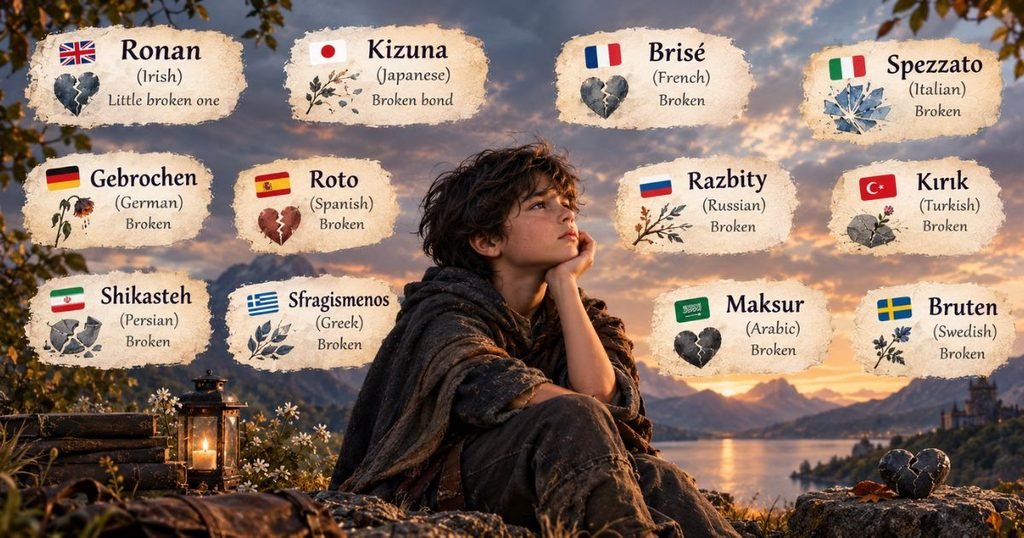
Sorrow names are older than most people think. Spanish families have long named daughters after Marian titles such as Dolores (‘sorrows’), and the Hebrew Bible records names given in pain. Because so few names literally mean ‘broken,’ these are the closest real equivalents. If your story leans darker, see our guide to names that mean death.
Given Names With Sorrow in Their Meaning
- Mara (Hebrew): ‘bitter.’ In the Book of Ruth, Naomi asks to be called Mara after her losses (Ruth 1:20).
- Dolores (Spanish): ‘sorrows,’ from María de los Dolores, Our Lady of Sorrows.
- Lola (Spanish): a pet form of Dolores that sounds light but carries the same root.
- Dolorosa (Latin): ‘sorrowful,’ as in the Via Dolorosa, the ‘Way of Sorrows’ in Jerusalem.
- Trista (Latin tristis, ‘sad’): a feminine form linked to Tristan.
- Tristessa (Italian-style, ‘sadness’): the title of Jack Kerouac’s 1960 novel.
- Mallory (Old French malheuré): ‘unfortunate’ or ‘unlucky.’
- Rue (English): ‘regret,’ and also a bitter herb. In Hamlet, Ophelia hands out rue as a sign of sorrow.
- Ruth (Hebrew): the heroine of the Book of Ruth. The old English word ruth means pity or sorrow, which is why we say ‘ruthless.’
- Lacrima (Latin): ‘tear.’
- Nenia (Latin): the Roman goddess of funeral laments.
- Bronagh (Irish, from brónach): ‘sorrowful.’
- Hazina (Arabic): ‘sad’ (feminine). In Swahili, an unrelated word hazina means ‘treasure.’
- Perdita (Latin): ‘lost.’ The abandoned baby in Shakespeare’s The Winter’s Tale (c. 1610), who is later found.
- Jabez (Hebrew): his mother named him in pain, and he later prays for blessing (1 Chronicles 4:9).
- Ben-Oni (Hebrew): ‘son of my sorrow,’ Rachel’s dying name for her baby. Jacob renamed him Benjamin (Genesis 35:18).
- Ichabod (Hebrew): ‘no glory,’ or ‘the glory has departed’ (1 Samuel 4:21).
- Tristram (variant of Tristan): the form used in Sterne’s Tristram Shandy (1759).
- Brennan (Irish): often listed as ‘sorrow,’ but most scholars trace it to braon, ‘drop.’ Treat the sorrow link as a popular folk reading.
- Dolor (Latin): ‘pain’ or ‘grief,’ the root of Dolores.
Poetic Word-Names for Grief
These are real words that work as names for characters, pets, and usernames.
- Elegy (Greek elegeia): a poem of mourning.
- Threnody (Greek threnos, ‘wailing song’): a song of lament.
- Dirge (from Latin dirige): the first word of an old burial service, now any funeral song.
- Requiem (Latin, ‘rest’): the Mass for the dead and the music written for it.
- Lament (Latin lamentum): deep grief put into words or music.
- Caoineadh (Irish, roughly KWEE-nuh): the traditional keening lament sung at Irish funerals.
- Melancholia (Greek, ‘black bile’): ancient medicine’s name for deep sadness.
- Lacrimosa (Latin, ‘tearful’): a famous movement of Mozart’s Requiem (1791).
- Sorrow (Old English sorg): grief in its plainest form.
- Woe (Old English wā): a cry of grief.
- Grieve (Old French grever, ‘to burden’): to feel the weight of loss.
- Bale (Old English bealu): harm or woe, as in baleful.
- Dole (Old French doel): grief, as in doleful.
- Pathos (Greek, ‘suffering’ or ‘feeling’): the quality that moves us to pity.
- Anguish (Latin angustia, ‘tightness’): pain that squeezes.
- Lacuna (Latin, ‘gap’): a missing piece, an empty space.
- Plaint (Old French, ‘lament’): a mournful complaint.
- Pavane (Italian/French): a slow court dance, and the title of Ravel’s Pavane for a Dead Princess (1899).
- Adagio (Italian, ‘slowly’): the tempo of Barber’s Adagio for Strings, long played at memorials.
- Nocturne (French, ‘of the night’): a night-piece in music, made famous by Chopin.
Names That Mean Broken Soul: Myth, Legend and Scripture
Ancient storytellers gave suffering a face and a name. Hesiod’s Theogony (c. 700 BCE) lists spirits of misery, doom, and pain among the children of Night and Strife. Norse, Celtic, and biblical traditions add named people who endure terrible loss. When we sorted these figures, we kept only those whose stories survive in a named source.
What Is a Good Name for a Broken Soul?
Psyche means ‘soul’ in Greek, and her story is one of trial and return. For a darker feel, Achlys (‘mist’ or ‘gloom’) and Oizys (‘distress’) are Greek spirits of suffering. Softer picks include Nanna, Sigyn, and Niobe, figures from myth who endure deep loss and stay in memory.
Greek Spirits of Suffering and Doom
- Achlys (Greek): ‘mist’ or ‘gloom,’ a personified misery described in the Shield of Heracles.
- Oizys (Greek): ‘misery’ or ‘distress,’ a child of Night in Hesiod’s Theogony.
- Algea (Greek): ‘pains,’ the plural spirits of pain born to Strife in Hesiod.
- Penthos (Greek): ‘grief,’ the plain Greek word for mourning, personified by later writers.
- Ponos (Greek): ‘toil’ or ‘hardship,’ another child of Strife.
- Moros (Greek): ‘doom,’ the spirit of inescapable fate.
- Keres (Greek): spirits of violent death who haunt battlefields.
- Nemesis (Greek): the goddess of retribution.
- Eris (Greek): ‘strife.’ Her golden apple helped spark the Trojan War.
- Lethe (Greek): ‘forgetfulness,’ also a river of the underworld.
- Acheron (Greek): the ‘river of woe,’ linked to the Greek akhos, ‘pain.’
- Cocytus (Greek): the ‘river of wailing.’
- Styx (Greek): the river of hatred, on which the gods swore their most binding oaths.
- Erebus (Greek): ‘darkness,’ the shadowy region beneath the earth.
Greek Heroes and Heroines Marked by Loss
- Niobe: a queen who weeps for her lost children. In myth she becomes a stone that never stops weeping.
- Cassandra: the Trojan princess cursed to speak true prophecies that no one believes.
- Antigone: defies a king’s order to bury her brother, in Sophocles’ tragedy.
- Iphigenia: a princess offered as a sacrifice so the Greek fleet can sail.
- Hecuba: the queen of Troy, who loses her husband and children.
- Andromache: Hector’s wife, left a widow when Troy falls.
- Briseis: a captive woman whose loss fuels Achilles’ rage in the Iliad.
- Patroclus: Achilles’ closest companion. His death shatters the hero.
- Hector: Troy’s defender, killed by Achilles and mourned by a whole city.
- Achilles: the scholar Gregory Nagy links his name to akhos, ‘grief.’ His heel is his famous wound.
- Icarus: the boy who flew too close to the sun and fell.
- Echo: a nymph who fades until only her voice remains.
- Narcissus: the youth who wastes away gazing at his own reflection.
- Hyacinthus: a young man killed by a stray discus. In Ovid, Apollo’s grief creates the hyacinth flower.
- Persephone: taken to the underworld and caught between two worlds.
- Demeter: her grief over Persephone withers the earth in the Homeric Hymn to Demeter.
- Alcyone: her grief for her drowned husband Ceyx moves the gods to turn them both into kingfishers.
- Ariadne: abandoned on Naxos by Theseus in many versions of the tale.
- Philomela: silenced by cruelty and later turned into a bird in Ovid’s retelling.
- Psyche: Greek ‘soul’ or ‘breath.’ She endures impossible trials in Apuleius’ tale.
- Prometheus: chained to a rock for giving fire to humankind.
- Sisyphus: condemned to roll a boulder uphill forever.
- Oedipus: Greek ‘swollen foot,’ from a wound given in infancy.
- Philoctetes: wounded by a snakebite and abandoned on Lemnos, in Sophocles’ play.
- Orpheus: loses Eurydice when he looks back at the edge of the underworld.
- Eurydice: the beloved Orpheus tries to bring back from the dead.
Norse Names Marked by Grief
Most of what we know comes from Snorri Sturluson’s Prose Edda (c. 1220) and the older Eddic poems.
- Baldr: the beloved god whose death all living things weep for.
- Hodr: Baldr’s blind brother, tricked into causing his death.
- Sigyn: Loki’s wife, who holds a bowl over his face to catch dripping venom.
- Freya (Old Norse Freyja, ‘lady’): she weeps tears of red gold for her missing husband.
- Gudrun: the widowed heroine whose grief anchors the Sigurd poems.
- Sigurd: the dragon-slayer undone by betrayal.
- Brynhild: the Valkyrie whose wounded pride and love end in tragedy.
- Hel: ruler of the realm of the dead. Her name comes from a root meaning ‘to hide.’
- Fenrir: the great wolf bound by the gods.
- Loki: the trickster, chained beneath a serpent’s venom.
Celtic and Welsh Names of Loss
- Rhiannon (Welsh, ‘great queen’): falsely accused of harming her newborn son and punished, in the Mabinogion.
- Blodeuwedd (Welsh, ‘flower-face’): made from flowers, then turned into an owl as punishment.
- Fionnuala (Irish, ‘white shoulder’): turned into a swan for 900 years in the Children of Lir.
- Connla (Irish): the young son of Cú Chulainn, killed in an unknowing duel with his father.
- Aoife (Irish, ‘beauty’): Connla’s mother and a fierce warrior.
- Emer (Irish): Cú Chulainn’s wife, remembered for enduring betrayal and loss.
- Oisín (Irish, ‘little deer’): returns from the Otherworld to find 300 years have passed.
- Étaín (Irish): hunted by jealous magic, transformed, and reborn.
- Macha (Irish): forced to race while pregnant, she curses the men of Ulster.
- Bran (Welsh, ‘raven’): Bran the Blessed, wounded by a poisoned spear in the Branwen tale.
- Lir (Irish, ‘sea’): the sea god who loses his children to enchantment.
Biblical Names of Grief and Restoration
- Job: the man whose suffering gives the Book of Job its name.
- Jeremiah: the ‘weeping prophet,’ traditionally linked to Lamentations.
- Ezekiel (Hebrew, ‘God strengthens’): sees a valley of dry bones come back to life (Ezekiel 37).
- Hannah: pours out her anguish in prayer at Shiloh (1 Samuel 1) and later has a son.
- Naomi (Hebrew, ‘pleasant’): loses husband and sons, then renames herself Mara.
- Rachel: ‘ewe.’ Jeremiah 31:15 pictures her weeping for her children.
- Leah: often glossed ‘weary.’ Genesis 29 describes her as unloved.
- Hagar: cast into the desert, where she names God ‘the One who sees me’ (Genesis 16:13).
- Tamar (‘date palm’): wronged in 2 Samuel 13 and left ‘desolate.’
- Miriam: the meaning is debated and sometimes given as ‘bitter.’ She leads the song at the sea in Exodus 15.
- Rizpah: keeps a long vigil over her sons’ bodies (2 Samuel 21).
- Jonah (‘dove’): runs, despairs, and is brought back.
- Samson: blinded and humbled, yet his strength returns (Judges 16).
- Absalom (‘father of peace’): David’s cry of grief over him (2 Samuel 18:33) is among the Bible’s most moving lines.
- Joseph: betrayed by his brothers, later reunited with them.
- Elijah: exhausted and despairing under a broom tree, then cared for (1 Kings 19).
- Peter: weeps bitterly after denying Jesus (Luke 22:62), then is restored.
- Esau: cries out bitterly when he loses his father’s blessing (Genesis 27:34).
Dark, Gothic and Fantasy Names That Mean Broken
Gothic fiction loves a fractured soul. These names come from haunted houses, vampire tales, and poems of loss. Game masters and novelists can drop them straight into a campaign or a cast list. For more shadowy picks, browse our list of names that mean dark.
Gothic Names With a Shattered Edge
- Carmilla (Le Fanu, 1872): the vampire of the novella that predates Dracula by 25 years.
- Lilith (Hebrew): a night spirit in Jewish folklore, later cast as Adam’s first wife.
- Morrigan (Irish, ‘great queen’ or ‘phantom queen’): the goddess of war and fate.
- Ligeia (Greek, ‘clear-voiced’): Poe’s 1838 tale of a lost wife who will not stay gone.
- Morella (Poe, 1835): another Poe heroine bound to death and memory.
- Berenice (Greek, ‘bringer of victory’): Poe’s 1835 tale of obsession.
- Madeline (from Magdalene): Madeline Usher in Poe’s 1839 The Fall of the House of Usher.
- Roderick (Germanic, ‘famous ruler’): Madeline’s haunted brother.
- Usher (Old French, ‘doorkeeper’): the crumbling house and family in Poe’s story.
- Dorian (Greek, ‘of Doris’): Wilde’s The Picture of Dorian Gray (1890), a portrait that takes the damage.
- Victor (Latin, ‘conqueror’): Victor Frankenstein, whose creation ruins him (1818).
- Severin (Latin, ‘stern’): a grave, serious name with a gothic chill.
- Sebastian (Greek, ‘venerable’): Saint Sebastian, the arrow-pierced martyr of countless paintings.
- Belladonna (Italian, ‘beautiful lady’): the deadly nightshade plant.
- Nightshade: the plant family behind belladonna, beautiful and poisonous.
- Hemlock: the poison plant tied to the death of Socrates.
- Vesper (Latin, ‘evening’): the evening star and the hour of fading light.
- Raven: the bird of Poe’s best-known poem.
- Nyx (Greek, ‘night’): the primordial goddess of night.
- Ravenna (Italian): the city where Dante is buried.
- Morwen (Sindarin, ‘dark maiden’): Tolkien’s mother in The Children of Húrin, who endures one loss after another.
- Corvus (Latin, ‘raven’): also a constellation.
- Draven: a modern coinage from The Crow comic and film. It has no historic meaning.
- Lucian (Latin, ‘light’): an ironic pick with a gothic sound.
- Mina (short for Wilhelmina): Mina Harker in Dracula (1897).
- Ulalume: an invented name from Poe’s 1847 poem of grief.
- Eleonora: Poe’s 1842 tale of love, loss, and a promise.
- Edgar (Old English, ‘wealthy spear’): Edgar Allan Poe himself.
Word-Names From Broken Stone, Ash and Ember
These are real words from geology and fire. They suit characters, pets, and usernames.
- Obsidian: volcanic glass that breaks into razor-sharp edges.
- Flint: a stone that fractures into sharp flakes.
- Slate: a rock that splits into thin sheets.
- Shale: fine-grained rock that breaks apart in layers.
- Scree: loose broken rock on a slope, from Old Norse skriða.
- Talus: the pile of broken rock at the foot of a cliff.
- Cairn (Scottish Gaelic càrn): a stack of stones raised as a memorial or marker.
- Jet: a black gemstone of fossil wood, worn as mourning jewelry in Victorian England.
- Onyx (Greek, ‘nail’ or ‘claw’): a black banded stone.
- Basalt: dark volcanic rock that cools and cracks into columns.
- Cinder: a small burnt remnant of fire.
- Ember: a glowing coal that outlasts the flame.
- Ash: what remains after burning. Also a tree.
- Char: to burn black.
- Soot: the black residue of smoke.
- Pyre (Greek pyr, ‘fire’): a fire built for a funeral.
- Ruin (Latin ruina, ‘collapse’): what is left of a fallen thing.
- Vestige (Latin, ‘footprint’): a trace of something gone.
- Relic (Latin reliquiae, ‘remains’): an object that survives its age.
- Remnant: the part that is left.
- Husk: the dry shell left behind.
- Hollow: empty inside.
- Wraith (Scots): a ghostly figure.
- Gloam (Old English glōm): twilight.
- Dusk (Old English dox, ‘dark’): the dimming of the day.
Names From Around the World That Echo Brokenness
Every culture has words for sorrow and for the mending that follows. We included words that real families and writers use as names, and we mark which ones are concepts rather than traditional given names.
Spanish Names From Marian Titles
Spanish naming has long drawn on titles of the Virgin Mary, including titles of sorrow and comfort.
- Angustias: ‘anguish,’ from María de las Angustias.
- Soledad: ‘solitude,’ from Our Lady of Solitude.
- Amparo: ‘shelter’ or ‘protection.’
- Consuelo: ‘consolation.’
- Remedios: ‘remedies,’ from Nuestra Señora de los Remedios.
- Socorro: ‘help’ or ‘relief.’
- Piedad: ‘pity’ or ‘mercy,’ the root of the Pietà.
- Mercedes: ‘mercies.’
- Caridad: ‘charity’ or ‘loving care.’
Sanskrit, Hindi, Persian and Urdu Words of Pain
- Shoka (Sanskrit): ‘sorrow.’ Tradition says Valmiki’s grief over a slain bird gave birth to the shloka verse form.
- Vyatha (Sanskrit/Hindi): pain or agony.
- Viraha (Sanskrit): the ache of separation, a central theme in Indian poetry.
- Vishada (Sanskrit): despair, as in Arjuna’s collapse that opens the Bhagavad Gita.
- Dukkha (Pali): suffering, the first of the Buddha’s Four Noble Truths.
- Gham (Persian/Urdu): grief.
- Dard (Persian/Urdu): pain. Also the pen name of the poet Khwaja Mir Dard (1721-1785).
- Ashk (Persian/Urdu): a tear.
- Hijr (Arabic/Urdu): separation from the beloved, a staple of the ghazal.
- Firaq (Arabic/Urdu): separation. The pen name of the poet Firaq Gorakhpuri.
- Zakhm (Persian/Urdu): a wound.
- Dagh (Persian/Urdu): a scar or stain. The pen name of Dagh Dehlvi (1831-1905).
- Ghazal (Arabic/Persian/Urdu): a poem of love and loss. Also used as a girl’s name.
- Birha (Hindi/Bhojpuri): folk songs of separation.
Words Other Languages Say English Cannot
- Hüzün (Turkish): shared, quiet melancholy. Orhan Pamuk wrote about the hüzün of Istanbul in his 2003 memoir.
- Hiraeth (Welsh): longing for a home that may no longer exist.
- Saudade (Portuguese): longing for someone or something absent.
- Sehnsucht (German): deep yearning.
- Weltschmerz (German): ‘world-pain,’ popularized by the writer Jean Paul.
- Mono no aware (Japanese): the gentle sadness of passing things.
- Duende (Spanish): raw, soulful emotion, explored in Lorca’s 1933 lecture on the subject.
Japanese Names and Words
- Kanashimi (悲しみ): sadness.
- Namida (涙): tears.
- Nagori (名残): the lingering feeling after something ends.
- Wakare (別れ): parting.
- Kizu (傷): a wound or scar.
- Kizuna (絆): bonds between people. It was Japan’s Kanji of the Year in 2011.
- Setsuna (刹那): a fleeting instant.
- Ai (哀): sorrow. It sounds exactly like 愛, ‘love.’
Yoruba Names Given After Loss
These Yoruba names belong to the àbíkú tradition. Families give them to a child born after earlier infant loss, as a plea for the child to stay.
- Malomo: ‘do not go again.’
- Kokumo: ‘will not die again.’
- Durojaiye: ‘wait and enjoy the world.’
- Kosoko: ‘there is no hoe,’ meaning no grave needs digging.
- Banjoko: ‘sit with me.’
Slavic and Eastern European Names
- Marzanna (Slavic): goddess of winter and death. Effigies of her were drowned each spring to end winter.
- Dolya (Slavic): a spirit of fate, from a word meaning ‘lot.’
- Doina (Romanian): a melancholy folk song and a girl’s name.
More Names of Longing and Lament
- Fado (Portuguese, ‘fate’): the music of longing and loss.
- Lorelei (German): the Rhine rock of Heine’s 1824 poem, from words meaning ‘murmuring rock.’
- Yagon (Hebrew): ‘grief,’ used in Psalm 31:10.
- Eibhlín (Irish): Eibhlín Dubh Ní Chonaill composed the great 1773 lament for her husband, Caoineadh Airt Uí Laoghaire.
Last Names That Mean Broken
Here is the honest truth about surnames: almost none historically mean ‘broken.’ Real surnames tend to name a place, a trade, a parent, or a nickname. So we split this section in two. First, a few real surnames with dark or hard-edged roots. Then a larger set of invented fantasy surnames, built from real words, for writers and game masters. We label them clearly so nobody mistakes them for family history.
Real Surnames With Dark or Hard-Edged Roots
- Blake (Old English): from blæc, ‘black,’ or blāc, ‘pale.’ Two opposite colors in one name.
- Doyle (Irish): from Dubhghaill, ‘dark foreigner.’
- Duffy (Irish): from Dubhthaigh, a name meaning ‘dark one.’
- Grimes (Old Norse): from Grímr, ‘masked one,’ a name of the god Odin.
- Moody (Old English): from mōdig, ‘brave’ or ‘proud.’ The sullen meaning came later.
- Crowe (Old English): from crāwe, a nickname for a dark-haired or crow-like person.
Invented Fantasy Surnames Built From Broken Things
Each name below is invented. Every one combines real English words, so it carries a built-in meaning.
- Ashfall: ash + fall. What drifts down after a fire.
- Ashenmoor: ashen + moor. A grey, burned-over wasteland.
- Bleakmoor: bleak + moor. An exposed and empty landscape.
- Blackthorn: a real thorny shrub that flowers on bare branches before its leaves appear.
- Briarhollow: briar + hollow. A thorny, empty valley.
- Cinderwell: cinder + well. A spring in burned ground.
- Cragmoor: crag + moor. Rough, broken highland.
- Emberfall: ember + fall. The last glow of a dying fire.
- Fallowmere: fallow + mere. A resting, unplanted land beside a lake.
- Frostmere: frost + mere. A frozen lake.
- Gravemoor: grave + moor. A moor of old burials.
- Greywater: grey + water. A dull, still river.
- Hollowmere: hollow + mere. An empty lake.
- Ironwound: iron + wound. A hard scar.
- Lornwood: lorn + wood. A forest of the forsaken.
- Mournfield: mourn + field. A field of grief.
- Nightfallow: night + fallow. Land left empty after dark.
- Ravensmoor: raven + moor. A haunt of ravens.
- Rivenhall: riven + hall. A split house.
- Scarborne: scar + borne. Carried from a wound.
- Shardwick: shard + wick (‘settlement’). A town of fragments.
- Shatterfield: shatter + field. Ground strewn with broken pieces.
- Sorrowmere: sorrow + mere. A lake of tears.
- Splinterwood: splinter + wood. A forest of broken trunks.
- Stormwrack: storm + wrack. Wreckage after a gale.
- Sundermere: sunder + mere. A lake split in two.
- Thornwound: thorn + wound. A pierced and healing hurt.
- Wraithmoor: wraith + moor. A ghost-haunted heath.
- Wrackham: wrack + ham (‘home’). A home of ruins.
- Ashwound: ash + wound. A burn that has healed.
- Dolorwood: dolor + wood. A forest of pain.
- Fraybourne: fray + bourne (‘stream’). A stream that wears at its banks.
- Hushmoor: hush + moor. A silent heath.
- Wintermourne: winter + mourn. A season of grief.
- Weepwater: weep + water. A river of tears.
- Riftwood: rift + wood. A forest split by a chasm.
- Cairnhollow: cairn + hollow. A valley of memorial stones.
- Cleftmere: cleft + mere. A lake in a crack of the hills.
- Bleakwell: bleak + well. A cold, lonely spring.
Names That Mean Broken but Beautiful: Healing and Resilience
A crack is not the end of the story. In kintsugi, the repaired line is the most admired part of the bowl. The same idea works for names. Many parents and writers pair a heavy name with a name of healing, so the full name tells the whole journey. For more uplifting picks, see our list of names that mean hope.
What Names Mean Broken but Beautiful?
The best fits are names tied to repair, rebirth, and comfort. Kintsugi and Kintsukuroi name the art of golden mending. Aurelian means ‘golden.’ Anastasia means ‘resurrection,’ and Phoenix is the bird that rises from its own ashes. Try pairing, such as Mara Aurora, Isolde Hope, Tristan Noah, or Deirdre Anastasia.
Girl Names That Rise After Breaking
- Anastasia (Greek): ‘resurrection.’
- Renata (Latin): ‘reborn.’
- Zoe (Greek): ‘life.’
- Vivian (Latin vivus): ‘alive.’
- Chaya (Hebrew): ‘life.’
- Eve (Hebrew Chava): ‘living.’ Genesis calls her the mother of all the living.
- Aurora (Latin): ‘dawn,’ and the Roman goddess of it.
- Dawn (English): the light after the night.
- Hope (English): the virtue name that needs no explaining.
- Faith (Latin fides): trust and loyalty.
- Grace (Latin gratia): ‘favor’ or ‘kindness.’
- Serena (Latin): ‘calm’ or ‘clear.’
- Shifa (Arabic): ‘healing’ or ‘cure.’
- Asha (Sanskrit): ‘hope’ or ‘wish.’
- Esperanza (Spanish): ‘hope.’
- Elpis (Greek): ‘hope,’ the one thing left in Pandora’s jar in Hesiod’s Works and Days.
- Amara: three meanings in one name: ‘grace’ (Igbo), ‘bitter’ (Latin), and ‘immortal’ (Sanskrit).
- Iris (Greek): ‘rainbow,’ and the messenger goddess who carries it.
- Nova (Latin): ‘new.’
- Irene (Greek): ‘peace.’
- Salome (Hebrew): from shalom, ‘peace.’
- Hygieia (Greek): goddess of health, root of the word hygiene.
- Iaso (Greek): goddess of recovery from illness.
- Panacea (Greek): ‘all-healing.’
- Felicity (Latin felicitas): ‘good fortune’ or ‘happiness.’
- Mercy (Latin merces): kindness shown to those who suffer.
- Patience (Latin pati): ‘to endure.’
- Constance (Latin): ‘steadfastness.’ Shakespeare’s Constance in King John is also a grieving mother.
Boy Names for Rising Again
- Phoenix (Greek): the bird that rises from its own ashes.
- Lazarus (Greek form of Eleazar, ‘God has helped’): raised from the dead in John 11.
- Raphael (Hebrew): ‘God has healed.’
- Asclepius (Greek): the god of medicine.
- Anastasius (Greek): ‘resurrection.’
- René (French): ‘reborn.’
- Vito (Italian, from Latin vita): ‘life.’
- Ezra (Hebrew): ‘help.’ He helped lead the rebuilding after exile.
- Isaiah (Hebrew): ‘Yahweh is salvation.’
- Gideon (Hebrew, ‘hewer’): an unlikely hero who finds courage.
- Noah (Hebrew): ‘rest’ or ‘comfort.’ Genesis 5:29 ties the name to comfort.
- Nehemiah (Hebrew): ‘Yahweh comforts.’ He rebuilt Jerusalem’s broken walls.
- Menachem (Hebrew): ‘comforter.’
- Nahum (Hebrew): ‘comfort.’
- Valentine (Latin valens): ‘strong’ or ‘healthy.’
- Atlas (Greek): ‘enduring,’ the Titan who holds up the sky.
- Constantine (Latin): ‘steadfast.’
- Ethan (Hebrew): ‘firm’ or ‘enduring.’
- Aurelian (Latin): ‘golden,’ a quiet nod to kintsugi.
- Barnabas (Aramaic): ‘son of encouragement’ (Acts 4:36).
- Felix (Latin): ‘lucky’ or ‘happy.’
- Joshua (Hebrew): ‘Yahweh is salvation.’
- Gabriel (Hebrew): ‘God is my strength.’
- Odysseus (Greek): the survivor of war and a ten-year journey home.
- Darius (Old Persian): ‘he who holds firm the good.’
- Hardy (English): ‘bold’ or ‘brave.’
Unisex Names for Strength After Breaking
- Rowan: a tree long believed to protect against harm.
- Willow: bends in storms. Its bark gave an early form of pain relief.
- Sage: ‘wise,’ and a herb whose Latin root salvare means ‘to heal.’
- River: flows around every obstacle.
- Reed: in Aesop’s fable, the reed bends while the mighty oak breaks.
- Hazel: a tree of Irish lore, and the source of witch hazel.
- Juniper: an evergreen whose berries were used in folk remedies.
- Aspen: trees that share one root system. Pando in Utah is among the largest known living organisms.
- Laurel: the tree Daphne became, and a symbol of victory.
- Fern: thrives in shade and unfurls from a tight curl.
- Cedar: durable, fragrant wood.
- Birch: a pioneer tree that settles on cleared or burned ground.
- Wren: a tiny bird with a loud song.
- Sparrow: a small, hardy bird.
- Clover: spreads across disturbed ground.
Plant-Medicine Names for Mending
People have used these plants to soothe, knit, and calm for centuries.
- Yarrow: its Latin name Achillea honors Achilles, said to treat wounds with it.
- Arnica: used on bruises.
- Comfrey: nicknamed ‘knitbone’ in folk medicine.
- Calendula: marigold, used on skin wounds.
- Lupine: among the first plants to return to Mount St. Helens after the 1980 eruption.
- Fireweed: an early colonizer of burned land.
- Aloe: a soothing gel from a succulent.
- Balm: a soothing ointment.
- Gilead: the biblical ‘balm in Gilead’ (Jeremiah 8:22), a famous image of healing.
- Lavender: calming, and often linked to the Latin lavare, ‘to wash.’
- Rosemary: ‘remembrance’ in Hamlet, from Latin ros marinus, ‘dew of the sea.’
- Pansy: from French pensée, ‘thought.’ Ophelia names it too.
- Heartsease: a folk name for the wild pansy, meaning comfort for the heart.
- Briar: thorny, and the ‘Briar Rose’ of the Sleeping Beauty tale.
- Ivy: clings on through hard winters.
Names for Comfort and Wholeness From Other Languages
- Karuna (Sanskrit/Pali): ‘compassion.’
- Metta (Pali): ‘loving-kindness.’
- Sukha (Sanskrit): ‘ease’ or ‘happiness.’
- Shanti (Sanskrit): ‘peace.’
- Sabr (Arabic): ‘patience’ and endurance.
- Shalom (Hebrew): ‘peace’ and wholeness.
- Shalem (Hebrew): ‘whole’ or ‘complete.’ It is the direct opposite of Sheber, ‘broken.’
- Tikva (Hebrew): ‘hope.’
- Amal (Arabic): ‘hope.’
- Ireti (Yoruba): ‘hope.’
- Nadia (Slavic): ‘hope.’
You May Also Read: 410 Girl Names That Mean Healing: Meanings, Origins & Inspiration.
How to Choose Names That Mean Broken
A good name carries a story you are glad to tell. Here is how to pick one with care, whether it is for a child, a character, or a username.
- Check the origin in two sources. Meanings shift between languages and spellings. Where scholars disagree, as with Brennan, Cordelia, and Miriam, treat the meaning as a reading, not a fact.
- Respect the culture. Names like Layla, Heer, Shirin, and the Yoruba abiku names belong to living traditions. Learn the story before you borrow the name.
- Say it with the surname. Read it aloud, write it, and imagine it called across a playground or a guild chat.
- Think about nicknames. Dolores becomes Lola. Tristan becomes Tris. Pick a name whose short form you also like.
- Pair weight with light. A sorrowful first name feels balanced beside a hopeful middle name.
- Test it in dialogue. For fiction, put the name in a line of speech. If it feels theatrical, try a quieter option.
- Check popularity. The US Social Security Administration publishes yearly baby name data, so you can see how common a name is.
Conclusion
Names that mean broken are not about weakness. They are about the stories we tell after something cracks. A few, like Riven and Sheber, say it outright. Most, like Mara, Branwen, and Tristan, hold sorrow and strength in the same breath. Like kintsugi, the best of them turn a fracture into the most interesting part. Say your favorites out loud, check the meaning, and trust your ear. Bookmark this page, share it with a fellow writer or parent-to-be, and tell us in the comments which name spoke to you.
FAQs
Are there any names that actually mean broken?
Yes, but only a few. Riven (English) means split or torn apart, Sheber (Hebrew) means breaking, and Shikasta (Persian) means broken. Most other names on these lists mean sorrow, grief, or heartbreak, or they belong to characters whose stories involve loss. Always check the origin before you choose.
What name means broken heart?
No common name translates exactly as ‘broken heart.’ Branwen, Nanna, and Elaine come from stories where a character’s heart breaks, and Deirdre is remembered as ‘Deirdre of the Sorrows.’ In Hebrew, the phrase for the brokenhearted is shevurei lev, which shares its root with the name Sheber.
What is a good name for a broken soul?
Psyche, Greek for ‘soul,’ pairs well with stories of suffering. Achlys (misery), Oizys (distress), and Algea (pains) are Greek spirits of suffering. For a softer feel, try Nanna, Sigyn, or Niobe, figures from myth who endured deep loss and are still remembered.
Is it bad to name a child something that means sorrow?
Not necessarily. Spanish names like Dolores and Soledad honor religious titles, and many families choose sorrow-linked names for remembrance. Check the meaning in several sources, say it with the surname, and consider a hopeful middle name such as Hope, Noah, or Aurora. A name carries history, but your child shapes its meaning.
What names mean broken but beautiful?
Names tied to kintsugi, the Japanese art of repairing pottery with gold, fit best: Kintsugi, Kintsukuroi, and Aurelian (‘golden’). Names of healing and hope also work, such as Anastasia (resurrection), Phoenix, Nehemiah (‘Yahweh comforts’), and Shifa (healing).